


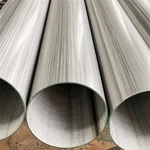
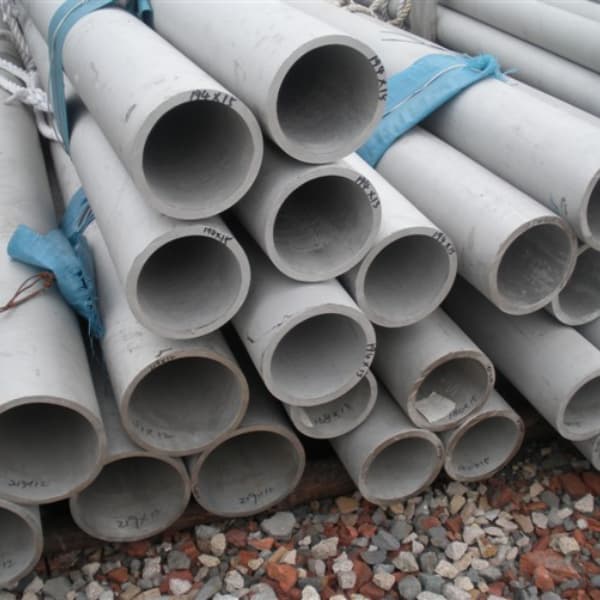
ASTM B725 Welded Nickel 200 Pipe
1. Standard: ASTM B161, ASTM B163, ASTM B474
2. OD Sizes: 1/2” - 48”
3. Thickness: SCH5~SCHXXS
4. Type: Welded / ERW / EFW / SAW
ASTM B725 Welded Nickel 200 Pipe is commercially pure nickel - 99.0% minimum nickel plus cobalt, with carbon held to 0.15% maximum - supplied under three separate ASTM product specifications depending on how the pipe is made and what it is for. Each of those specifications sets its own minimum yield, and the three numbers are not the same. A 100 MPa result can be fully compliant on one certificate and non-conforming on another, from the same alloy, from the same mill.
Product Forms
Bar & Rod
Plate & Sheet
Coil & Strip
Pipe & Tube
Fitting: Flange, Tee, Elbow, Reducer etc.
Forging: Ring, Shaft, Circle, Block etc.
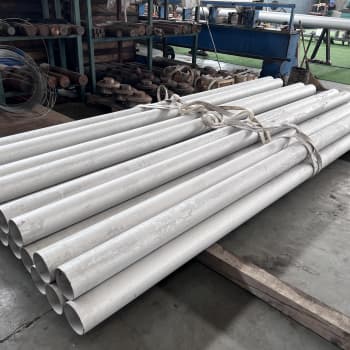
1. Which Specification Governs Your Pipe
Before the mechanical data, the mapping. Nickel 200 pipe is not covered by one standard; the standard follows the product form.
| Standard | Product form | Typical use | Min yield (0.2%) | Min tensile |
| ASTM B161 | Seamless pipe and tube | General corrosive service, process piping | 80 MPa (12 ksi) | 380 MPa (55 ksi) |
| ASTM B163 | Seamless condenser and heat exchanger tube | Shell-and-tube exchangers | 99 MPa (14 ksi) | 380 MPa (55 ksi) |
| ASTM B725 | Welded pipe (large diameter) | Larger bore process lines | 103 MPa (15 ksi) | 380 MPa (55 ksi) |
| ASTM B160 | Rod and bar (not pipe) | Fittings stock, machined parts | 105 MPa | 380 MPa |
| ASTM B162 | Plate, sheet and strip (not pipe) | Vessel walls, linings | 100 MPa | 380 MPa |
Three observations from that table.
First, tensile minimum is 380 MPa across all three pipe standards. Only yield moves. That is a deliberate choice by the specification writers, not an oversight - commercially pure nickel's defining trait is very high elongation (40% minimum, often 50%+ in practice) at modest strength, and the yield floor is set per product form rather than per alloy.
Second, the welded standard B725 sets the highest yield floor at 103 MPa, which reads backwards until you remember that welded pipe is made from strip that has been cold rolled and then formed - it carries a different thermal and work history from a seamless tube drawn to size.
Third, this is where most confusion originates in trade listings. Supplier pages routinely quote "Nickel 200 yield: 100 MPa" or "148 MPa typical" without naming a standard, and buyers compare that against their own purchase specification, which may say 80 or 99 or 103. A gap of 20 MPa is enough to trigger a non-conformance report over a certificate that was never wrong.
Nickel 200 Pipe Size and Weight Reference (NPS 1/2" – 12")
| NPS | OD (mm) | Sch 10S wall (mm) | Sch 40S wall (mm) | Approx. kg/m at Sch 40S |
| 1/2" | 21.3 | 2.11 | 2.77 | 1.27 |
| 3/4" | 26.7 | 2.11 | 2.87 | 1.69 |
| 1" | 33.4 | 2.77 | 3.38 | 2.50 |
| 1-1/2" | 48.3 | 2.77 | 3.68 | 4.05 |
| 2" | 60.3 | 2.77 | 3.91 | 5.44 |
| 3" | 88.9 | 3.05 | 5.49 | 11.3 |
| 4" | 114.3 | 3.05 | 6.02 | 16.1 |
| 6" | 168.3 | 3.40 | 7.11 | 28.3 |
| 8" | 219.1 | 3.76 | 8.18 | 42.6 |
| 10" | 273.0 | 4.19 | 9.27 | 60.3 |
| 12" | 323.8 | 4.57 | 10.31 | 79.7 |
Weights are calculated from nominal OD and wall at nickel density 8.89 g/cm³. Actual delivered weight varies with the wall tolerance of the governing standard, which is why the weight column on a B161 certificate is a nominal figure, not a measured one.
2. Why 80 MPa Is Not a Weak Pipe
The instinct on seeing 80 MPa is to assume the material is soft or second-rate. It is worth putting the number in context, because a 200-series nickel pipe at 80 MPa yield still carries 380 MPa tensile and 40% elongation - properties that let it be bent, flared, expanded into tubesheets and rolled without cracking, which is precisely what a heat exchanger or a process line needs during installation.
The design consequence is real though. ASME B31.3 allowable stress for nickel 200 pipe sits at roughly two-thirds of yield at ambient, subject to the code's own table, so a lower yield floor translates directly into a thicker wall for the same design pressure. On a 6-inch line at moderate pressure the difference between designing to 80 MPa and designing to 103 MPa is on the order of 15–20% more wall, and wall is not free - it is weight, weld time and cost on every metre.
Which leads to the practical rule: quote and specify the standard that will actually govern the pipe, and check the design allowable against that standard's floor, not against whichever number appeared in a datasheet summary.
3. Size Range: Where Seamless Stops
The second thing the three-standard map tells you is where seamless capability ends and welded pipe takes over. Buyers regularly ask for "Nickel 200 seamless pipe, 16 inch" and are surprised by the answer.
Nickel 200 seamless pipe in normal commercial supply runs from roughly 6 mm to 219 mm outside diameter, with heavier schedules available in the smaller sizes. Beyond about 8 to 10 inch, the practical route is welded pipe to B725, which is produced in diameters from roughly 5 inch up to 48 inch and beyond on a fabricated basis.
This is not a supplier limitation dressed up as a technical fact. Cold drawing pure nickel tube to large diameter requires very heavy wall reduction passes, and the material's high ductility does not fully offset the tooling load and the risk of internal surface damage at that scale. Welded construction is the economically rational answer above roughly 10 inch, and the specification framework acknowledges it by giving welded pipe its own standard rather than extending B161.
| Requirement | Seamless route | Welded route |
| Governing standard | B161 (pipe), B163 (heat exchanger tube) | B725 |
| Typical OD range | ~6–219 mm | ~127–1220 mm |
| Wall range | 0.9–12 mm typical | 1.5–12 mm typical |
| Longitudinal weld | none | ERNi-1, full penetration |
| Post-weld treatment | n/a | solution anneal for critical corrosion service |
| Yield floor | 80 / 99 MPa | 103 MPa |
4. Carbon, the Number That Decides the Grade
Nickel 200 holds carbon to 0.15% maximum. That limit is comfortable for most service, and it is also why the pipe carries a ceiling of about 315 °C in long-term service. Above that temperature, carbon in nickel becomes supersaturated and precipitates as graphite along grain boundaries, and a pipe that shows no wall loss can lose ductility and fail without warning.
For pipe specifically, this matters more than it does for plate, because pipe is where the temperature gradient concentrates. A heat exchanger tube bundle on the hot end of a caustic evaporator train will see the highest temperature in the circuit at the tube wall, and that is exactly where the 0.15% carbon limit stops being theoretical.
Where service temperature will exceed 315 °C, the correct move is not to look for a thinner wall or a different schedule - it is to change grade to Nickel 201 (UNS N02201, carbon 0.02% maximum), which holds the same chemistry otherwise but is essentially immune to graphite precipitation. We supply both and will say plainly which one your temperature requires.
5. Price Logic for Nickel 200 Pipe
Nickel 200 is one of the few alloys where the raw material is nearly the whole cost story. At 99%+ nickel content, there is no alloying complexity to hide behind - the invoice tracks the nickel price plus a conversion premium.
Indicative ranges, ex-works, for Nickel 200 seamless pipe in standard schedules: typically starting from USD 32–48/kg for NPS 1/2" to 2" in Sch 40S, moving to USD 30–45/kg for 4" to 8", with large-diameter welded B725 pipe generally at USD 28–40/kg once fabrication and weld qualification are included. Heavy-wall and special tolerances push above those bands; small quantities of non-standard sizes can double the conversion premium.
Two practical points on quoting. Because nickel content dominates, a 5% move in the LME nickel price moves Nickel 200 pipe cost by roughly 4–5%, far more than it moves a stainless grade - so ask when the nickel reference on your quote was fixed. And because B161, B163 and B725 carry different yield floors and different production routes, a quote that does not name the standard is not a comparable quote. Ours does.
FAQ
Q: About ASTM B725 Welded Nickel 200 Pipe price per kg?
A: Prices ranges from $25 to $40 per kg, vary depending on size, wall thickness, supplier etc.
Q: How long does your delivery time take?
A: Delivery time is within 5-21 days
Q: Is There Sample Service?
A: Samples Are Provided Free Of Charge
Q: What Is The Minimum Order Quantity?
A: No Minimum Order Quantity
Q: How to pack the products?
A: The inner layer has a waterproof paper outer layer and is fixed with a fumigation wooden pallet.
Q: Exported Countries
A: Brazil, South Africa, Indonesia, India, Singapore, Malaysia, Iran, Russia, UAE, Chile, Laos, etc
Hot Tags: nickel 200 pipe, UNS N02200, ASTM B161,nickel 200 seamless pipe, B163 heat exchanger tube, B725 welded pipe, commercially pure nickel pipe,
You Might Also Like


Send Inquiry