


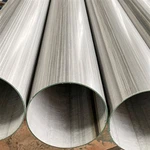
Nickel Alloy Plate
What is Nickel Alloy Plate
Nickel Alloy Sheet is a versatile and highly durable material used in various industries. Composed of nickel and other metals like copper, chromium, and iron, nickel alloy sheet presents unique physical and mechanical characteristics, including exceptional corrosion resistance in harsh environments, high-temperature stability and remarkable strength-to-weight ratio. This blog will explore nickel alloy sheet properties and advantages to help you understand why it is an excellent choice for commercial and industrial applications.


Excellent resistance to high temperatures
Nickel alloy sheet's high-temperature strength makes it an excellent material for manufacturing components in various high-temperature environments, including gas turbines, jet engines and chemical plants. Even at temperatures exceeding 1000°C, nickel alloy sheet remains stable and retains its strength, creating a robust and reliable material option.
Corrosion resistance
Nickel alloy sheet is highly resistant to corrosion, making it an ideal choice for harsh environments with exposure to seawater, acids and other corrosive substances. It is exceptionally durable and can withstand extended exposure to these harsh conditions without losing strength or structural stability.
High-strength-to-weight ratio
Nickel alloy sheet has a high strength-to-weight ratio, making it an efficient material for manufacturing components that require high strength at low weights. This feature makes it an excellent choice for aerospace, medical, and industrial applications.
Versatility
Nickel alloy sheet has excellent weldability, ductility, and malleability, giving it a broad range of applications. It is ideal for manufacturing components like valves, pumps, tubes, and fittings, among others. The versatility of this material makes it an excellent option in aerospace, oil, gas, defence, and chemical industries.
Resistant to cracking and distortion
Nickel alloy sheet is resilient, even when exposed to extensive heat, stress and harsh environments. It is highly resistant to fatigue cracking, creep deformation, and thermal distortion, creating a durable and stable material that can withstand harsh operating conditions without fracturing or weakening.
Why Choose Us
Customer Service
We earn your respect by delivering on time and on budget. We built our reputation on exceptional customer service. Discover the difference it makes.
Expertise and Experience
Our team of experts have years of experience in delivering high quality services to our clients. We hire only the best professionals who have a proven track record of delivering exceptional results.
Quality Assurance
We have a rigorous quality assurance process in place to ensure that all our services meet the highest standards of quality. Our team of quality analysts checks each project thoroughly before it is delivered to the client.
State-of-the-art Technology
We use the latest technology and tools to deliver high quality services. Our team is well-versed in the latest trends and advancements in technology and uses them to provide the best results.
Competitive Pricing
We offer competitive pricing for our services without compromising on quality. Our prices are transparent, and we do not believe in hidden charges or fees.
Customer Satisfaction
We are committed to delivering high quality services that exceed our clients' expectations. We strive to ensure that our clients are satisfied with our services and work closely with them to ensure their needs are met.
Properties of Nickel Alloys
Nickel has always been a vital material for a wide variety of industries for the simple reason that it is a highly versatile material that will alloy with most other metals.
Nickel alloys resist high pressures and temperatures, making them well-suited for high-performance applications such as jet-engine blades. They also resist corrosion. That is why Monel is used in deep-seal mining, where seawater poses a constant threat of corrosion.
Nickel and nickel alloys are non-ferrous metals with high strength and toughness, excellent corrosion resistance, and superior elevated temperature properties. Pure nickel is a bright silver-white metallic element of the iron group and is hard, malleable, and ductile. Pure nickel itself is tough and corrosion resistant and provides an excellent base for developing specialized alloys.
Suitable for a Range of Applications
Its high versatility, combined with its outstanding heat and corrosion resistance has led to its use in a diverse range of applications; such as Aircraft gas turbines, steam turbines in power plants and its extensive use in the energy and nuclear power markets.
High Performance Nickel Alloys
A range of Nickel alloys that fully demonstrate the dazzling array of abilities that Nickel possesses and have catered to businesses of all sizes in every sector. All Nickel alloys offer the utmost strength, durability and reliability amongst the harshest of environments. So whether you need an alloy that offers tremendous corrosion resistance in reducing chemical environments or seawater, remains steadfast in the face of extreme temperatures, (both low and high) or simply a material that is readily weldable even in a hardened condition, we will ensure you that we have the perfect alloy for the job that won't let you down.
Suitable for the Harshest of Environments
Some of the nickel alloys include the RA 330, which is known as the workhorse of austenitic, heat resistant alloys due to its sheer ability to carry on regardless in harsh environments. Allied to the immense strength displayed by the RA 330 it also offers high resistance to carburization and oxidation in temperatures rising to as high as 1150 °C.
One of the most popular alloys is 'Alloy 86', which is that rare breed of metals that has been developed with good workability, ductility and weldability in mind whilst offering high creep strength and an exceptionally good cyclic oxidation resistance at 1050 °C. As it was intended mainly for use in high temperature applications it comes as no surprise that it is a highly sought after for use in heat treatment furnace equipment, afterburner parts and gas turbine combustion chambers.
Nickel Alloys won't Weaken or Perish
Nickel alloys often work in industries that depend on materials that are highly durable and won't weaken or perish. Time is money and you don't want to spend too much of either looking for replacements for parts that just weren't up to the job. Nickel specialises in providing the highest quality Nickel alloys that mean you will no longer need to.
Nickel is a chemical element, which is represented by Ni symbol and an atomic number of 28. It is a silver-white lustrous metal featuring a tinge of gold hue. It comes under the transition metals and is extremely hard as well as ductile.
Nickel is a versatile metal and tends to alloy with a majority of metals. Nickel alloys are alloys wherein the nickel stand as the primary element. There is a complete solubility between nickel and copper.
Additionally, there is a wide range of solubility between chromium, iron, and nickel, allowing the formation of multiple alloy combinations. The high versatility of this material accompanied by its exceptional corrosion and heat resistance makes it an ideal material to use in many industrial applications.
Types of Nickel Alloy
Nickel can be easily alloyed with a majority of metals, including chromium, copper, molybdenum, iron, etc. Moreover, when nickel is added to other metal, the properties tend to alter. Below we are mentioning some common types of alloy.
Nickel-Copper Alloys
Nickel-copper alloys are extremely resistant to corrosion by seawater and saltwater; thereby making with ideal for marine applications. This type of alloy has 63% nickel and 28-34% copper concentration.
Nickel-Iron Alloys
Nickel-iron alloys are ideal for application where the thermal expansion in the property is at a low rate. It has a high degree of dimensional stability, making nickel-iron alloys quite useful in building applications such as thermostat rods, measurement equipment. Some nickel-iron alloys that hold a higher concentration of nickel are used in the manufacturing of transformers, memory storage device, inductors, etc.
Nickel-Chromium Alloys
Nickel chromium-alloys are reckoned for their high resistance to corrosion, greater electrical resistance, and high-temperature strength. This type of alloy is used in making heating elements like toasters.
Nickel-Molybdenum Alloys
Nickel-molybdenum alloys provide high chemical resistance to acids along with reducers such as hydrogen chloride, phosphoric acid, hydrochloric acid, and sulfuric acid. The chemical formation of this type of alloy has 29-30% concentration of molybdenum and 66-74% concentration of nickel. Common applications of nickel-molybdenum alloys include gaskets, pumps and valves, heat exchangers, pressure vessels, piping, and heat exchangers.
Nickel-Chromium-Iron Alloys
Nickel-chromium-iron alloys amalgamate to generate alloys that oxidation resistance, as well as high-temperature corrosion. The alloy typically is used for their high rapture and creep properties. It has composition generally stands at Nickel 30-35%, chromium- 19-23%, and Iron 39.5%.
Nickel-Titanium Alloys
Nickel-titanium alloys hold shape retention or shape memory properties. When shaped in higher temperatures and deformed in lower temperatures, this type of alloy remembers its original shape and reform to it once header. The whole process is known as transition temperature. You can alter the transition temperature by controlling the alloy composition. Nickel-titanium alloy features high-elastic property that can be leveraged to be used as a shock absorber and assist in protecting the stone buildings.
Nickel-Chromium Alloys
This type of alloy encompasses molybdenum and chromium in order to add more creep rupture strength. It concentration include chromium 20-24%, molybdenum 8-10%, cobalt 10-15%, and nickel 44.5%. Some of the common applications associated with this alloy include gas turbines, furnace components, catalyst grid supports, etc.
Nickel alloy is a highly versatile element, which comes with features including high heat and corrosion resistance. This characteristic makes nickel alloy an effective Al6Xn Tubing in many structures that generated a lot of heat. It is used in a wide range of application such as steam turbines, aircraft gas turbines, energy and nuclear power industries, etc.
Nickel Alloys: What Do They Stand For
The term Nickel Alloys covers a range of materials where nickel is usually a significant proportion of the chemistry (normally 50%+ although we also classify our Alloy 286 / 660 high temperature bolting steel -with its 24-27% nickel content – as a nickel alloy).
Nickel is added to high chromium stainless steel to create a class of corrosion and heat resistant steels where the tendency of nickel to form austenite is responsible for toughness and high strength at both high and low temperatures. Nickel also improves resistance to oxidation and corrosion. It increases toughness at low temperatures when added in smaller amounts to alloy steels.
Nickel and nickel alloys are used for a wide variety of applications, including aircraft gas and steam turbines, medical applications, nuclear power systems, and of most interest to Broder Metals Group, oil, chemical and petrochemical industries.
Nickel is a very versatile alloy material element, and there are many classifications that nickel alloys can be classified into. One of the most common classifications is as follows:
Commercially Pure/Low Alloy Nickels – Nickel is supplied in powder, pellet, or anode forms. These materials are very high density, offering magnetic and electronic property capabilities. They also offer excellent corrosion resistance along with reasonable thermal transfer characteristics.
Nickel-Copper alloys – Possess excellent corrosion resistance in reducing chemical environments and in sea water, where they deliver excellent service in nuclear submarines and various surface vessels. By changing the various proportions of nickel and copper in the alloy, a whole series of alloys with different electrical resistances can be created. Prime amongst these alloys are Alloy 400 and Alloy K500.
Nickel-chromium – Provide higher strength and resistance to elevated temperatures. Prime alloys are Alloy 600, Nimonic alloys including N80a, Alloy X750. Alloy 718, Alloy 625. Alloy C-22, and Alloy C-276.
Iron-Nickel-Chromium Alloys – Used in high-temperature petrochemical environments, where sulphur-containing material are cracked into component distillate parts. Prime alloys in this class are Alloy 800 / 800HT. Alloy 825, Alloy 925
Controlled-expansion alloys – Offer high strength and low coefficient of thermal expansion, for example Alloy 902, 903, 907, and 909.
Nickel-lron Low-Expansion Alloys – Developed for the lamp and electronics industries where glass-to-metal seals in sealed environments are important. Prime alloys are Alloy 42 and Alloy 426.
Soft Magnetic Alloys – These nickel-iron alloys also offer magnetic permeability properties used principally in switchgear and for direct current motors and generators.
Welding Alloys – Additions of aluminium, titanium, magnesium, and other elements are made to the filler metals and welding electrodes to provide better weld effects and to overcome any hot-short cracking and malleability problems.
Processes in Nickel Alloy Fabrication
Nickel Alloy Fabrication is a multi-staged journey that may include a variety of processes encoding its mechanical properties. The processes involved in Nickel Alloy Fabrication initially start with casting or powder metallurgy, followed largely by welding and forming methods to shape and build up the Nickel alloy product.
Casting: This is the primary step where molten Nickel alloy is poured into a mold and allowed to solidify, taking the shape of the cavity. It is a frequently employed method to produce Nickel alloy components, particularly those with complex geometries.
Powder Metallurgy: An alternative to casting, this process involves creating the alloy as a powdered mixture of its constituent elements. This powder, once compacted into the desired shape, is then heated to form a solid component.
Welding: Often required in the creation of specific Nickel alloy components, welding is done using various methods like Tungsten Inert Gas (TIG) welding, Metal Inert Gas (MIG) welding, and shielded metal arc welding (SMAW).
Forming: Includes various types of mechanical manipulations, from simple bending to complex extruding processes, to shape the material.
Forging: The process involves heating Nickel alloy and then deforming it with a press or hammer. Forging can significantly strengthen the material by refining its internal grain structure.
Machining: This is a group of processes where parts are fashioned by removing unwanted material, often through turning, milling, or drilling.
Each of these processes has its set of considerations to preserve the defining properties of Nickel alloys and to ensure a successful fabrication.
Welding Techniques for Nickel Alloys
Welding is a crucial part of Nickel Alloy Fabrication. Owing to the performance characteristics of Nickel alloys, welding processes need to ply smoothly with their thermal and physical properties. Generally, the same welding processes used for steel can be utilised for Nickel alloys. However, careful control of parameters and proper techniques are paramount.
Tungsten Inert Gas (TIG) welding, also known as Gas Tungsten Arc Welding (GTAW), is commonly used in Nickel Alloy welding. This method uses a constant current power supply providing electrical energy for the arc. A Few advantages of TIG welding include efficient energy transfer, better directed arc and smooth ripples. However, it requires high operator skill and is less tolerant to fit-up issues.
Another popular method is Metal Inert Gas (MIG) welding or Gas Metal Arc Welding (GMAW). MIG welding uses a consumable electrode and an argon-rich shielding gas. It provides high welding rates and is easier to perform on complex geometries.
Lastly, Shielded Metal Arc Welding (SMAW) is used less frequently due to its lower productivity but is useful for specific applications, particularly for field welding.
Each of these welding techniques offers unique outcomes, and the choice largely depends on the properties desired in the end product.
Heat Resistance Property of Nickel Alloys
Apart from resistance to corrosion, Nickel alloys exhibit another prime property - high-temperature stability. These alloys retain their mechanical strength even when subjected to notable temperature changes.
Nickel Alloy's heat resistance comes from their ability to form a protective, adherent oxide layer when heated, which prevents additional oxidation and hence increases the service life of components made from these alloys.
For example, certain Nickel alloys like Inconel 718 can withstand temperatures up to 700 degrees Celsius, retaining substantial tensile strength. As a result, it is widely used in components like gas turbines and rocket engines that operate under high thermal stress.
Therefore, be it tremendous resistance to corrosive environments, or reliable strength under high-temperature and stress, Nickel alloys through their versatile combinations and excellent material properties fulfil our advanced technological requirements remarkably well.
How to Clean Nickel Plated Metal
Nickel-plated metal provides an attractive finish--when it is clean and free of tarnish. Nickel-plated metal was a popular choice in the past for decorative trim on items like wood stoves and other pieces that would be considered antiques today. If you have some old nickel-plated metal that needs attention, use a method that has proven to be successful in restoring nickel-plated metal to its original, shiny finish.
Step 1
Prepare a solution of 1/2 water and 1/2 ammonia in a container large enough to place the nickel-plated items.
Step 2
Submerge the items in the solution for 30 minutes. Remove the items from the solution and scrub them with steel wool grade 0000. Dry them with a clean, soft cloth. Repeat until the nickel-plated finish is clean.
Step 3
Rub a non-abrasive metal or chrome polish, on the nickel-plated finish. Buff it well to restore it to a shiny finish.
Our Factory
Among them, industrial stainless steel pipes & tubes have very high quality and price advantages which meet the ASTM, ASME, ANSI standard, these steel pipes are widely used boiler, heat exchanger and condensator tubes, Chemical plant, petro-chemical plant, pulp paper mill, beverage plant, gas, steam, water transport system, sewage treatment, power plant, sewer works...etc.

FAQ
Q: Is nickel alloy good?
Q: What is the difference between nickel alloy and pure nickel?
Q: How durable is nickel alloy?
Q: What is nickel alloy vs stainless steel?
Q: Is nickel alloy cheap?
Q: Are nickel alloys toxic?
Q: Is nickel alloy expensive?
Q: Does nickel alloy rust?
Q: Is nickel alloy brittle?
Q: What is nickel alloy used for?
Q: Is nickel alloy stronger than steel?
Q: What is better nickel plated or stainless steel?
Q: Is nickel better than aluminum?
Q: What is the color of nickel alloy?
Q: Which disease is caused by nickel?
Q: Is nickel plating bad for you?
Q: Is nickel metal worth money?
Q: What is the cheapest alloy?
Q: How do you clean nickel alloy?
Q: Can nickel be absorbed through the skin?