


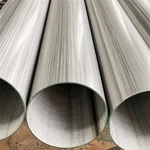
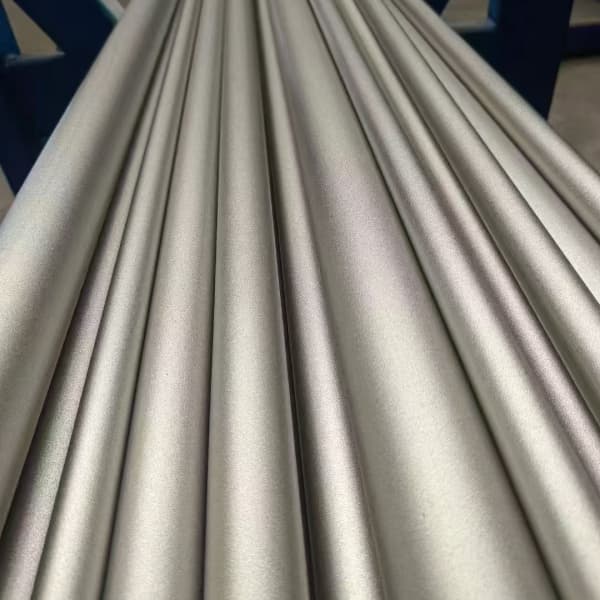
ASTM B167 Inconel 601 Seamless Nickel Alloy Pipe
1. Standard: ASTM B163, ASME SB163, ASTM B167, ASME SB167, ASTM B474, ASME SB474
2. Diameters: 0.1- 1219.2 mm
3. Wall thickness: 0.1 to 25mm
4. Length: SRL, DRL and Customized
ASTM B167 Inconel 601 Seamless Nickel Alloy Pipe protects itself with two. The 21-25% chromium forms the familiar chromium-oxide scale that every stainless user recognizes; the 1.0-1.7% aluminium adds a second, tightly adherent aluminium-oxide layer that keeps the scale intact when chromium alone would spill it.
That dual-film chemistry is the whole story of 601: it is the Inconel grade that was written for the hottest dry-service environments in the plant - furnace components, radiant tubes, heat-treatment fixtures - and the same pipe that carries process gas where oxidation, carburization and sulphidation are the enemies, not chlorides.
Product Forms
Bar & Rod
Plate & Sheet
Coil & Strip
Pipe & Tube
Fitting: Flange, Tee, Elbow, Reducer etc.
Forging: Ring, Shaft, Circle, Block etc.
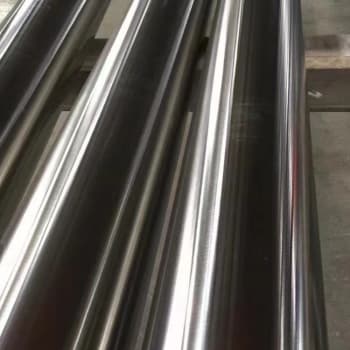
The one-line identity of Inconel 601
Inconel 601 is a nickel-chromium-iron alloy (UNS N06601, W.Nr. 2.4851) strengthened for high-temperature oxidation service by a deliberate aluminium addition. It is the aluminium - barely one and a half percent - that separates 601 from its better-known sibling Inconel 600.
Inconel 600 resists carburization and handles many hot duties, but its oxide scale breaks down in cyclic oxidation above a certain temperature; 601's alumina reinforcement extends the usable envelope and, just as importantly, makes it survive thermal cycling, where scale spallation destroys lesser alloys.
Chemical composition and what each element does
| Element | Range (wt %) | Role in the alloy |
| Nickel | 58.0 - 63.0 | Matrix: high-temperature stability and resistance to carburization and chloride attack |
| Chromium | 21.0 - 25.0 | Primary oxidation barrier (Cr2O3 scale) and corrosion resistance |
| Iron | Balance | Cost and fabricability |
| Aluminium | 1.0 - 1.7 | The 601 signature: alumina reinforcement of the oxide scale for cyclic oxidation resistance |
| Carbon | 0.10 max | Standard control; not a creep-optimized grade |
| Manganese | 1.0 max | Deoxidation and hot workability |
| Silicon | 0.50 max | Oxidation behaviour and deoxidation |
| Copper | 1.0 max | Impurity limit |
| Sulphur | 0.015 max | Tightly limited for hot workability and scale adhesion |
Read the table as a high-temperature design, not a corrosion design. Nickel carries the furnace duty, chromium builds the primary scale, and aluminium - the element every competing alloy leaves out - is what lets 601 keep that scale under cycling conditions. The result is an alloy that outlasts stainless grades and even Inconel 600 in the oxidation zone, while remaining fabricable and weldable.
Mechanical properties per ASTM B167 (seamless pipe)
| Property | Minimum (annealed) | Typical |
| Tensile strength | 550 MPa (80 ksi) | 620 - 700 MPa |
| Yield strength 0.2% | 205 MPa (30 ksi) | 275 - 350 MPa |
| Elongation | 30% | 40 - 50% |
| Hardness | - | ~180 HB |
Density is 8.11 g/cm³ and the melting range sits at roughly 1360 - 1411°C - a reminder that 601 remains mechanically sound far beyond the temperature where stainless steels have already lost their strength. The annealed minimums are comfortable for fabrication: 601 bends, forms and machines without the springback surprises of hardened precipitation grades.
High-temperature behaviour: oxidation, carburization, sulphidation
601's working identity is defined by three hot-service mechanisms, and each one has a distinct answer:
- Oxidation - the chromium-oxide scale, reinforced by alumina, resists attack in continuous service around 1100°C and cyclic service around 1150°C. The alumina's key job is resisting spallation, which is why 601 survives furnace cycles that flake the scale off stainless alloys
- Carburization - the high nickel content keeps carbon from diffusing into the grain boundaries in carbon-rich atmospheres, protecting the ductility that furnace tubes need
- Sulphidation - 601 is preferred over iron-based alloys in sulphidizing gases because the nickel-chromium base forms a more protective scale in many sulphidizing atmospheres
The qualification that honest suppliers state up front: 601 is not a creep-optimized alloy. For applications governed by long-term creep strength - petrochemical furnace coils at extreme temperatures - the nickel-iron-chromium creep grades are the better answer. 601's territory is oxidation-dominated duty where the component is chosen to survive the atmosphere, not to carry heavy load at the creep limit.
Cold and hot service limitations
601 is a high-temperature alloy first, and its cold-service profile follows from the nickel matrix: it retains good toughness to cryogenic temperatures, and the austenitic structure gives it no ductile-to-brittle transition. Corrosion-wise, 601 is not a chloride-service alloy - for seawater, hypochlorite or oxidizing chloride duty the chromium-molybdenum grades are the correct specification. The buyer who needs both furnace duty and wet-corrosion duty should be told plainly that these are two alloys, and 601 is the furnace one.
Welding Inconel 601
- Use nickel filler: ERNiCrFe-2 or ERNiCrFe-3 are the standard choices for 601, matching the base-metal composition
- Clean rigorously - the aluminium in 601 forms tenacious oxides that must be removed from the weld zone before welding
- Control heat input; 601 welds cleanly with TIG, MIG or SMAW when the joint is clean and the interpass temperature is disciplined
- For furnace service, a full-penetration root with back-purging keeps the weld metal as oxidation-resistant as the base
Where Inconel 601 pipe earns its keep
- Radiant tubes and furnace components in continuous and cyclic heat-treatment furnaces
- Thermocouple sheaths and protection tubes in hot gas streams
- Heat-treatment fixtures, baskets and trays that cycle between hot and cold zones
- Exhaust and combustion gas handling where oxidation is the dominant mechanism
- Glass and ceramics processing components exposed to hot, oxidizing atmospheres
- Petrochemical and refining applications in oxidizing and mildly carburizing service within the alloy's envelope
- Power-generation components operating in hot combustion gases
Product forms and standards
| Form | Standard | Identity |
| Seamless pipe / tube | ASTM B167 | UNS N06601, 2.4851 |
| Welded tube | ASTM B517 | Welded construction |
| Plate / sheet / strip | ASTM B168 | Vessel and fabricated components |
| Bar / rod | ASTM B166 | Fasteners and machined parts |
Procurement details that matter on a 601 order
- Specify ASTM B167 seamless, UNS N06601 (2.4851), solution annealed - the anneal condition is what delivers the fabricable, corrosion-sound structure
- Confirm the heat treatment on the certificate with the annealing temperature range, not a vague "annealed" line
- Request the heat number and full chemistry - the aluminium range (1.0-1.7%) is the 601 identity check, and a certificate without it should be questioned
- For furnace duty, confirm straightness, surface condition and that the pipe is free of the surface contamination that could seed scale failure
- If the application is creep-dominated, ask for the honest engineering answer before ordering: 601 for oxidation, or a creep-optimized grade for long-term load
The bottom line
Inconel 601 is the furnace alloy with the two-film trick: chromium for the base scale, aluminium for scale adhesion. Buyers who need pipe for hot, oxidizing, cycled service - where stainless spalls and where 600 reaches its ceiling - will find 601 delivers the service life the rest of the catalogue cannot. Specify it honestly, weld it with nickel filler, and 601 will do what its datasheet promises: stay intact where the atmosphere is the problem.
FAQ
Q: About ASTM B167 Inconel 601 Seamless Nickel Alloy Pipe price per kg?
A: Prices ranges from $25 to $40 per kg, vary depending on size, wall thickness, supplier etc.
Q: How long does your delivery time take?
A: Delivery time is within 5-21 days
Q: Is There Sample Service?
A: Samples Are Provided Free Of Charge
Q: What Is The Minimum Order Quantity?
A: No Minimum Order Quantity
Q: How to pack the products?
A: The inner layer has a waterproof paper outer layer and is fixed with a fumigation wooden pallet.
Q: Exported Countries
A: Brazil, South Africa, Indonesia, India, Singapore, Malaysia, Iran, Russia, UAE, Chile, Laos, etc
Hot Tags: inconel 601 pipe, uns n06601, alloy 601 seamless pipe, astm b167 n06601, 2.4851, high temperature oxidation alloy pipe, radiant tube alloy, nickel chromium iron aluminum pipe
Next
No InformationYou Might Also Like


Send Inquiry