


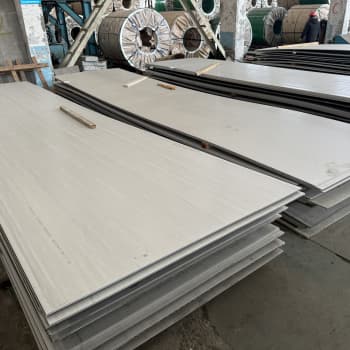
Alloy 800 sheet (UNS N08800) is originally developed to provide a cost-effective alternative to high-nickel alloys during strategic metal shortages in the 1950s, its iron-nickel-chromium balance offers a unique sweet spot: it is more oxidation-resistant than standard stainless steels, yet more affordable than the Inconel 600 series. HT PIPE is a incoloy alloy 800 sheet supplier with 15+ export experience. Contact us for more information and quotes for free!
1. Alloy 800 (UNS N08800)
Primary Focus: General corrosion and oxidation resistance.
Optimal Temperature: Below 1100℉ (593℃).
Key Detail: It is typically annealed at lower temperatures, resulting in a finer grain structure that prioritizes tensile strength at moderate temperatures.
2. Alloy 800H (UNS N08810)
Primary Focus: Creep resistance.
Optimal Temperature: Above 1100℉ (593℃).
Key Detail: Controlled carbon content (0.05% to 0.10%) and a high-temperature solution anneal produce a coarse grain size (ASTM 5 or coarser), which is essential for resisting "creep"-the slow deformation of metal under constant stress at high heat.
3. Alloy 800HT (UNS N08811)
Primary Focus: Maximum stress-rupture life.
Optimal Temperature: High-stress thermal environments.
Key Detail: Further tightens the chemistry of 800H by mandating a combined Aluminum and Titanium content of 0.85% to 1.20%. This ensures the highest possible rupture strength in the series.
Performance in Aggressive Environments
Alloy 800 sheet is engineered to handle specific chemical "attacks" that would degrade standard 300-series stainless steels.
- Oxidation Resistance: The high chromium content forms a protective, adherent scale that prevents deep metal penetration by oxygen, even during rapid thermal cycling.
- Carburization Resistance: The 30--35% nickel content acts as a barrier against carbon absorption, making these sheets ideal for petrochemical "cracker" tubes and heat-treating baskets where carbon-rich atmospheres are present.
- Sulfidation Stability: Unlike alloys with very high nickel content, the iron-base of Alloy 800 provides better resistance to sulfur-bearing gases, which can otherwise cause "hot corrosion."
Fabrication and Welding Considerations
Working with Alloy 800 sheet requires adherence to specific protocols to maintain its corrosion-resistant properties:
- Welding: Use Inconel Filler Metal 82 or Welding Electrode 182 for most applications. If the sheet will be exposed to temperatures where creep is a factor (the 800H/HT range), use Inconel 617 or Haynes 230 fillers to match the high-temperature strength of the base metal.
- Machining: Because it is an austenitic alloy, it work-hardens quickly. Use heavy-duty equipment, sharp tools, and a constant feed rate to stay "under" the work-hardened zone.
- Forming: Alloy 800 has excellent cold-forming characteristics similar to 316 stainless steel, though higher forces are required due to its higher yield strength.
Global Sourcing and Standards
Whether you are sourcing in Houston, Mumbai, Düsseldorf, or Shanghai, ensure your supplier provides material certified to the following international standards:
| Form | ASTM Standard | ASME Standard |
| Sheet/Plate | ASTM B409 | ASME SB409 |
| Tube/Pipe | ASTM B163 / B407 | ASME SB163 / SB407 |
| Bar/Rod | ASTM B408 | ASME SB408 |
FAQ
Q: Why is Alloy 800 preferred over Stainless Steel 310 for furnace liners?
While both perform well in high heat, Alloy 800 offers superior resistance to chloride stress-corrosion cracking and sigma phase embrittlement. Stainless 310 can become brittle after long-term exposure to temperatures between 1100℉ and 1500℉, whereas Alloy 800 remains ductile, making it safer for structural components that undergo thermal expansion.
Q: Is Alloy 800 magnetic?
No. Alloy 800 is a stable austenitic alloy and remains non-magnetic in almost all practical conditions. This makes it suitable for specialized electronic or medical applications where magnetic interference must be avoided, though its high-temperature cost usually limits it to thermal environments.
Q: What is the maximum service temperature for Alloy 800HT?
In most atmospheric conditions, Alloy 800HT can be used at temperatures up to 1900℉ (1038℃). However, its load-bearing capacity (allowable stress) drops significantly at these extremes. For pressure vessel applications regulated by ASME codes, the maximum temperature limits are typically lower to ensure a high safety margin.
Q: Does Alloy 800 sheet require post-weld heat treatment (PWHT)?
Generally, no. Alloy 800 does not require PWHT to restore corrosion resistance or ductility after welding. However, if the material is very thick or the application involves extreme thermal cycling, a stress-relief anneal may be performed to prevent distortion during service.


