


HT PIPE is a Alloy 825 stud bolts fasteners supplier with 15+ export experience. Contact us for more information and quotes for free!
Alloy 825 stud bolts fasteners belongs to the nickel-iron-chromium family, this specialized alloy provides a uniquely balanced chemical profile. It offers an exceptionally cost-effective alternative to higher-cost nickel-base alloys while drastically outperforming standard austenitic and duplex stainless steels in highly reducing and oxidizing acids.
Primary Global Standards
Material Specification: ASTM B425 / ASME SB425 (Standard specification for Ni-Fe-Cr-Mo-Cu alloy rod and bar used for fast processing into fasteners).
Dimensional Layouts: ASME B18.2.1 for heavy hex bolts, ASME B18.2.2 for nuts, and BS 4882 or DIN 976 for high-integrity threaded studs.
Environmental Compatibility: Fully compliant with NACE MR0175 / ISO 15156 requirements
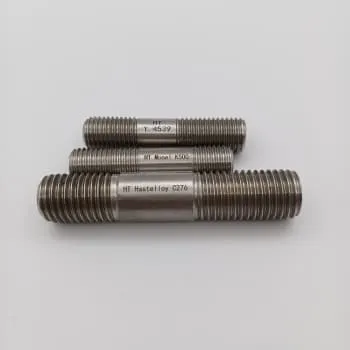
Sizing and Configurations
Fasteners are engineered across an extensive dimensional footprint to match heavy-duty flange connections:
Thread Diameters: Available from metric sizes M3 to M80, and imperial sizes from 3/16 inch up to 6 inches.
Thread Pitch Configurations: Fine and coarse thread profiles including ASME B1.1 2A/3A or 2B/3B distributions (UNC, UNF, and UN thread classes).
Common Forms: Continuous fully-threaded stud bolts, double-ended studs, tap-end studs, heavy hex face bolts, and matching heavy hex nuts.
ASTM B423 UNS N08825 Chemical Composition
| Grade | Cr | Fe | Ni | C | Mn | Cu | Si | S |
| Inconel 825 | 19.5 – 23.5 | 1.0 max | 38.0 – 46.0 | 0.05 max | 1.0 max | 1.5 – 3.0 | 0.5 max | 0.03 max |
Alloy 825 Mechanical Properties
| Density | Melting Point | Tensile Strength | Yield Strength (0.2%Offset) | Elongation |
| 8.47 g/cm3 | 1413 °C (2580 °F) | Psi – 95,000 , MPa – 655 | Psi – 45,000 , MPa – 310 | 40% |
Global Industrial Applications
Because Alloy 825 fasteners bridge the gap between expensive specialty superalloys and standard stainless steel, they serve as crucial components across several major industrial sectors worldwide.
1. Offshore and Marine Engineering
From the North Sea to Asia-Pacific deepwater fields, offshore platforms operate in splash zones where salt spray and stagnant seawater rapidly corrode low-alloy fasteners. Utilizing UNS N08825 stud bolts to secure subsea valves, splash-zone structural brackets, and marine piping manifolds prevents crevice attacks and localized pitting.
2. Upstream and Midstream Oil & Gas
In sour gas wells containing elevated levels of hydrogen sulfide, carbon dioxide, and elemental sulfur, standard high-tensile steel fasteners are highly vulnerable to sulfide stress cracking. The high nickel composition of Alloy 825 stops this degradation pathway, making it ideal for downstream refining units and Christmas tree valve assemblies.
3. Chemical Processing and Acid Production
Alloy 825 stands out for its exceptional performance in hot sulfuric acid environments. Chemical plants utilize these fasteners to clamp together glass-lined piping systems, heat exchangers, pickling tank heating coils, and industrial evaporators handling hot phosphoric acid mixtures.
4. Pollution Control and Desalination
Flue gas desulfurization (FGD) scrubbers capture aggressive sulfur-containing gases, creating an environment rich in highly corrosive condensates. Fasteners constructed from Werkstoff 2.4858 safely secure recycling pumps, damper mechanisms, and mixing tanks against acid-induced breakdown.
Manufacturing, Forging, and Quality Control
Producing high-quality Alloy 825 stud bolts fasteners requires careful thermal and mechanical control to maintain the alloy's specialized grain structures.
Forging and Thermal Treatment
Hot Forging: Executed within a precise temperature window of 870°C to 1180°C (1600°F to 2150°F). Finishing operations should be kept between 1600°F and 1800°F to optimize its post-processing corrosion performance.
Stabilizing Anneal: Heavy-walled fasteners or pieces subjected to intense hot-working require a dedicated stabilizing anneal. This process redistributes chromium and titanium elements within the matrix, neutralizing any microstructural sensitivity introduced during cooling.
Essential Testing Frameworks
To guarantee reliability in high-pressure installations, fasteners undergo strict inspection protocols before shipment:
Chemical Verification: Positive Material Identification (PMI) testing to confirm element percentages match ASTM B425 limits.
Mechanical Verification: Hardness mapping (typically monitored under Rockwell B limits) along with destructive tensile and yield testing.
Microstructural Verification: Intergranular corrosion tests evaluated per ASTM A262 Practice C or E guidelines.
Dimensional Verification: Thread fit checks utilizing calibrated go/no-go ring gauges to maintain strict compliance with international thread standards.


