


ASME B16.11 SW 45° Tee angled branch outlet offers measurable advantages in steam service and pressure drop management, but the selection process is full of pitfalls: wrong pressure class, incompatible materials, and weld accessibility issues that nobody flags until the fitting is already on the pipe.
HT PIPE is a leading stockist and global exporter with over 16 years of expertise in international trade. We supply pipes, plates, round bars, and a comprehensive range of pipe fittings, flanges, and valves. Contact us now for free quotes and personalized product information.
When Should You Pick a 45° Tee?
This is the part worth talking about first - not every branch should be 45°, and picking the wrong one creates problems.
Use cases for 45° Tee:
- Steam piping systems: the 45° outlet angle helps reduce condensate buildup at turns, lowering water hammer risk
- Systems where you need to minimize localized pressure drops: 45° branches create less fluid turbulence than 90° branches
- Space-constrained areas where welding access is limited: a 45° orientation sometimes gives the torch better reach
- Petrochemical plant piping where you need to reduce stress concentration points
Material Selection: Common Grades and Applications
| Material Grade | Key Properties | Recommended Applications |
|---|---|---|
| ASTM A105 | Carbon steel, good hot strength, low cost | General steam, water, oil systems |
| ASTM A182 F304/F316 | Stainless steel, corrosion resistant | Chemical, food/pharma, seawater systems |
| ASTM A182 F321 | Titanium-stabilized, resists intergranular corrosion | High-temperature service (>425°C) |
| ASTM A182 F11/F22 | Chromium-molybdenum alloy steel | High-temp, high-pressure boiler systems |
| Duplex Steel (2205/2507) | High strength + chloride resistance | Chloride-containing media, offshore platforms |
| Inconel 625/825 | Nickel-based, highly corrosion resistant | Strong acids, brine, high-temp corrosive environments |
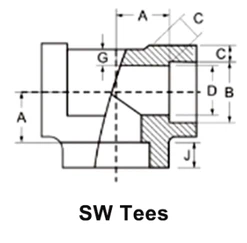
|
Nominal size |
Socket bore diameter |
Bore diameter of fittings |
Socket wall thickness |
Body wall |
Depth of socket |
Center to bottom of socket |
|||||||||||||||
|
DN |
NPS |
B |
D |
C |
Gmin |
Jmin |
A |
||||||||||||||
|
3000 |
6000 |
9000 |
3000 |
6000 |
9000 |
3000 |
6000 |
9000 |
90°Elbow,Tee,Cross |
45°Elbow |
|||||||||||
|
Avg |
Min |
Avg |
Min |
Avg |
Min |
3000 |
6000 |
9000 |
3000 |
6000 |
9000 |
||||||||||
|
6 |
1/8 |
10.9 |
6.1 |
3.2 |
- |
3.18 |
3.18 |
3.96 |
3.43 |
- |
- |
2.41 |
3.15 |
- |
9.5 |
11.0 |
11.0 |
- |
8.0 |
8.0 |
- |
|
8 |
1/4 |
14.3 |
8.5 |
5.6 |
- |
3.78 |
3.30 |
4.60 |
4.01 |
- |
- |
3.02 |
3.68 |
- |
9.5 |
11.0 |
13.5 |
- |
8.0 |
8.0 |
- |
|
10 |
3/8 |
17.7 |
11.8 |
8.4 |
- |
4.01 |
3.50 |
5.03 |
4.37 |
- |
- |
3.20 |
4.01 |
- |
9.5 |
13.5 |
15.5 |
- |
8.0 |
11.0 |
- |
|
15 |
1/2 |
21.9 |
15.0 |
11.0 |
5.6 |
4.67 |
4.09 |
5.97 |
5.18 |
9.53 |
8.18 |
3.73 |
4.78 |
7.47 |
9.5 |
15.5 |
19.0 |
25.5 |
11.0 |
12.5 |
15.5 |
|
20 |
3/4 |
27.3 |
20.2 |
14.8 |
10.3 |
4.90 |
4.27 |
6.96 |
6.04 |
9.78 |
8.56 |
3.91 |
5.56 |
7.82 |
12.5 |
19.0 |
22.5 |
28.5 |
13.0 |
14.0 |
19.0 |
|
25 |
1 |
34.0 |
25.9 |
19.9 |
14.4 |
5.69 |
4.98 |
7.92 |
6.93 |
11.38 |
9.96 |
4.55 |
6.35 |
9.09 |
12.5 |
22.5 |
27.0 |
32.0 |
14.0 |
17.5 |
20.5 |
|
32 |
11/4 |
42.8 |
34.3 |
28.7 |
22.0 |
6.07 |
5.28 |
7.92 |
6.93 |
12.14 |
10.62 |
4.85 |
6.35 |
9.70 |
12.5 |
27.0 |
32.0 |
35.0 |
17.5 |
20.5 |
22.5 |
|
40 |
11/2 |
48.9 |
40.1 |
33.2 |
27.2 |
6.35 |
5.54 |
8.92 |
7.80 |
12.70 |
11.12 |
5.08 |
7.14 |
10.15 |
12.5 |
32.0 |
38.0 |
38.0 |
20.5 |
25.5 |
25.5 |
|
50 |
2 |
61.2 |
51.7 |
42.1 |
37.4 |
6.93 |
6.04 |
10.92 |
9.50 |
13.84 |
12.12 |
5.54 |
8.74 |
11.07 |
16.0 |
38.0 |
41.0 |
54.0 |
25.5 |
28.5 |
28.5 |
|
65 |
21/2 |
73.9 |
61.2 |
- |
- |
8.76 |
7.62 |
- |
- |
- |
- |
7.01 |
- |
- |
16.0 |
41.0 |
- |
- |
28.5 |
- |
- |
|
80 |
3 |
89.9 |
76.4 |
- |
- |
9.52 |
8.30 |
- |
- |
- |
- |
7.62 |
- |
- |
16.0 |
57.0 |
- |
- |
32.0 |
- |
- |
|
100 |
4 |
115.5 |
100.7 |
- |
- |
10.69 |
9.35 |
- |
- |
- |
- |
8.56 |
- |
- |
19.0 |
66.5 |
- |
- |
41.0 |
- |
- |
NOTE:
1) The average of the socket wall thickness around the periphery shall be no less than listed above. The minimum values are permitted in the localized area.
2) In view of the tolerance of the outside diameter of the pipes, there is a possibility that the socket bore diameter is a little greater than what is specified in ASME B16.11.
3) In case the sizes of the connecting pipes differ from the corresponding ones listed, the actual sizes of the matching pipes shall be specified in the purchasing documents.


