


The flange face is the part of a flange nobody looks at on a drawing, but it is the reason a joint either holds for ten years or leaks on the first hydro test. ASME B16.5 defines six face geometries, and they are not interchangeable. Mating an RF flange to an RTJ flange, or a male face to a flat face, does not produce a marginal seal - it produces no seal at all, because the gasket cannot contact both surfaces properly. This guide walks through each face type, what it looks like, which gasket goes on it, the pressure and service range it covers, and the mistakes that cause site failures.
Why the Face Geometry Matters
A flange joint seals because the bolt load compresses a gasket between two parallel metal surfaces, and the gasket material flows into the microscopic roughness of those surfaces. The shape of the seating area - raised, flat, grooved, tongue-and-groove - decides how the bolt load is distributed, how much gasket area is active, and how well the gasket is retained.
A raised face concentrates the gasket load in a smaller diameter, which gives a higher unit stress and easier sealing at moderate pressure. A ring groove forces the gasket into a defined channel, which contains the gasket against internal pressure.
A flat face spreads the load across the whole flange, which is required when the mating equipment flange is cast iron and would crack if loaded like a steel flange. The face type is not a cosmetic choice; it is the sealing mechanism.
Raised Face (RF): The Default
The raised face is the most common flange face in industrial piping, covering probably 80% of all flanges in service. It is a small raised ring on the flange face, outside the bolt circle, with a smooth machined finish.
The height of the raised face depends on the pressure class: Class 150 and 300 use a 1.5 mm raised height, while Class 600 and above use a 6.4 mm raised height. The gasket sits on this raised ring, and the bolt load compresses it between two raised rings facing each other.
RF flanges accept a wide range of gaskets: sheet gaskets (non-asbestos, PTFE, graphite), spiral-wound gaskets with inner and outer rings, and kammprofile gaskets. They work across the full Class 150 to Class 2500 range, which is why they are so common. The trade-off is that the gasket is not contained - on a high-pressure joint, internal pressure can blow the gasket out sideways unless the gasket is properly sized and bolted.
RF flanges are standard in oil and gas, petrochemical, chemical processing and water service. The face finish is usually 125 to 250 AARH (3.2 to 6.3 micrometers) for soft gaskets, and 250 to 500 AARH for spiral-wound gaskets.
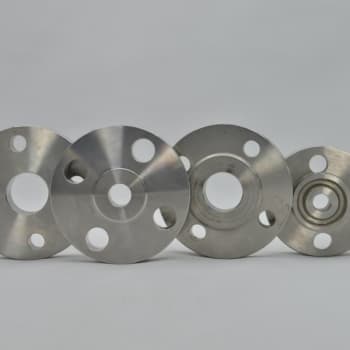
Flat Face (FF): For Brittle Equipment Flanges
The flat face flange has no raised ring at all - the entire face is one flat plane. It exists for one engineering reason: when you bolt a steel flange to a cast iron, bronze or FRP equipment flange, the brittle material cannot handle the point load concentration of a raised face.
If you tried to put an RF flange against a cast iron flange, the raised ring would punch through the brittle material and crack it. The flat face spreads the bolt load across the full face area, and the gasket is a full-face gasket that covers the entire flange, holes and all.
FF flanges are used on cast iron valves, pumps and equipment flanges, typically in lower-pressure service (Class 125 to Class 300). They are not common on process piping where both flanges are steel, because they require much higher bolt torque to achieve the same unit stress as an RF flange.
A practical rule: if one flange in the pair is cast iron or non-metallic, use FF on both sides with a full-face gasket. Mixing FF on one side and RF on the other does not work - the raised face will crush the brittle flange.
Ring Type Joint (RTJ): High Pressure, High Temperature
The RTJ flange has a machined circular groove (or two concentric half-grooves) cut into the flange face, into which a solid metal ring gasket sits. The ring is oval or octagonal in cross-section, and under bolt load it deforms plastically into the groove, creating a metal-to-metal seal that does not rely on a soft gasket.
This is the face type for Class 600 and above, high-temperature service (above about 400 C), and oil and gas wellhead / Christmas tree service where a soft gasket would extrude or blow out.
The ring gasket itself is the sealing element: it is softer than the flange (usually soft iron, low-carbon steel, 304/316 stainless, Inconel or Monel depending on service), and it deforms to conform to the groove. The flange face itself does not come into contact - the seal is entirely between the ring and the two groove surfaces.
RTJ flanges are used on subsea wellheads, high-pressure manifolds, steam service above 40 bar, and sour service where graphite gaskets would be attacked by hydrogen. The drawback is cost: the groove is expensive to machine, the ring is a precision part, and RTJ flanges require careful handling - a scratched groove ruins the seal. Once the ring is compressed, it cannot be reused; a new ring is fitted on each disassembly.
Male and Female (M&F): Precision Locating
The male and female flange pair uses matching raised and recessed surfaces: one flange has a raised male face (about 6.4 mm high), the other has a matching recessed female face (about 4.8 mm deep). The male fits into the female, and the gasket sits on the narrow annular surface between them.
The female face locates and retains the gasket, which prevents it from being blown out by internal pressure - this is the advantage over RF. M&F flanges are commonly used on pumps, valves and heat exchanger channels, where the gasket must stay centered during assembly and the equipment flange is already female.
The gasket on an M&F flange is confined to the female recess, so it cannot extrude sideways. This makes M&F suitable for higher pressure than RF without a spiral-wound ring, and it is easier to align during assembly because the male pilot centers the two flanges. The trade-off is that the male face is easily damaged if the flange is dropped or struck - a nick on the male edge ruins the seal.
M&F flanges are also not interchangeable with RF, and you cannot mix a male with a flat face. They are covered by ASME B16.5 and used across the Class range up to about Class 900.
Tongue and Groove (T&G): Gasket Fully Contained
Tongue-and-groove is the most contained face geometry: one flange has a raised annular tongue, the other has a matching annular groove, and the gasket sits entirely inside the groove. Unlike M&F, the tongue is narrower and the groove deeper, so the gasket is fully enclosed on both sides and the outer tongue edge protects it from the atmosphere.
T&G flanges are used on gasket materials that are sensitive to oxidation or extrusion - asbestos substitutes, PTFE, spiral-wound in critical service - and on joints that are not regularly disassembled.
The advantage is maximum gasket confinement and excellent sealing on volatile or hazardous service. The disadvantage is maintenance: the tongue is fragile, the groove is hard to clean, and the gasket cannot be inspected without full disassembly.
T&G flanges come in large and small variants (large T&G for heat exchangers, small T&G for pump connections). They are less common in general piping than RF, but standard on critical equipment flanges. Like M&F, they are not interchangeable with any other face type.
Cross-Comparison at a Glance
| Face type | Gasket used | Typical class range | Best for |
| Raised Face (RF) | Sheet, spiral-wound, kammprofile | 150 - 2500 | General process piping |
| Flat Face (FF) | Full-face sheet gasket | 125 - 300 | Cast iron / FRP equipment |
| Ring Type Joint (RTJ) | Metal ring (oval/octagonal) | 600 - 2500 | High pressure, high temp, wellhead |
| Male & Female (M&F) | Confined sheet / spiral | 150 - 900 | Pumps, valves, heat exchangers |
| Tongue & Groove (T&G) | Fully confined sheet / spiral | 150 - 900 | Critical, hazardous service |
The Non-Interchangeability Rule
The single most important rule: two flanges with different face types do not mate. You cannot bolt an RF flange to an RTJ flange, or an M&F flange to an FF flange, and expect a seal. The gasket will not be able to contact both surfaces across its full width.
When you order a flange, specify the face type explicitly on the inquiry, and confirm that the mating equipment (valve, pump, compressor) has the same face. A common site mistake is ordering a spare flange with RF and discovering the pump is RTJ - the spare does not fit and has to be remanufactured. Always match the face type to the equipment nameplate.
Face Roughness Is Part of the Spec
Even on the same face type, the surface finish (roughness) matters. A gasket needs the right roughness to bite into - too smooth and it slips, too rough and the gasket cannot seal the peaks. ASME B16.5 specifies typical finishes: 125 to 250 AARH for soft sheet gaskets, 250 to 500 AARH for spiral-wound gaskets. The finish is measured by the machining pattern on the face - a continuous spiral or a concentric serration produced by a flange facing tool. A face that has been damaged by a dropped wrench, or scored by a bad gasket removal, must be refaced before reassembly. This is a separate operation from selecting the face type, and it is where many site leaks originate.
Common Field Mistakes
- Using an RF gasket on an RTJ flange because it "looked close" - the gasket will not seal in the groove.
- Mixing FF and RF flanges on a cast iron valve, cracking the cast iron flange under load.
- Reusing an RTJ ring gasket after disassembly - the ring has taken a permanent set and will not re-seal.
- Torqueing an FF flange to RF bolt values, which cracks the brittle equipment flange.
- Failing to clean the M&F female recess before assembly, leaving old gasket material that prevents the male face from seating.
- Ignoring the face finish and using a soft gasket on a machined-smooth face that has no serrations.
How to Choose
Start from the service: if the pressure is Class 600 or above, or the temperature is high, default to RTJ. If you are bolting to cast iron or FRP equipment, use FF.
If the joint is on a pump, valve or heat exchanger that specifies M&F, match it. For general process piping below Class 600, use RF with a spiral-wound or sheet gasket - it is the default for good reason.
T&G is reserved for critical service where gasket containment is the priority. When in doubt, check the equipment nameplate and match the face type; the flange face is not the place to improvise.


