


HT PIPE is a nickel 201 plate sheet strip supplier with 15+ export experience. Contact us for more information and quotes for free!
To appreciate the utility of Alloy 201 strip, it is helpful to contrast it with its sister grade, Alloy 200. Both are comprised of at least 99.0% pure nickel, yielding exceptional electrical and thermal conductivity alongside robust magnetic properties. However, their performance diverges significantly when exposed to high temperatures.
The Carbon Threshold: Alloy 200 contains a maximum carbon content of 0.15%. When subjected to sustained temperatures above 315°C (600°F), this carbon precipitates out of the solid solution as graphite. This phenomenon, known as graphitization, occurs along the material's grain boundaries, causing severe embrittlement and catastrophic structural failure.
The Low-Carbon Solution: Alloy 201 restricts its maximum carbon content to a strict 0.02%. This structural adjustment prevents graphitization, allowing the material to maintain its ductility and tensile strength at temperatures up to 677°C (1250°F) under ASME Boiler and Pressure Vessel codes.
Product Forms
Bar & Rod
Plate & Sheet
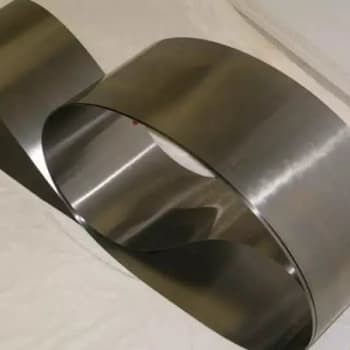
Coil & Strip
Pipe & Tube
Fitting: Flange, Tee, Elbow, Reducer etc.
Forging: Ring, Shaft, Circle, Block etc.
Superior Corrosion Resistance
Alloy 201 provides exceptional resistance to reducing chemicals and neutral or alkaline salt solutions. It is widely considered the standard for handling caustic alkalis, such as sodium hydroxide (caustic soda), even when the medium is in a highly concentrated, molten state. While it develops a protective oxide film under oxidizing conditions, it should be noted that severe corrosion can occur if exposed to highly oxidizing acid salts like ferric chloride.
High Thermal and Electrical Conductivity
With an electrical resistivity of approximately 8.5 microhm-cm at room temperature, Alloy 201 strip conducts electricity and transfers heat far more efficiently than standard stainless steel grades or specialized nickel-chromium superalloys.
Workability and Fabricability
Featuring a low work-hardening rate and an annealed yield strength of roughly 15,000 PSI (100 MPa), the material accommodates extensive cold-forming operations. It can be deep-drawn, spun, stamped, and bent into intricate geometries without requiring frequent intermediate stress-relief annealing. Furthermore, its clean metallurgical profile allows for seamless welding using standard Gas Tungsten Arc Welding (GTAW/TIG) and Gas Metal Arc Welding (GMAW/MIG) practices.
| Material Property | Specification / Value |
| UNS Designation | N02201 |
| Standard Specifications | ASTM B162, ASME SB162 |
| Nominal Composition | Ni ≥ 99.0%, C ≤ 0.02%, Mn ≤ 0.35%, Fe ≤ 0.40%, Cu ≤ 0.25% |
| Density | 8.89 g/cm³ (0.321 lb/in³) |
| Melting Range | 1435°C – 1445°C (2615°F – 2635°F) |
| Tensile Strength (Annealed) | 55,000 PSI (380 MPa) minimum |
| Elongation in 2 inches | ~40% (varies by cold-rolled temper) |
Critical Global Applications
Advanced Battery Manufacturing: High-purity nickel strip is critical for welding battery connections, busbars, and terminals in electric vehicles (EVs) and stationary energy storage systems. Its low internal resistance minimizes energy loss and mitigates heat generation during high-rate charging and discharging cycles.
Chemical and Petrochemical Processing: The material is frequently specified for evaporator tubes, pressure vessels, and reaction chambers used in chlor-alkali processing, synthetic fiber production, and the manufacturing of vinyl chloride monomers.
Electronics and Aerospace: Its low vapor pressure, low gas content, and reliable magnetostrictive attributes make it a dependable option for electronic lead wires, passive cathodes, heating element supports, and specialized aerospace instrumentation.
What are the main differences between Alloy 201 and Alloy 200?
The critical differentiator is carbon content.
Alloy 200 contains up to 0.15% carbon, which precipitates as graphite at temperatures above 315°C (600°F), destroying the metal's ductility.
Alloy 201 restricts carbon to a maximum of 0.02%, preserving its stable crystal lattice and mechanical safety at elevated temperatures.


