


Two certificates arrived on the same desk last month. Both said Monel 400. One quoted ASTM B127, the other quoted AMS 4544. The buyer - a fabricator near Milan who has been buying nickel alloys for eleven years - read both, nodded, and asked the question that made the quotation collapse: "These are the same material, yes?" They are not the same document, and the difference is not academic. It sits in the acceptance criteria your inspector will apply when the plate lands.
That is the pattern behind almost every Monel 400 plate RFQ we see: the buyer knows the name, not the paperwork boundaries. Below are the five questions that come up most often, answered with the numbers that actually decide the order.
Product Forms
Bar & Rod
Plate & Sheet
Coil & Strip
Pipe & Tube
Fitting: Flange, Tee, Elbow, Reducer etc.
Forging: Ring, Shaft, Circle, Block etc.
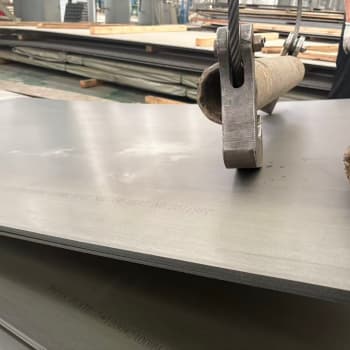
Q1: Is plate, sheet and strip the same product with a different label?
No. ASTM B127 draws two hard lines, and both carry consequences for what you can physically do with the material.
|
Form |
Thickness |
Width |
What it means for you |
|
Strip |
Any |
Under 600 mm |
Coil-fed press work, gaskets, shims |
|
Sheet |
Up to 4.76 mm (3/16 in) |
600 mm and over |
Forming, deep drawing, spinning, linings |
|
Plate |
Over 4.76 mm |
600 mm and over |
Structural, tube sheets, vessel internals, cladding backing |
The 4.76 mm figure is not a supplier convention - it is written into B127. It matters because the thickness tolerances, the flatness allowances, and the available mill condition all change across that line.
A fabricator in Milan learned this the expensive way. He ordered 4 mm Monel 400 "plate" for a set of dished heads that had to be spun. He got material that met every chemistry requirement, every mechanical minimum - and it cracked in the second forming pass. The mill had supplied hot-rolled plate stock rolled to 4 mm rather than cold-rolled sheet. Same alloy, same certificate number format, wrong product form for the operation.
The rule: if your process bends, draws, spins or flanges the material, order sheet, not plate, and write "cold rolled, annealed" on the PO. Plate is for flat work and machining.
Q2: Annealed, hot rolled, or cold worked - which condition should the PO say?
Monel 400 cannot be strengthened by heat treatment. It is a single-phase solid solution, so everything about its strength comes from either annealing (soft, ductile) or cold work (strong, less ductile). That makes the delivery condition the single most important line on your order.
|
Condition |
Typical tensile |
Typical yield 0.2% |
Elongation |
Where it belongs |
|
Hot rolled, annealed |
480–585 MPa |
170–310 MPa |
35–50% |
General plate work, vessels, tube sheets |
|
Hot rolled, as-rolled |
~517 MPa min |
~276 MPa min |
~30% |
Structural plate where ductility is secondary |
|
Cold rolled, annealed |
480–585 MPa |
170–310 MPa |
35–50% |
Sheet for forming |
|
Cold worked (stress relieved) |
585–760 MPa |
380–585 MPa |
15–25% |
Wear parts, shafts, high-load inserts |
Two notes that matter more than the table:
Annealing range. B127 uses roughly 730–870 °C for sheet and strip and 805–870 °C for plate, with water quench or rapid air cool. Some published data sheets quote a much wider 870–1040 °C "annealing" range. If your purchase order says "annealed" without a temperature, you have no defensible acceptance position. Write the range.
Stress relief is not annealing. 540–565 °C with slow cooling relieves residual stress from machining or forming without recrystallising. It does not restore ductility. Buyers who ask for "stress relief" believing they are getting soft material end up with a plate that machines well and bends badly.
Q3: Why do some Monel 400 plates tear at the edge during hot rolling, and what does cerium have to do with it?
This is the technical question almost nobody asks until they have a problem, and it is where Monel 400 plate differs from every stainless plate your buyer has handled.
Monel 400 has no chromium. There is no Cr₂O₃ passive film to reform after a scratch or a hot-rolling pass. What protects the alloy is the nickel-copper matrix itself - and that matrix is vulnerable to two specific contaminants:
Sulphur. Sulphur pickup at hot-working temperature causes grain-boundary embrittlement. It is the single most common cause of scrapped nickel-copper plate and forgings, and it comes from furnace fuel, refractory, and residual lubricant, not from the metal.
Lead, bismuth, and other low-melting metals. These embrittle the grain boundaries even at trace levels, which is why dedicated tooling and clean furnaces are non-negotiable.
ASTM B127 deals with this by bounding residual elements hard: Ce (cerium) 0.20% max, total residual elements capped, sulphur 0.024% max. The cerium limit is not a metallurgical alloying addition - it is a scrap-control ceiling, because cerium arrives with reclaimed charge and above that level the hot-working window narrows sharply. That is the mechanism behind the "fish-scale" edge tearing you occasionally see on heavy Monel plate that technically passed chemistry.
What to put on the PO: require the mill to report the full residual set from B127 Table 1, not just Ni, Cu, Fe, Mn, C, Si, S. If your application involves heavy hot forming, ask for the hot-working practice and confirm a sulphur-free furnace atmosphere.
Q4: Is it magnetic? The answer changes with the thermometer
Monel 400 is not "non-magnetic" in the clean way buyers expect from 316L. Copper suppresses the Curie point of nickel from 358 °C down to roughly room temperature, and where exactly it lands depends on the iron content of the heat.
|
Heat-actual Fe |
Approximate Curie point |
Room-temperature behaviour |
|
1.0% |
~21 °C |
Non-magnetic at normal ambient |
|
1.5% |
~30 °C |
Weakly magnetic in winter, non-magnetic in summer |
|
2.0% |
~40 °C |
Weakly ferromagnetic at room temperature |
|
2.5% (B127 ceiling) |
~49 °C |
Weakly ferromagnetic in most service |
So: two plates, both fully compliant with B127, can behave differently on a magnet. Above the Curie point the alloy is paramagnetic with relative permeability near 1.001; below it, weakly ferromagnetic, and cold work raises permeability further because dislocation density pins magnetic domains.
If your application needs genuinely low permeability - instrumentation housings, magnetic-sensitive assemblies, naval hardware - specify the requirement at enquiry stage: annealed condition, iron in the lower half of the 2.5% bracket, heat-actual iron reported on the certificate, and a permeability acceptance test to an agreed ceiling. A magnet test at goods-in proves nothing.
Q5: What are the temperature ceilings, and why does sulphide matter?
Monel 400 plate holds useful strength from cryogenic temperature up to a few hundred degrees, but its corrosion ceiling is atmosphere-dependent - and the sulphur ceiling is far lower than the oxidation one.
|
Environment |
Practical ceiling |
Reason |
|
Seawater / brine, continuous |
~260 °C |
Film stability |
|
Hydrofluoric acid, continuous |
~150 °C |
Film stability in HF |
|
Reducing atmosphere (no sulphur) |
~400 °C |
Oxidation onset |
|
Air / flue gas containing sulphur |
~540 °C continuous, ~450 °C recommended long-term |
Nickel sulphidation - the alloy's real weak point |
|
Cryogenic |
Down to −196 °C |
No ductile-brittle transition |
That fourth row is the one that catches buyers. Monel 400 has excellent high-temperature strength, and a datasheet saying "service to 540 °C" reads like a licence to put the plate in a sulphur-bearing furnace. It is not. Above roughly 450 °C in sulphur-containing gas, nickel sulphidation proceeds faster than anything in the mechanical property table suggests, and the failure looks like thinning rather than deformation.
The other ceiling worth writing down is oxidizing media. Nitric acid, aerated ferric chloride, wet chlorine - Monel 400 has no chromium to rebuild a film, so these environments strip it. If your stream is oxidizing, the answer is a nickel-chromium-molybdenum alloy, not a thicker Monel plate.
What this adds up to
Monel 400 plate is a straightforward alloy sold with a complicated set of paperwork boundaries. The chemistry is fixed by B127 and there is very little room to get it wrong. What buyers get wrong is everything around the chemistry: order plate for a forming job, ask for annealing without a temperature, accept "non-magnetic" as a property rather than a test, or read the 540 °C figure as if it applied to a sulphur-bearing furnace.
Send the forming operation, the delivery condition you want stated, the atmosphere, and the temperature to market@htpipe.com with your thickness and size list. We will tell you which form and which condition actually fits - including when a thinner annealed sheet does the job better than the plate you were about to order.
FAQ
Q: What is the difference between ASTM B127 and AMS 4544 for Monel 400 plate?
B127 is the general ASTM product specification for nickel-copper plate, sheet and strip, used for industrial and ASME code work. AMS 4544 is the aerospace specification with tighter controls on residual elements, grain size and surface condition, and a different acceptance framework. Both describe the same alloy, but they are not interchangeable documents - an aerospace PO that says "Monel 400 plate" and cites B127 is not compliant.
Q: Can Monel 400 plate be hardened by heat treatment?
No. It is a single-phase solid-solution alloy with no precipitation-hardening additions. Strength comes from cold work only. If you need higher strength, the correct answer is hot-rolled as-rolled plate, cold-worked tempers, or a change of grade to K-500 - not another heat treatment cycle.
Q: Does Monel 400 plate need post-weld heat treatment?
Not by code for most services. Stress relief at 540–565 °C is applied where dimensional stability or service in HF and hot caustic demands it. What is mandatory is cleanliness: sulphur and lead contamination at the joint cause cracking that no PWHT will recover. Use ERNiCu-7 filler (AWS A5.14) and keep the joint free of sulphur-bearing marking compounds and lubricants.
Q: What thickness range is Monel 400 plate supplied in?
Cold-rolled sheet from around 0.5 mm to 4.76 mm, hot-rolled plate from 4.76 mm up to roughly 100 mm depending on mill. Above about 50 mm the supply base narrows considerably and lead times extend, so confirm availability before the design is frozen.
Q: How does Monel 400 plate compare with 316L plate in seawater?
Monel 400 resists flowing seawater at rates well below 0.025 mm/year and is immune to chloride stress corrosion cracking. 316L relies on a chromium oxide film that breaks down in warm chloride water and is susceptible to chloride SCC above about 60 °C. The premium is real, and it buys a failure mode that 316L cannot offer at any thickness.
CTA:
Need Monel 400 plate with the delivery condition and form written correctly into the order?
Contact market@htpipe.com - plate, sheet and strip to ASTM B127 with the full B127 residual report.


