


Up to NPS 4, small-bore piping is joined in three completely different ways, and most specification problems on a job do not start with the fitting itself - they start with the wrong joining method being chosen for the pressure, temperature and duty. Butt-weld fittings (ASME B16.9) are the default for larger lines. For smaller piping, forged socket-weld and threaded fittings come under ASME B16.11. This article compares the three methods and explains how to pick between them without reading three standards at once.
Three Ways to Join Small-Bore Pipe at a Glance
| Method | Standard | Pressure class | Typical size | Best for |
| Socket-weld | ASME B16.11 | Class 3000 / 6000 / 9000 | NPS 1/2 - 2 | High pressure, vibration, small bore where welding space is tight |
| Threaded (screwed) | ASME B16.11, NPT per B1.20.1 | Class 2000 / 3000 / 6000 | NPS 1/2 - 2, up to 4 | Low-pressure, instrument, air, water lines needing disassembly |
| Butt-weld | ASME B16.9 | Follows pipe wall schedule | NPS 1/2 and up | High pressure, high temperature, critical process lines |
Socket-Weld Fittings: How the Joint Actually Works
A socket-weld fitting has a bored pocket slightly larger than the pipe OD. The pipe drops in until it bottoms out, then the joint is fillet-welded around the outside. The one detail every fabricator is taught but drawings still forget: the pipe must not sit hard against the bottom of the socket. Leave a gap of about 1.5 to 3 mm at the bottom before welding. Without that gap, thermal expansion traps stress at the weld root and cracks show up months or years later.
Socket-weld fittings are forgiving in small sizes. A welder can fit them in tight spots where a butt weld would not reach, and the fillet weld is quick and inspectable. Their weakness is internal crevices and services where cleanliness or hygiene matters - the socket gap can trap fluid. They are also not recommended for services where erosion-corrosion at the gap is likely.
Threaded Fittings: NPT and Where They Belong
Threaded fittings cut or machine NPT (tapered pipe thread, per ASME B1.20.1) at both ends. The joint seals when the tapered threads are tightened, usually with PTFE tape or thread sealant. They are the cheapest way to run instrument air, plant air, water and small utility lines, and the joint can be disassembled with two wrenches, which is why threaded unions and nipples survive everywhere in low-pressure service.
The limits are clear. Threaded joints are not a substitute for welded joints on high-pressure process lines, especially where vibration, cyclic loading or thermal shock is present. The thread root is a stress concentration, and in thin-wall pipe the threads themselves remove most of the wall. They are also not suitable for lethal service or for systems that must be 100% radiographed - there is nothing to radiograph.
Butt-Weld Fittings: The Heavy-Duty Default
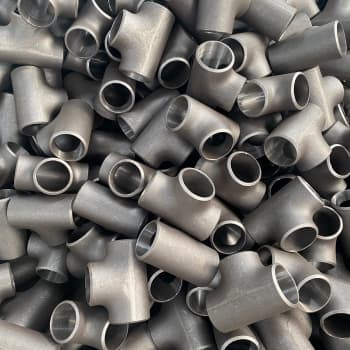
Butt-weld fittings have the same wall thickness as the pipe and are joined by full-penetration groove welds. The joint is as strong as the pipe itself, it can be radiographed, and there is no crevice to trap fluid. For critical service - high pressure, high temperature, hazardous fluid, long-term offshore duty - butt weld is the default, and socket-weld or threaded is chosen only where the size or geometry makes butt weld impractical.
Pressure Classes and Matching Pipe Wall
ASME B16.11 uses class designations that do not map one-to-one with flange pressure ratings. The numbers correspond to the approximate maximum pressure the forged fitting body can handle, and the standard requires the fitting to pair with pipe of a matching wall thickness. The typical matching is:
| End type | Class | Matches pipe wall |
| Threaded | 2000 | SCH 80 / XS |
| Threaded | 3000 | SCH 160 |
| Threaded | 6000 | XXS |
| Socket-weld | 3000 | SCH 80 / XS |
| Socket-weld | 6000 | SCH 160 |
| Socket-weld | 9000 | XXS |
Putting a Class 3000 socket-weld elbow on SCH 40 pipe defeats the purpose: the fitting can hold the pressure, but the thinner pipe welded to it is the weak point. The two have to match.
Materials and Marking
B16.11 fittings are forgings, and the material follows the same grade system as flanges. Carbon steel is ASTM A105. Low-temperature service uses A350 LF2. Stainless forged fittings use A182 grades (F304, F304L, F316, F316L, F321, F347). Every fitting must carry a durable marking per MSS SP-25: manufacturer mark, grade, size, class and heat number. On receipt, the marking is the first thing an inspector checks before anything else.
How to Choose, in Three Rules
- High pressure, high temperature or critical process line at NPS 1/2 and up: use butt-weld (B16.9). Socket-weld only where space forces it.
- Small-bore high-pressure line where butt weld is too awkward: use Class 3000 or 6000 socket-weld, matched to SCH 160 or XXS pipe.
- Low-pressure, non-critical, disassembled lines (instrument air, water, drains): threaded, Class 2000 on SCH 80, never on thin wall, never where vibration is significant.
Common Specification Mistakes
- Ordering Class 3000 fittings but using SCH 40 pipe - the fitting and the pipe are not matched.
- Forgetting the 1.5-3 mm root gap on socket-weld joints.
- Using threaded fittings on a line that will see thermal cycling or vibration, then wondering why it leaks.
- Mixing NPT and BSPT threads - they look similar but do not seal.
- Ordering socket-weld fittings for hygienic or food/pharma duty, where the crevice is unacceptable.


