


Understanding FF, RF, and RTJ Flange
Flange is crucial component used to connect pipes, valves, pumps, and other equipment in piping systems. The face type of a flange is essential as it determines how the flange connects with another component. RF (Raised Face), FF (Flat Face), and RTJ (Ring Type Joint) are three common types of flange faces, each with specific features and applications.
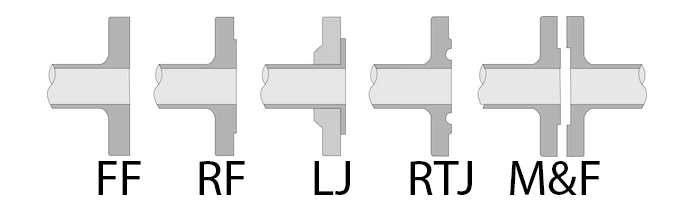
1. Flat Face (FF) Flanges
A Flat Face flange features a completely flat sealing surface that sits at the exact same height as the outer bolting circle. There is no step-up or raised area on the face.
Gasket Type used: Full-face gaskets (covers the entire face of the flange, including the bolt holes).
Common Pressure Ratings: Typically limited to Class 150 low-pressure applications.
Primary Materials: Frequently utilized on cast iron, bronze, plastic, or fiberglass (FRP) equipment and valves.
The Engineering Logic: FF flanges are designed to minimize bending stresses on the flange lip during bolt torqueing. When the bolts are tightened, the torque loads are distributed evenly across the entire surface area, preventing fragile cast iron or non-metallic flanges from cracking.
2. Raised Face (RF) Flanges
The Raised Face flange is the most widely specified flange type in modern process piping. It features a small, elevated circle directly surrounding the pipe bore, raising the sealing surface above the outer bolting circle.
Standard Height: For Class 150 and Class 300, the face is raised by 0.06 inches (2mm). For Class 600 and higher, the face is raised by 0.25 inches (7mm).
Gasket Type used: Ring gaskets or spiral-wound gaskets (placed entirely inside the bolt circle).
Surface Finish: Usually machined with a concentric or phonographic serrated spiral finish (125–250 micro-inches AARH) to bite into the gasket material and secure it against blowout.
The Engineering Logic: By concentrating the entire bolting force onto a smaller, centralized surface area, the RF design exerts massive compressive pressure on the gasket, ensuring a highly secure seal at elevated temperatures and pressures.
3. Ring Type Joint (RTJ) Flanges
The Ring Type Joint flange is an ultra-heavy-duty sealing mechanism designed specifically for severe, high-pressure, and high-temperature environments. It features a deep, machined concentric groove on its face.
Gasket Type used: Solid metallic ring gaskets (Type R, RX, or BX oval/octagonal rings).
Common Pressure Ratings: Standard choice for Class 600, Class 900, Class 1500, and Class 2500 piping systems.
The Engineering Logic: When the flange bolts are tightened, the solid metal ring gasket is forced into the machined groove. This metal-to-metal deformation creates an incredibly robust, leak-proof seal that can handle high-integrity oil patch drilling, chemical refining, and high-pressure steam lines.
Technical Summary: Side-by-Side Comparison
| Feature | Flat Face (FF) | Raised Face (RF) | Ring Type Joint (RTJ) |
| Pressure Range | Low (Class 150) | Medium to High (Class 150–2500) | Extreme (Class 600–2500+) |
| Sealing Type | Full-face soft gasket | Ring or Spiral-wound gasket | Solid metal ring gasket |
| Primary Material | Cast iron, ductile iron, bronze | Carbon steel, Stainless, Duplex | High alloys, Heavy forged steels |
| Risk of Cracking | Ultra-low (Flat distribution) | Moderate if over-torqued | Low (Rigid metal-on-metal) |
Suppliers
Our company is a professional and reliable one-stop service manufacturers suppliers exporters. We not only provide stainless steel pipes, tubes, plate, sheets, round bar, but also fabricated pipe spools service, of course, including pipe fittings, FF, RF, RTJ flanges, fasteners, etc. Free samples can be provided. Contact us for a free quote.


