


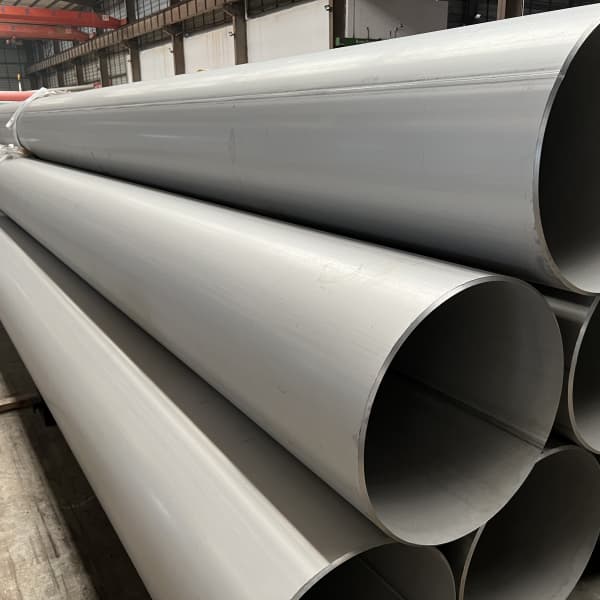
ASTM A312 347H Pipe
1. Standard: ASTM A312 / ASME SA312、ASTM A213/ASME SA213、ASTM A269/ASME SA269
2. Size: 1/2“NB - 16”NB(seamless);1/2“NB - 48”NB (welded)
3. Thickness: 0.5mm-30mm
4. Length: Single, Double Random & Cut Length
5. Grades: Alloy 347h, UNS S34709, WNR.1.4961
Most stainless steels have a quiet expiry date in high-temperature service. Above roughly 500°C, the carbon dissolved in the austenite migrates to the grain boundaries, reacts with chromium, and leaves a chromium-depleted skeleton around every grain - the metal looks the same, but it has become brittle, weld-decayed, and vulnerable to attack along the very lines that hold it together.
ASTM A312 347H Pipe avoids this by a design trick as old as metallurgy itself: give the carbon something better to react with. The niobium in 347H forms stable niobium carbides in preference to chromium carbides, the grain boundaries stay rich in chromium, and the pipe keeps its strength and corrosion resistance through decades of 600-750°C service.
This is the material of refinery transfer lines, superheater tubing and high-temperature chemical plant - and this article explains the mechanism, the numbers, and the buying notes that matter.
Product Forms
Bar & Rod
Plate & Sheet
Coil & Strip
Pipe & Tube
Fitting: Flange, Tee, Elbow, Reducer etc.
Forging: Ring, Shaft, Circle, Block etc.
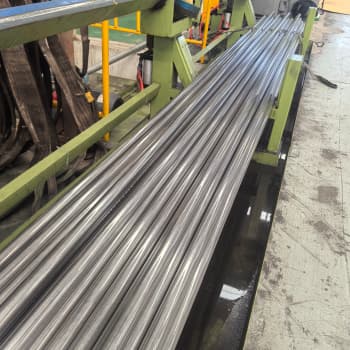
The stabilization mechanism: why 347H does not sensitize
In unstabilized austenitic grades such as 304 and 316, the 425-870°C band - exactly the range welds and hot service create - allows carbon to precipitate as chromium carbide at grain boundaries, draining chromium from the adjacent metal.
The depleted band corrodes preferentially and the joint fails by intergranular attack. In 347H the niobium is a stronger carbide former than chromium: the carbon combines with niobium as NbC instead, the chromium stays in solution, and the grain boundaries remain protected.
Because the carbon is already locked up, the pipe can be welded, heated, and cooled through the sensitization band repeatedly without losing its corrosion resistance. That single mechanism is why 347H is specified where the line is too hot for 316L and too long-lived for an annual inspection.
The chemistry, and the 8 x C rule
| Element | Range (wt %) | Role in the pipe |
| Carbon | 0.04 - 0.10 | Deliberately higher than 347 - carbon gives high-temperature creep strength |
| Chromium | 17.0 - 19.0 | Corrosion resistance and the oxide film |
| Nickel | 9.0 - 13.0 | Austenite stability and toughness |
| Niobium (+ tantalum) | 8 x C min, up to ~1.10 | The stabilizer - ties up carbon as NbC, protecting grain boundaries |
| Manganese / Silicon | 2.00 / 1.00 max | Deoxidation and melting control |
| Phosphorus / Sulfur | 0.045 / 0.030 max | Kept low for ductility |
The defining line on the certificate is the niobium requirement written as a multiple of the carbon content: niobium must be at least 8 times the carbon present. A 0.08% carbon 347H therefore needs at least 0.64% niobium. The ratio guarantees there is enough stabilizer to lock up every carbon atom - check that line when you read a 347H certificate, because it is the line that proves the grade is actually stabilized.
347, 347H and 321: three relatives, two stabilizers
| Grade | Carbon | Stabilizer | Where it is used |
| TP321 | 0.08 max | Titanium (5 x C min) | General stabilized service, moderate temperature |
| TP347 | 0.08 max | Niobium (8 x C min) | Welded and heavy-section stabilized service |
| TP347H | 0.04 - 0.10 | Niobium (8 x C min) | High-temperature creep service - superheater, refinery |
347H is 347 with its carbon range raised, and the carbon is exactly what the high-temperature designer wants: at 650°C and above, creep strength rises with carbon content, and the niobium keeps the extra carbon from doing damage. Where 321 relies on titanium - which can be lost across a weld - 347's niobium is a weld-safe stabilizer, which is why 347H, not 321H, is the standard choice for welded high-temperature lines.
Mechanical properties (pipe per ASTM A312)
| Property | TP347 / TP347H | Notes |
| Tensile strength | 515 MPa min | Room-temperature minimum |
| Yield strength 0.2% | 205 MPa min | Room-temperature minimum |
| Elongation | 35% min | Longitudinal, per A312 |
| Hardness | ~92 HRB max | Typical annealed range |
| Density | 7.96 g/cm³ | Melting range ~1400 - 1450 °C |
The room-temperature table looks ordinary because the grade's value is not there - it is in the creep curve at 600-750°C, where the higher carbon keeps the pipe from sagging and the niobium keeps it from embrittling. Buyers comparing only tensile numbers miss the point of the grade.
Standards and product forms
| Form | Standard | Notes |
| Seamless / welded pipe | ASTM A312 (TP347H) | General process piping |
| Boiler / superheater tube | ASTM A213 (TP347H) | Heat-exchanger and boiler tubing |
| Pressure-vessel pipe | ASME SA312 / SA213 | Code service with the corresponding BPV section |
| Plate | ASTM A240 (347H) | High-temperature plate and fabrication |
The European designation is 1.4961 (X6CrNiNb18-10); UNS is S34709. For welded pipe in high-temperature service, confirm the welding filler and the heat treatment with the supplier - the weld is where stabilization decisions are actually tested.
Where 347H pipe is the right answer
- Refinery transfer lines and FCCU service - hot hydrocarbon at 550-700°C with thermal cycling
- Superheater and reheater tubing in boilers - creep strength where 316L and 321 run out of margin
- High-temperature chemical plant - heat exchanger tubing on aggressive hot streams
- Steam service where design life is counted in decades and replacement is a shutdown event
- Any welded stabilized line that must not sensitize in the 425-870°C band during fabrication or service
Welding and fabrication notes
- Use stabilized filler (347-type) or a niobium-bearing grade - do not weld 347H with 308 or 316 filler
- The stabilization means no mandatory preheat and no PWHT for most services - a fabrication advantage over alloy steels in the same temperature class
- Keep the heat input moderate and the interpass temperature low, as with any austenitic weld
- Solution anneal after heavy cold work if the pipe is bent or formed severely
What to check on the certificate
- Carbon in the 0.04 - 0.10% range - the H is the whole point
- Niobium at least 8 x carbon - the stabilization ratio that defines the grade
- Heat-treatment record: solution annealed per A312 with the temperature and quench stated
- Mechanical test results against the A312 minima, and the heat number for traceability
At room temperature, 347H is nothing special - which is the trap. Its value is entirely in the high-temperature behaviour: the creep strength that comes from carbon, and the grain-boundary protection that comes from niobium. Specify it where the line runs hot and must not be replaced, and the certificate will outlast the first campaign.
FAQ
Q: About ASTM A312 347H Pipe price per kg?
A: Prices ranges from $25 to $40 per kg, vary depending on size, wall thickness, supplier etc.
Q: How long does your delivery time take?
A: Delivery time is within 5-21 days
Q: Is There Sample Service?
A: Samples Are Provided Free Of Charge
Q: What Is The Minimum Order Quantity?
A: No Minimum Order Quantity
Q: How to pack the products?
A: The inner layer has a waterproof paper outer layer and is fixed with a fumigation wooden pallet.
Q: Exported Countries
A: Brazil, South Africa, Indonesia, India, Singapore, Malaysia, Iran, Russia, UAE, Chile, Laos, etc
Hot Tags: 347h pipe, tp347h, uns s34709, 347h stainless steel pipe, niobium stabilized pipe, a312 tp347h, 1.4961, high temperature stainless pipe, 316 pipe, 316l pipe, 904L Stainless Steel Pipe, 904L Stainless Steel Tube, a269 tubing, a312 pipe
Previous
Stainless Steel 15-5PH PipeNext
No InformationYou Might Also Like


Send Inquiry