


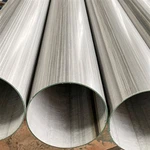
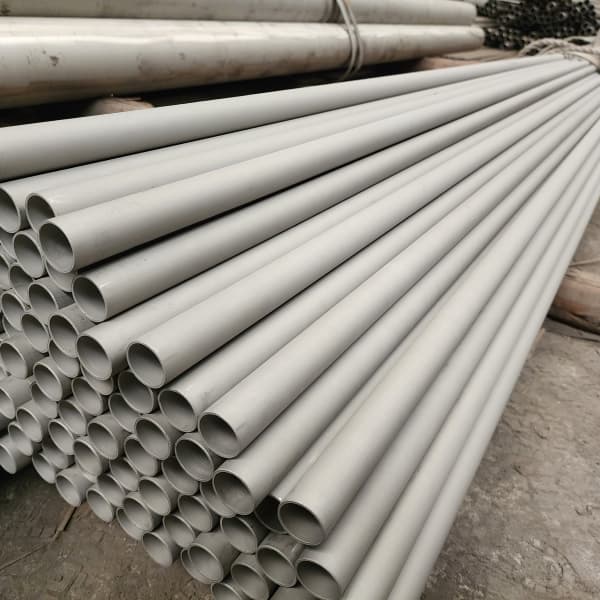
Hastelloy C2000 Nickel Alloy Pipe
1. Standard: ASTM B622, ASTM B619, ASTM B474
2. OD:3.35 mm OD To 152 mm OD
3. Thickness: SCH5~SCHXXS
4. End: Beveled End, Plain End
Hastelloy C2000 Nickel Alloy Pipe is the solution-annealed, corrosion-resistant Ni-Cr-Mo product that carries a deliberate copper addition, and that copper is the whole story. Every other C-family alloy, from C276 to C22, balances oxidizing and reducing acid resistance with chromium and molybdenum alone. C2000 takes the same framework and adds 1.30-1.90% copper, which shifts the alloy's behavior in sulfuric acid and other reducing acids enough that many chemical plant line lists specify it where C276 and C22 sit on the edge.
The material is supplied under ASTM B622 for seamless pipe and tube, with welded equivalents under ASTM B619 and B626. It is classified as a low-carbon Ni-Cr-Mo-Cu alloy, and the copper addition is what separates it from the rest of the C-series. The alloy is also listed in ASME SB-622 for pressure boundary applications, which is the form most petrochemical and FGD enquiries are written against.
Product Forms
Bar & Rod
Plate & Sheet
Coil & Strip
Pipe & Tube
Fitting: Flange, Tee, Elbow, Reducer etc.
Forging: Ring, Shaft, Circle, Block etc.
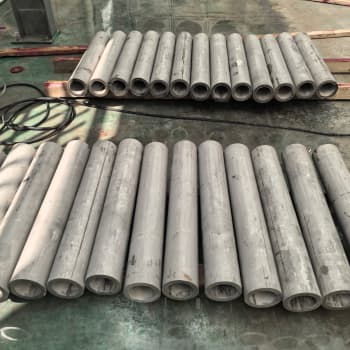
Alloy C2000 Pipe Specifications
| Standards | ASTM B619, ASTM B622 / ASME SB619, ASME SB622, ASTM B 619; ASME SB 619 (Welded); ASTM B 622; ASME SB 622 (Seamless) |
| Seamless pipe size | 3.35 mm OD To 101.6 mm OD |
| Welded pipe size | 6.35 mm OD To 152 mm OD |
| Wall thickness | 0.020" –0.220" or more |
| Type | Seamless, ERW, EFW, Welded, Fabricated |
| Length | Single Random, Double Random, Standard & Cut length |
| Finish | Polished, AP (Annealed & Pickled), BA (Bright & Annealed), MF |
| End | Plain End, Beveled End, Treaded |
| Test Certificate | Manufacturer Test Certificate |
| Laboratory Test Certificate from Govt. Approved Lab. | |
| SGS Third-Party Inspection |
Chemical composition of Hastelloy C2000 pipe per ASTM B622
The table below lists the ASTM B622 heat-analysis limits for UNS N06200. Nickel is the balance element and is typically present at 59% minimum, with the chromium and molybdenum levels positioned close to the C22 profile while copper occupies the band that C22 does not contain.
| Element | Composition limit, % |
| Ni | 59.0 min (balance) |
| Cr | 22.0 - 24.0 |
| Mo | 15.0 - 17.0 |
| Cu | 1.30 - 1.90 |
| Fe | 3.0 max |
| Co | 2.0 max |
| Mn | 0.50 max |
| Si | 0.08 max |
| C | 0.010 max |
| P | 0.025 max |
| S | 0.010 max |
Three numbers in this table carry the engineering weight. The 22.0-24.0% chromium range is the highest in the C-series family and drives resistance to oxidizing media such as nitric acid, ferric chloride, and aerated sulfuric acid. The 15.0-17.0% molybdenum range provides the reducing-acid resistance that nickel-molybdenum alloys are known for. The copper row, 1.30-1.90%, is the element that no other C-family alloy carries, and it is the reason C2000 pipe is a first-line choice for sulfuric acid service where C276 and C22 show borderline behavior.
The 0.010% carbon maximum is another important detail. Low carbon keeps the alloy in the solution-annealed condition stable and limits the formation of grain-boundary carbides during welding and service in the 650-980°C sensitization range. Together with the tight 0.08% silicon maximum, it is one of the reasons C2000 pipe can be welded in the field without a post-weld heat treatment in most services.
Mechanical properties of C2000 pipe in the annealed condition
ASTM B622 requires the following minimum mechanical properties for UNS N06200 seamless pipe in the solution-annealed condition, which is the condition in which the pipe is always delivered and used:
| Property | Minimum value (ASTM B622) |
| Tensile strength | 690 MPa (100 ksi) |
| Yield strength, 0.2% offset | 310 MPa (45 ksi) |
| Elongation in 2 in (50.8 mm) | 40% |
These are the guaranteed values that appear on the mill test certificate. Actual production values run higher: Haynes International's published typical data for solution-annealed sheet show around 752 MPa tensile and 359 MPa yield at room temperature, and typical annealed pipe elongation runs 40-45%. The practical consequence for the pipe buyer is that C2000 is a fully structural material, not a corrosion-only choice. It carries ASME B31.3 design allowables comparable to the other wrought C-series alloys, and the same wall-thickness calculation logic applies as for C276 or C22.
Physical properties and weight data
The density of Hastelloy C2000 is 8.5 g/cm³ (0.307 lb/in³), slightly lower than C276 because of the copper content. The theoretical weight of C2000 pipe is calculated with the same nickel-alloy formula used across the product range: weight in kg per metre equals 0.02466 times (outside diameter minus wall thickness) times wall thickness, with all dimensions in millimetres. A DN100 (114.3 mm) SCH 40S C2000 pipe with a 6.02 mm wall therefore works out to approximately 16.07 kg/m before mill tolerance, and this is the figure used for quotation and freight purposes unless the order specifies actual weighed mass.
| Property | Value |
| Density | 8.5 g/cm³ |
| Melting range | 1350 - 1400°C (approx.) |
| Modulus of elasticity (room temp) | 213 GPa (approx.) |
| Electrical resistivity (room temp) | 1.26 μΩ·m (approx.) |
| Thermal conductivity, 100°C | 11.4 W/m·K (approx.) |
Manufacturing standards and available forms
C2000 piping products are manufactured and supplied against the following specifications:
- ASTM B622 / ASME SB-622 - seamless nickel and nickel-cobalt alloy pipe and tube
- ASTM B619 / ASME SB-619 - welded pipe, standard dimensions
- ASTM B626 / ASME SB-626 - welded tube, standard dimensions
- ASTM B366 - fittings and flanges for the alloy in piping systems
Seamless pipe under B622 is produced by hot or cold working of a pierced billet followed by solution annealing at 1121-1149°C (2050-2100°F) and rapid cooling, typically water quenching. The anneal is what restores the corrosion resistance after working: the chromium, molybdenum, and copper must be fully in solid solution, and the rapid quench prevents the precipitation of secondary phases that would otherwise create localized attack in service.
Welded pipe under B619 is formed from annealed C2000 strip and welded with matching filler metal (ERNiCrMo-17, AWS A5.14 classification). After welding the pipe is full-body annealed and then cold worked at the weld zone where required to meet the wall and diameter tolerances of the specification. For most chemical and FGD services the welded product performs to the same corrosion standards as seamless; seamless remains the default where the piping code or the client specification demands it.
Available sizes and schedules
C2000 seamless pipe is stocked and manufactured in the following envelope, with intermediate sizes and custom wall thicknesses available on request:
| Parameter | Range |
| Outside diameter | 6.0 mm (1/8") to 219.1 mm (8"), larger sizes on project basis |
| Wall thickness | 0.5 mm to 18.26 mm (SCH 5S to SCH XXS) |
| Length | Fixed length 6 m / 12 m, or random lengths per order |
| End finish | Plain end, beveled end, or threaded as required |
| Test pressure | Hydrostatic test per ASTM B622, or pneumatic per agreement |
The practical buying range for process pipe is NPS 1/8 to NPS 8 in SCH 10S, SCH 40S, and SCH 80S. Larger diameters and heavy walls are produced against project enquiries, usually as welded pipe or as custom-drawn seamless, and the lead time is quoted on the actual order. When the enquiry states a schedule rather than an explicit wall, the standard ASME B36.10 wall is supplied unless the drawing calls for minimum wall calculation.
Corrosion performance: where C2000 earns its specification
The copper addition gives C2000 a corrosion profile that sits between the C-series alloys in a specific way. In strongly oxidizing media such as nitric acid, ferric chloride, and cupric chloride, the high chromium content provides the resistance. In reducing media such as hydrochloric acid and dilute sulfuric acid, the molybdenum content carries the performance. The copper row adds a measurable improvement in sulfuric acid over a wide concentration and temperature envelope, which is precisely the service where C276 and C22 are often marginal.
| Environment | C2000 behavior | Comment |
| Sulfuric acid, dilute to 70% | Excellent | Copper addition is the differentiator vs C276/C22 |
| Hydrochloric acid, dilute | Very good | Mo-driven resistance; limit depends on temperature |
| Nitric acid and oxidizing media | Excellent | High Cr range carries this duty |
| Chloride-bearing process streams | Excellent | High resistance to pitting and crevice corrosion |
| Wet chlorine and hypochlorite | Very good | Common in pulp and bleach plant service |
| Seawater and brine | Excellent | Pitting resistance comparable to the best C-family grades |
The pitting and crevice corrosion resistance of C2000 in chloride environments is among the highest of the wrought nickel alloys. In ASTM G48 testing the critical pitting temperature and critical crevice temperature of C2000 are consistently above those of C276, which makes the alloy a standard choice for chlorine dioxide stages in pulp mills, for FGD absorber internals, and for heat exchangers in chlorinated seawater service. The alloy also resists stress-corrosion cracking in chlorides, which removes the failure mode that threatens austenitic stainless steels in the same duty.
Typical applications for C2000 pipe
The specification of C2000 pipe in operating plants concentrates on services where oxidizing and reducing conditions alternate, or where sulfuric acid at elevated temperature meets chloride contamination. Common applications include:
- Sulfuric acid production and storage lines, including 93-98% acid service where temperature is controlled
- Flue gas desulfurization (FGD) piping, absorber spray lines, and wash water systems
- Pulp and paper bleach plants, particularly chlorine dioxide (ClO2) generation and application lines
- Chemical reactor internals and heat exchanger tubing in pharmaceutical and agrochemical plants
- Chlor-alkali process piping handling wet chlorine, hypochlorite, and brine
- Pickling and acid regeneration lines in steel processing
In each of these services the C2000 pipe is specified because the line sees both oxidizing and reducing excursions, or because the chloride content makes C276 marginal and 316L unacceptable. The cost premium over C276 is moderate, and it buys a wider operating envelope rather than a higher strength, so the specification decision is usually made by the corrosion engineer on the basis of pilot data rather than by the piping designer.
Welding and fabrication of C2000 pipe
Hastelloy C2000 pipe is welded with matching ERNiCrMo-17 filler metal (AWS A5.14 / A5.11 classification). The weld procedure is straightforward for a nickel alloy: GTAW with or without filler is standard, and no preheat is required.
A post-weld heat treatment is normally not required because the low carbon content and the rapid-cooled annealed base metal keep the weld heat-affected zone in a corrosion-resistant condition for most services. Where the client specification demands maximum corrosion resistance after welding, a full solution anneal at 1121-1149°C followed by water quenching restores the optimum microstructure, but this is rarely done for pipe in the field.
Fittings and flanges for C2000 systems are supplied to ASTM B366, which covers wrought fittings of the same alloy, and the flanges are machined from forged or bar product of matching chemistry. The piping designer should specify the filler metal class on the WPS, and the welder qualification should be against a nickel-alloy procedure, not a stainless steel procedure.
The alloy is more sluggish in the weld pool than austenitic stainless, and the interpass temperature should be kept below 100°C to avoid hot cracking in thick sections.
Quality control and certification
Every length of C2000 pipe supplied against ASTM B622 is accompanied by the mill test certificate. The certificate reports the heat chemistry, the mechanical test results, and the non-destructive examination performed. The standard examination package for this grade includes the hydrostatic test required by the specification, and, where the order requires it, eddy-current or ultrasonic examination of the full length.
Positive material identification (PMI) is offered as an additional inspection step, and is recommended when the pipe is being installed alongside C276 or C22, because the alloys are visually identical and the copper difference is not detectable by eye.
For export orders the certification is issued per EN 10204 3.1 or 3.2 as specified, and third-party inspection by SGS, BV, or TUV is arranged on request. The packing for overseas shipment is wooden crates or steel frames with sealed ends, so that the pipe arrives at the project site without thread damage or end contamination, ready for installation.
Hastelloy C2000 pipe is a specialized product, and the buying decision rests on the corrosion data, not on the price alone. When the line list specifies UNS N06200, the pipe should be ordered against ASTM B622 with the annealed condition stated, the schedule or wall thickness given explicitly, and the test certificate requested in the format the project QA plan requires.
FAQ
Q: About Hastelloy C2000 Nickel Alloy Pipe price per kg?
A: Prices ranges from $25 to $40 per kg, vary depending on size, wall thickness, supplier etc.
Q: How long does your delivery time take?
A: Delivery time is within 5-21 days
Q: Is There Sample Service?
A: Samples Are Provided Free Of Charge
Q: What Is The Minimum Order Quantity?
A: No Minimum Order Quantity
Q: How to pack the products?
A: The inner layer has a waterproof paper outer layer and is fixed with a fumigation wooden pallet.
Q: Exported Countries
A: Brazil, South Africa, Indonesia, India, Singapore, Malaysia, Iran, Russia, UAE, Chile, Laos, etc
Hot Tags: Hastelloy C2000 pipe, UNS N06200, ASTM B622, N06200 seamless pipe, Hastelloy C-2000 tube, nickel chromium molybdenum copper alloy, 2.4675, C2000 pipe supplier
Previous
ASTM B622 UNS N06022 PipeYou Might Also Like


Send Inquiry