


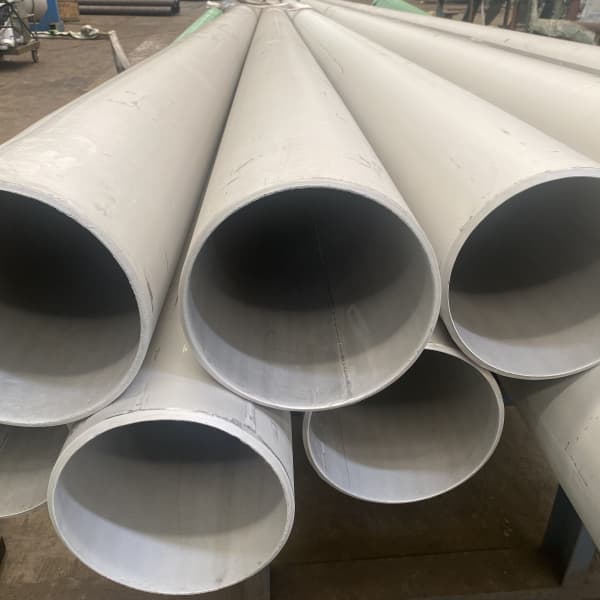
Welded Hastelloy C276 Pipe
1. Standard: ASTM B622, ASTM B619, ASTM B474, ASTM B626
2. OD: 1/8″NB – 24″NB
3. Thickness: SCH5~SCHXXS
4. End: Beveled End, Plain End
Welded Hastelloy C276 pipe - produced to ASTM B619 / ASME SB619 - dominates large-diameter applications where seamless pipe is either unavailable or prohibitively expensive above 12 inches NPS. If your project involves flue gas desulfurization ducting, large-bore process cooling lines, or chemical waste headers, welded C276 is not just the economical choice. It is often the only practical one.
HT PIPE is a leading stockist and global exporter with over 16 years of expertise in international trade. We supply asme sb 626 n10276 welded tube, plates, round bars, and a comprehensive range of pipe fittings, flanges, and valves. Contact us now for free quotes and personalized product information.
Product Forms
Bar & Rod
Plate & Sheet
Coil & Strip
Pipe & Tube
Fitting: Flange, Tee, Elbow, Reducer etc.
Forging: Ring, Shaft, Circle, Block etc.

Dimensions and Wall Schedules for B619 Welded Pipe
Welded C276 pipe can be produced in sizes that seamless simply cannot match. The practical ranges:
NPS: 1/2" through 36" (larger diameters available by special agreement)
Wall thickness: 1.65 mm (SCH 5S) up to 50 mm+ for heavy-wall applications
Length: Up to 12 meters single random; cut-to-length available
Common schedules: SCH 10S, SCH 40S, SCH 80S, SCH 160, XXS
Welded vs. Seamless: Addressing the Fusion Joint Debate
A common point of contention for procurement specialists is whether a welded longitudinal seam compromises system safety compared to an extruded seamless pipe (ASTM B622). In the past, matching filler metals or lower weld efficiency required down-rating operating pressures.
However, modern automated welding techniques have narrowed this performance gap:
ASTM B619 Class I pipes are manufactured from hot-rolled or cold-rolled strip, welded automatically without filler metal, and then cold-worked or heat-treated to ensure the weld zone aligns structurally with the base metal.
ASTM B619 Class II utilizes filler metal (typically matching alloy C276 wire) followed by complete non-destructive evaluation (NDE), including 100% radiography or hydrostatic testing.
Because nickel alloys possess excellent ductility, automatic gas tungsten arc welding (GTAW/TIG) or plasma arc welding (PAW) produces a highly uniform bead. When executed correctly, the joint efficiency factor is rated at 1.0, allowing working pressures to match seamless equivalents across standard schedules (Sch 5S, 10S, 40S, 80S).
Furthermore, welded production provides better wall thickness concentricity over long distances, reducing the risk of thin spots sometimes found in heavy-walled seamless extrusions.
The Chemistry That Makes C276 Weldable
One of the reasons Hastelloy C276 became the go-to nickel alloy for welded fabrication is its controlled chemistry. The carbon is held at ≤0.010% and silicon at ≤0.08%. This is not a random spec limit - it is a deliberate metallurgical decision. In older-generation alloys like the original Hastelloy C (UNS N10002), carbon levels around 0.08% caused carbide precipitation in the weld heat-affected zone (HAZ). Those carbides created grain boundary chromium depletion, which in turn opened the door to intergranular corrosion attack in acidic service.
C276's low-carbon, low-silicon formulation means that after welding, the HAZ does not sensitize to the same degree. The standard does not require post-weld heat treatment (PWHT) for C276 to maintain its corrosion resistance in most services. That is a significant cost and schedule advantage, especially when you are welding 50-meter runs of large-bore pipe in a Saudi summer where ambient temperatures hit 48°C and every additional process step in the field is an expensive proposition.
Key Mechanical Properties (Solution Annealed Condition)
| Property | ASTM B619 Minimum | Typical Mill Values |
|---|---|---|
| Tensile strength | 690 MPa (100 ksi) | 750–790 MPa |
| Yield strength (0.2% offset) | 283 MPa (41 ksi) | 350–380 MPa |
| Elongation in 2" | 40% | 45–52% |
| Hardness | - | 85–95 HRB |
| Density | - | 8.89 g/cm³ |
Weld Seam Inspection: What B619 Actually Requires vs What Your Project Should Demand
ASTM B619 requires:
Hydrostatic testing at a pressure that produces a stress of not less than 50% of the yield strength (or pneumatic testing as an alternative)
Non-destructive electric test (eddy current or ultrasonic) is required for certain sizes
Transverse tension test and flattening test on a per-heat basis
Reverse bend test - the weld seam is bent with the root in tension. No cracks shall develop.
FAQ
Q: About Welded Hastelloy C276 pipe price per kg?
A: Prices ranges from $25 to $40 per kg, vary depending on size, wall thickness, supplier etc.
Q: How long does your delivery time take?
A: Delivery time is within 5-21 days
Q: Is There Sample Service?
A: Samples Are Provided Free Of Charge
Q: What Is The Minimum Order Quantity?
A: No Minimum Order Quantity
Q: How to pack the products?
A: The inner layer has a waterproof paper outer layer and is fixed with a fumigation wooden pallet.
Q: Exported Countries
A: Brazil, South Africa, Indonesia, India, Singapore, Malaysia, Iran, Russia, UAE, Chile, Laos, etc
Hot Tags: welded hastelloy c276 pipe, China welded hastelloy c276 pipe manufacturers, suppliers
Previous
Alloy UNS N10665 PipeNext
No InformationYou Might Also Like


Send Inquiry