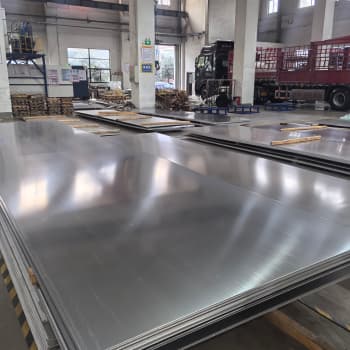
Ask any valve shop, pump builder, or oilfield fabricator in the Middle East or Europe what stainless they need and 17-4PH is on the list more often than not. It is not exotic. It is not the most corrosion-resistant stainless on the market. What it does is sit in a sweet spot nobody else occupies well: strength you can dial in with a furnace cycle, at a price far below a nickel alloy.
A 17-4PH shaft in the H900 condition yields around 1,170 MPa. Annealed 316L yields roughly 205 MPa. Same part envelope, same drawing, roughly five times the load capacity - that single sentence explains why the grade survives every supply-chain squeeze.
What Is 17-4PH Stainless Steel?
17-4PH is a precipitation-hardening (PH) martensitic stainless steel. The name breaks down cleanly once you know the convention: 17 = nominal 17% chromium, 4 = nominal 4% nickel, PH = precipitation hardening. It is also written as Type 630 (ASTM), UNS S17400, and AISI 630.
The word "precipitation-hardening" is doing the real work here. Unlike 410 or 420, which get their hardness from carbon and are then brittle, 17-4PH gets its strength from copper-rich precipitates that form during a low-temperature aging treatment. That has three consequences that matter to a buyer:
Strength is a choice, not a fixed number. Change the aging temperature and you change the yield strength - one heat of material spans roughly 725 to 1,170 MPa.
Dimensional stability is excellent. The final heat treatment runs at 480–620°C, well below the solution-annealing temperature, so parts move very little during aging. You can finish-machine close, age, and hold tolerance.
You machine it soft, then harden it. Condition A (solution-annealed) is soft and machinable. That is the state you want for chip-making.
Chemically it is a martensitic grade with enough chromium and a copper-niobium addition to make the precipitation reaction work. It is ferromagnetic in every condition - solution-annealed and aged alike - because the matrix stays martensitic. That matters for magnetic-particle inspection (a plus) and disqualifies it from non-magnetic applications (a minus).
Equivalent Grades
|
System |
Designation |
|
UNS |
S17400 |
|
ASTM / AISI |
Type 630, AISI 630 |
|
EN / DIN |
1.4542, X5CrNiCuNb16-4 |
|
EN (overaged deviation) |
1.4548 |
|
JIS |
SUS 630 |
|
GB (China) |
05Cr17Ni4Cu4Nb |
|
AFNOR (France) |
Z6CNU17-04 |
|
AMS |
5622, 5643, 5604, 5825 (filler) |
Buyer note: 1.4542 and 1.4548 are both 17-4PH chemistry; the differences are in specified condition and analysis tightness, not in the base grade. If your drawing says 1.4542 and the mill certificate says 1.4548, that is usually fine - but confirm the aging condition matches what your design assumed.
Chemical Composition of 17-4PH (ASTM A564 / A693, Type 630)
|
Element |
Content (wt%) |
Why It's There |
|
Carbon (C) |
0.07 max |
Kept low on purpose - limits carbide formation, protects toughness and weldability |
|
Manganese (Mn) |
1.00 max |
Deoxidation |
|
Silicon (Si) |
1.00 max |
Deoxidation |
|
Phosphorus (P) |
0.040 max |
Residual, controlled |
|
Sulfur (S) |
0.030 max |
Residual, controlled |
|
Chromium (Cr) |
15.00 – 17.50 |
Corrosion resistance; matrix stability |
|
Nickel (Ni) |
3.00 – 5.00 |
Austenite conditioning, toughness |
|
Copper (Cu) |
3.00 – 5.00 |
The precipitation former - the whole strengthening mechanism |
|
Niobium + Tantalum (Nb+Ta) |
0.15 – 0.45 |
Grain refinement, contributes to age-hardening response |
|
Iron (Fe) |
Balance |
Matrix |
Source: Heat-analysis limits per ASTM A564 Type 630 / AMS 5622, cross-verified against three independent mill data sheets.
The two elements that determine whether you get the properties you paid for are copper and niobium. Copper below 3% and the aging response is weak; niobium below 0.15% and the grain structure coarsens. Both are worth checking on the MTR, not just trusting the grade name.
Mechanical Properties by Heat Treatment Condition - The Core Table
This is the table most buyers actually need. All values below are minimum specification values for bar per ASTM A564 Type 630, with typical hardness ranges listed alongside.
|
Condition |
Aging Cycle |
Tensile Rm min |
Yield Rp0.2 min |
Elong. min |
Hardness (typical) |
Notes |
|
Condition A (solution-annealed) |
1,040±10°C, quench |
~1,000 MPa |
~790 MPa |
~17% |
~28–33 HRC |
Soft, machinable, not for service |
|
H900 |
482°C / 1 h, air |
1,310 MPa |
1,170 MPa |
10% |
40–47 HRC |
Highest strength; not for sour service |
|
H925 |
495°C / 4 h |
1,170 MPa |
1,070 MPa |
10% |
38–41 HRC |
Intermediate |
|
H1025 |
552°C / 4 h |
1,070 MPa |
1,000 MPa |
12% |
33–38 HRC |
Best strength–toughness balance |
|
H1075 |
580°C / 4 h |
1,000 MPa |
860 MPa |
13% |
31–36 HRC |
Higher toughness |
|
H1100 |
595°C / 4 h |
965 MPa |
795 MPa |
14% |
30–35 HRC |
- |
|
H1150 |
621°C / 4 h |
930 MPa |
725 MPa |
16% |
28–37 HRC |
Max toughness (single age) |
|
H1150D |
621°C / 4 h ×2 |
860 MPa |
725 MPa |
16% |
≤33 HRC |
The sour-service condition |
|
H1150M |
760°C + 621°C |
795 MPa |
725 MPa |
~18% |
≤24–28 HRC |
Lowest hardness, max ductility |
Source: ASTM A564 Type 630 minimum values; hardness ranges are typical per mill and AMS 5622 data.
Reading This Table Like a Buyer
Three things fall out of it immediately:
Strength roughly doubles from H1150 to H900, but elongation only drops from 16% to 10%. You are not trading away all ductility for the strength, which is why H900 parts are still used in dynamic service.
The hardness gap matters more than the strength gap when H₂S is involved. H900 at 40–47 HRC is far above the NACE ceiling of 33 HRC. H1150D exists specifically to clear it.
H1025 is the honest default for most industrial parts that are not sour-service and not weight-critical. You get 1,000 MPa yield and 33–38 HRC, with notably better toughness than H900.
17-4PH Heat Treatment: What Actually Happens in the Furnace
If you only remember one thing about buying 17-4PH, remember that the heat treatment is the product. The chemistry is a commodity; the condition is the specification. Two suppliers quoting "17-4PH bar" are not quoting the same material if one is H900 and the other is H1150.
Step 1 - Solution Annealing (Condition A)
Temperature: 1,040 ± 10°C (some specifications say 1,025–1,065°C)
Hold: 30–60 minutes
Cool: Rapid air or oil quench
This dissolves the alloying elements into a uniform martensitic matrix and produces the soft, ductile, machinable state. All 17-4PH starts here. If a supplier ships you bar "as-rolled" without a documented solution anneal, you have no control over what the subsequent aging will produce.
Step 2 - Aging (Precipitation Hardening)
Temperature: 480–760°C depending on condition
Hold: 1 hour (H900) to 4 hours (most others), 8 hours total for H1150D
Cool: Air
During this step, fine copper-rich particles precipitate inside the martensite. They pin dislocation movement, and the material gets hard and strong.
Lower aging temperature = higher strength, lower toughness. Higher aging temperature = lower strength, higher toughness and much better stress-corrosion cracking resistance. That is the entire trade, in one sentence.
Dimensional Contraction - the Detail That Ruins Parts
17-4PH shrinks predictably during aging, and the amount depends on condition:
|
Transition |
Linear contraction (in/in) |
On a 100 mm feature |
|
Condition A → H900 |
0.0004 – 0.0006 |
~0.04 – 0.06 mm |
|
Condition A → H1150 |
0.0009 – 0.0012 |
~0.09 – 0.12 mm |
Recommended sequence: rough-machine in Condition A → age to specified condition → finish-machine to final dimension. If post-aging machining is impossible, apply the contraction factor as an offset to your Condition A dimensions. A part finish-machined before aging will come out undersize.
17-4PH vs 15-5PH vs 13-8 Mo vs 304/316 vs 17-7PH
No buying decision on this grade happens in isolation. Here is how the common comparisons actually resolve.
|
Grade |
Family |
Yield (typical) |
Corrosion |
Magnetic |
Best For |
Where It Loses |
|
17-4PH |
Martensitic PH |
1,170 MPa (H900) |
≈ 304 |
Yes |
Valves, shafts, fasteners, general high-strength parts |
Chloride pitting; poor SCC at high hardness |
|
15-5PH |
Martensitic PH |
~1,170 MPa (H900) |
≈ 17-4PH |
Yes |
Aerospace fittings, transverse-toughness-critical forgings |
Costs more; no strength gain over 17-4PH |
|
13-8 Mo |
Martensitic PH |
~1,380 MPa (H1000) |
Much better |
Yes |
Chloride/SCC-critical, high-reliability aerospace |
Significantly more expensive |
|
17-7PH |
Semi-austenitic PH |
~1,380 MPa (CH900) |
≈ 304 |
Weakly (annealed) |
Springs, diaphragms, formed sheet |
Needs thermal transformation; not for machined bar |
|
304 / 316L |
Austenitic |
205–310 MPa |
Excellent |
No |
General fabrication, chloride service |
Cannot be heat-treated stronger |
The Three Comparisons That Come Up Most
17-4PH vs 15-5PH. These are near-twins. 15-5PH tightens the composition range and reduces delta ferrite, which sharpens transverse ductility and toughness and makes the material more forgeable. If you are buying air-melted stock and the drawing calls for transverse impact requirements, 15-5PH has the edge. But if the 17-4PH is ESR or VAR refined - which is standard for critical work - that advantage largely closes, and 17-4PH wins on availability and price. For sour service, both need H1150D at ≤33 HRC. In oil and gas, 17-4PH H1150D is specified far more often simply because it has a longer field history and broader global stock.
17-4PH vs 316. This is the wrong comparison to frame as a choice - it is a choice between strength and corrosion, and either one can be the right answer. 316 contains molybdenum, which buys chloride pitting resistance that 17-4PH simply does not have (17-4PH PREN ≈ 17; 316L ≈ 25; duplex 2205 ≈ 34). If your part's binding constraint is a chloride environment, you want 316L, duplex, or a nickel alloy. If it is mechanical load, 17-4PH wins by a factor of four to five.
17-4PH vs 17-7PH. Both are called "17-x PH" and people confuse them constantly. 17-7PH is semi-austenitic: it stays austenitic when annealed, is formable and only weakly magnetic, and only becomes strong after a separate thermal transformation step. It is for springs, clips, and formed sheet - not for machined bar, and not for a part that needs to be magnetic. Do not substitute one for the other.
Corrosion Resistance: The Honest Assessment
17-4PH resists atmospheric corrosion, fresh water, mild industrial atmospheres, and many chemical media at roughly the level of 304 stainless. It is clearly better than 410, 420, and most 400-series hardenable grades. That is the good news, and it is most of the good news.
Where it fails:
Pitting and crevice corrosion in chlorides. With no deliberate molybdenum, the grade is vulnerable. In ferric chloride testing it shows measurable weight loss to both. In stagnant seawater it shows clear crevice-corrosion sensitivity - the alloy is susceptible to crevice attack if left exposed to stagnant seawater.
Stress corrosion cracking (SCC), and this one depends entirely on your aging condition. In marine exposure testing, H900 specimens failed in 68 days or less. Overaging to H1150 or H1150D dramatically improves SCC resistance. If you are specifying the highest strength condition for a chloride-exposed part because "stronger is better," you are choosing the most crack-prone condition available.
Practical rules:
For immersed or stagnant chloride service, use cathodic protection, a coating, or specify 316L/duplex/nickel alloy instead.
Never leave a crevice - design it out or seal it.
If SCC is a live risk, specify H1150/H1150D, not H900.
In sour (H₂S) service, hardness control is mandatory (see below).
NACE MR0175 / ISO 15156 - the Sour-Service Rule
This is the single most important application constraint on the grade:
|
Condition |
Acceptable in sour service? |
|
H900, H925, H1025, H1075, H1100 |
❌ No |
|
H1150 |
⚠️ Case-by-case, subject to hardness verification and design stress limits |
|
H1150D (double-aged) |
✅ Yes - the standard specification |
The limit is 33 HRC maximum, and H1150D (two consecutive 4-hour cycles at 621°C) is the only commonly specified condition that achieves it consistently across all product forms and section sizes.
Field lesson worth repeating: In a severe sour gas field, nine of 185 NACE-compliant valve stems failed within 15 months. When the failed material was measured, hardness came back at C32–C33 - above the C22–C30 the certificates reported. The material was right and the spec was right; the verification discipline was not. If you buy 17-4PH for H₂S service, insist on 100% hardness verification per piece (ASTM E18), not a spot check.
Temperature Limits
|
End |
Limit |
What Happens Beyond It |
|
High |
~315°C (600°F) |
Over-aging; strength and corrosion resistance degrade progressively |
|
Low |
~−50°C |
Ductility falls; not a cryogenic grade |
For HPHT wells or high-temperature service above roughly 315°C, the industry moves to nickel-based alloys such as Inconel 718. Do not push 17-4PH past its ceiling - it will over-age in service.
Welding 17-4PH: Filler, Preheat, PWHT
17-4PH is genuinely weldable - the 0.07% carbon max helps a lot - but it is not weld-and-forget.
Filler metal:
|
Joint |
Filler |
|
17-4PH to 17-4PH (matching strength) |
ER630 (AWS A5.9 / AMS 5825) or E630 (AWS A5.4) |
|
17-4PH to carbon/low-alloy steel |
309 or 309Cb |
|
17-4PH to 304L/316L (dissimilar) |
309L or 312L |
|
Non-critical / low-strength |
308L (does not respond to aging - strength will be well below base metal) |
Procedure essentials:
Weld in Condition A whenever possible. Welding in the aged condition creates a heavily overaged HAZ and tanks the toughness.
Preheat: not required under ~100 mm. For thick, highly restrained joints, 100°C is a reasonable safeguard; some consumable data sheets call for 150–200°C to avoid cracking.
Interpass temperature: keep below 150–177°C. Running hot can transform the whole weld to fresh martensite and cause quench cracking.
Shielding: 100% argon for GTAW, with back purge. Cleanliness matters - this grade is sensitive to hydrogen-induced cracking, so degrease with acetone and keep moisture out.
Post-weld heat treatment: for critical welds, re-solution anneal (~1,040°C / 1 h) then age to the target condition. As-welded deposits reach only about 980 MPa; full re-solution plus aging restores roughly 1,130 MPa. Direct aging after welding is acceptable for some non-critical repairs but will not homogenize the weld and HAZ. For sour service, H1150D is the default after welding.
Code caveat: welded 17-4PH is generally not accepted by ASME code for pressure-vessel service. If your component is code-stamped, verify the applicable code requirements before designing a welded joint in this grade.
Applications by Industry
The condition-selection logic below is the real content here - the industry list is just where it lands.
Oil & Gas (upstream and downstream). Valve stems, valve bodies and trim, pump shafts, downhole tools, wellhead components, fasteners, BOP/X-tree parts. Condition is safety-critical: wet H₂S means H1150D at ≤33 HRC, full stop. Moderate, non-sour service can use H900 or H1025 for the strength.
Aerospace. Structural parts, fasteners, landing-gear components, turbine components. Where transverse toughness or a nuclear/aerospace spec is binding, 15-5PH or 13-8 Mo takes over from 17-4PH.
Medical & surgical instruments. Scissors, forceps, needle holders, bone drills, dental instruments, endoscopic tooling. Bar and wire are governed by ASTM F899. It holds a cutting edge after age hardening, autoclaves without dimensional drift, and machines cleanly in Condition A.
⚠️ 17-4PH is an instrument grade, not an implant material. It is not on standard implant lists (those are titanium and cobalt-chromium alloys). If a supplier offers 17-4PH for a permanent implant, treat it as a red flag.
Food, dairy & pharmaceutical processing. Pump components, valves, mixer hardware, fasteners where you need strength plus a cleanable surface. It resists the mild acids and cleaning agents of food-contact washdowns. One caveat: keep service below roughly 300°C, and review any use of aggressive chloride-based sanitizers at elevated temperature against 316L or higher-alloy options.
Power generation & heavy machinery. Turbine impellers and disks, guide/seal/labyrinth rings, pump rotors, gears, shafts.
Marine. Propeller and rudder shafts, hub rings - but always with cathodic protection or coating, and never with unsealed crevices in stagnant seawater.
Moulds and tooling. Mould inserts and high-wear mechanical parts benefit from the hardness plus the modest corrosion resistance.
Standards & Specifications by Product Form
|
Product Form |
Standard |
|
Bars, forgings, and rings |
ASTM A564 Type 630, AMS 5643, EN 10250-4 |
|
Plate, sheet, and strip |
ASTM A693 Type 630, AMS 5604 |
|
Pressure-vessel plate (code) |
ASME SA693 |
|
Bars and forgings (aircraft quality) |
AMS 5622 |
|
Forgings for pressure applications |
ASTM A705 |
|
Filler wire |
AWS A5.9 ER630 / AMS 5825 |
|
Castings (equivalent) |
ASTM A747 CB-7Cu-1 |
|
Surgical instrument bar/wire |
ASTM F899 |
|
Sour service |
NACE MR0175 / ISO 15156-3 |
|
Sizes / tolerances (bar) |
ASTM A484 |
|
Surface / dimensional (plate) |
ASTM A480 |
Available Forms & Sizes
|
Form |
Size Range |
Conditions Supplied |
Finish Options |
|
Round bar |
Ø 10 – 400 mm |
Condition A, H900, H1025, H1075, H1150, H1150D |
Black, peeled, turned, ground |
|
Flat bar |
4×13 – 90×165 mm |
Condition A, H1025, H1150 |
As-rolled, machined |
|
Plate |
3 – 100 mm thickness |
Condition A, H900, H1150 |
No.1, 2B, pickled |
|
Sheet |
0.5 – 3 mm, 1220×2440 / 1500×3000 |
Condition A, H1150 |
2B, BA |
|
Tube (seamless / welded) |
Ø 6 – 219 mm OD |
Solution-annealed |
Pickled, bright |
|
Wire |
Ø 0.5 – 10 mm |
H900, bright annealed |
Bright annealed |
|
Forgings (rings, discs, blocks) |
Drawn to order |
Condition A, H1150D |
Rough-turned, precision-turned |
Non-standard sizes and cut-to-length are quoted on request. If your drawing calls for a specific aging condition that is not listed, tell us the condition on the RFQ - do not assume it is "standard."
Quality, Certificates & Traceability
Every 17-4PH order from Huitong ships with:
EN 10204 3.1 mill test certificate per heat and per serial number - chemistry, mechanical properties (tensile, yield, elongation, reduction of area, hardness), heat-treatment record, and NDE results.
EN 10204 3.2 third-party witnessed inspection available on request (BV, SGS, Lloyd's, TÜV, Intertek, DNV).
Chemical analysis per ASTM A751, tensile per ASTM E8, hardness HB/HRC, Charpy V-notch per ASTM A370 where required.
NDE: ultrasonic testing (ASTM A388 / EN 10228-3), magnetic-particle examination (ASTM A275) - the martensitic structure makes MT fully effective.
Melting route: air-melt for general use; ESR for oil & gas, valve, and marine; VAR for nuclear, aerospace, and high-cycle-fatigue critical components (typically adds roughly 15–25% to ingot cost).
On the RFQ, always state the aging condition explicitly - "17-4PH, H1025, ASTM A564 Type 630" - not just "17-4PH." And for sour service, add "H1150D, NACE MR0175/ISO 15156-3, hardness ≤33 HRC verified 100% per piece."
Frequently Asked Questions
What does 17-4PH stand for?
17% chromium, 4% nickel, precipitation hardening. Formal designation is UNS S17400 / Type 630.
Is 17-4PH stainless steel magnetic?
Yes - in every condition, including solution-annealed, because of its martensitic structure. This differs from 304 and 316, which are non-magnetic when annealed. Useful for magnetic-particle inspection; disqualifying for non-magnetic requirements.
Is 17-4PH stronger than 316?
Substantially. H900 yields ~1,170 MPa versus 205–310 MPa for annealed 316L - roughly four to five times. But 316 has molybdenum and far better chloride corrosion resistance. Strength favors 17-4PH; chlorides favor 316.
What is the H900 condition?
Aging at 482°C for 1 hour, air cooled. Highest strength of the standard conditions (~1,310 MPa tensile, ~1,170 MPa yield, 40–47 HRC). Not acceptable for NACE sour service.
What is the difference between H1150 and H1150D?
H1150 is a single 4-hour cycle at 621°C. H1150D is double aging - two consecutive 4-hour cycles. The double cycle produces a more stable microstructure and consistently achieves hardness below 33 HRC, which is why H1150D is the standard choice for NACE MR0175 sour service. H1150 is acceptable only case-by-case with hardness verification.
What is the NACE hardness limit for 17-4PH?
33 HRC maximum. Only H1150D (and, on a case-by-case basis, H1150) qualifies. Condition A, H900, H925, H1025, H1075, and H1100 are not acceptable for sour service.
Can 17-4PH be hardened by cold working?
No. 17-4PH hardens only through precipitation heat treatment (aging), not by cold work. That is a key distinction from 301 or 17-7PH.
What is the maximum service temperature?
About 315°C (600°F). Prolonged exposure above it over-ages the alloy and reduces strength. Ductility falls below roughly −50°C, so it is not suitable for cryogenic service.
Can 17-4PH be welded?
Yes - GTAW, GMAW, and SMAW, with matching ER630/E630 filler, generally no preheat under ~100 mm, interpass below 150–177°C, and re-solution anneal plus aging for critical welds. Welded 17-4PH is generally not accepted by ASME code for pressure-vessel service, so verify code requirements if the component is code-stamped.
What is the difference between 17-4PH and 15-5PH?
Both are martensitic PH stainless with similar strength. 15-5PH tightens the analysis and reduces delta ferrite, improving transverse ductility, toughness, and forgeability. 17-4PH has broader availability across product forms and a longer oil & gas service history. For sour service, both need H1150D at ≤33 HRC.
How should I machine 17-4PH?
Machinability is best in Condition A. Rough-machine in Condition A with carbide tooling (TiAlN/AlCrN coated, positive rake; ~115–190 m/min for turning), age to the target condition, then finish-machine. Reduce speed 20–30% for aged material, and finish H900 precision features by grinding.
Request a Quote for 17-4PH Stainless Steel Plate & Bar
Tell us the form, size, quantity, and aging condition (H900 / H1025 / H1150 / H1150D), and we will confirm stock, certification, and delivery within 24 hours.
📧 Email: market@htpipe.com
📍 Zhengzhou, China
We supply 17-4PH plate, bar, sheet, tube, wire, and forging stock worldwide, with EN 10204 3.1/3.2 documentation and heat treatment to your named condition.