


Every piping engineer has stood in front of a stockroom rack with a flange requirement in hand and faced the same choice: weld neck or slip-on. Both are covered by ASME B16.5, both bolt to the same companion flange, and both will hold pressure in a code design.
The difference is not whether they work, but how they transfer load into the pipe, how they behave under cyclic and high-pressure service, and where the fabrication cost lands. This article walks through the geometry, the mechanical logic, and the purchasing rules that decide between them.
The Geometry Difference in One Drawing
A weld neck flange carries a tapered hub that is bored to match the pipe bore and joined by a full-penetration butt weld. The hub acts as a gradual transition, so the flange thickness blends smoothly into the pipe wall. A slip-on flange slides over the pipe and is fillet-welded at both the back and the front face, carrying the load through a short, stiff transition that is not tapered.
| Feature | Weld neck (WN) | Slip-on (SO) |
| Hub geometry | Tapered hub, bore matches pipe | Plain bore, pipe slides through |
| Weld type | One full-penetration butt weld | Two fillet welds (back + face) |
| Load path | Gradual, through the tapered hub | Short, stiff path through fillets |
| Inspection | Weld accessible for RT/UT | Face weld hard to inspect fully |
| Typical cost | Higher per piece | Lower per piece |
The weld detail is the heart of the difference. A full-penetration butt weld between pipe and hub behaves like continuous pipe: the joint efficiency is the same as the pipe itself. Two fillet welds carry load through a shear path, which is why code work treats the slip-on flange as the structurally weaker option in cyclic duty.
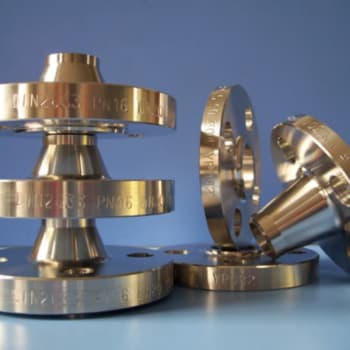
Where the Weld Neck Flange Wins
The weld neck flange is the default for severe service, and the reasons are mechanical rather than cosmetic:
- High pressure. In Class 900, 1500 and 2500 systems, the hub transition keeps peak stress at the joint lower than a slip-on fillet arrangement can manage.
- Cyclic loading and thermal cycling. The smooth stress flow through the tapered hub resists fatigue crack initiation far better than the abrupt section change of a slip-on.
- Severe service. Where the line carries corrosive or erosive media, the flush bore eliminates the crevice that a slip-on bore creates at the face weld.
- Inspection requirements. Butt welds are radiographable across the full section; the slip-on face weld is not.
Most plant specifications make the weld neck mandatory above a pressure class threshold and in all lines subject to vibration or thermal cycles, because the marginal cost of the hub is small next to the cost of a fatigue failure at a flange.
Where the Slip-On Flange Is the Right Buy
The slip-on flange survives in service because it is not always the wrong answer:
- Low to moderate pressure, Class 150 and 300, in non-cyclic water, air, and utility services.
- Fabrication speed. The pipe does not need precise end preparation; the flange is slipped on, tacked and fillet-welded quickly, which matters on large field-erected runs.
- Alignment tolerance. Slip-ons are forgiving when pipe runs are slightly off, which is why they dominate structural and low-pressure piping in plants.
- Cost. The per-piece price and the welding hours are both lower, and on a large order the difference is real money.
The rule of thumb used by most piping designers: slip-on below the fatigue-critical threshold, weld neck everywhere the joint must behave like the pipe itself.
The Crevice Question Nobody Mentions on Datasheets
A slip-on flange leaves a small gap between the pipe OD and the flange bore, capped by the face fillet weld. In chloride-bearing or corrosive media, that crevice can concentrate attack, and the face weld, which cannot be fully radiographed, carries the burden of sealing it.
For corrosion-resistant alloy lines - duplex, nickel alloys, high-alloy stainless - the flush bore of a weld neck is frequently specified not for pressure reasons but for this single crevice concern. If the line carries chlorides at temperature, ask for weld neck and end the argument before it starts.
Dimensional and Pressure Considerations per ASME B16.5
Both types are manufactured to the same ASME B16.5 facing, bolt circle and pressure-temperature ratings, so a weld neck and a slip-on of the same size and class bolt to the same companion.
The dimensional difference is internal: weld neck bore matches the specified pipe schedule and carries an identified wall-thickness compatibility rule, while slip-on bores allow the pipe to slide with a designed clearance. For wall thickness and hub dimensions, the standard tables govern, and buyers should confirm the bore schedule on the enquiry so the flange actually matches the pipe ordered.
Buying Decision Checklist
Use the following sequence when building the requisition:
- Define the pressure class from the design conditions and the fluid class per the plant specification.
- Check cyclic duty: compressors, pumps, steam traps, thermal cycles, vibration sources - all push the decision to weld neck.
- Check the fluid: chlorides, corrosive media, or cleanliness requirements push the decision to weld neck for the crevice benefit.
- Compare the all-in cost: flange price plus welding plus inspection hours, not the flange price alone.
- Confirm the material, facing and bore schedule on the PO, and the test certificate required.
When the comparison is done honestly, most process lines above Class 300 and all alloy lines in corrosive service land on weld neck, and the slip-on earns its place in utility and low-pressure duty where its speed and cost are genuine advantages. That is the balance the code expects and the balance a disciplined buyer should reproduce.
FAQ
When is a weld neck flange mandatory?
Whenever the plant specification or the code design demands a joint that behaves like continuous pipe: high pressure classes (900 and above), cyclic or vibrating service, thermal cycling, and alloy lines where the flush bore matters. Most specs make weld neck mandatory on process lines above Class 300 and on all corrosive-medium lines.
How much more does a weld neck flange cost than a slip-on?
The flange itself typically costs 20 to 50 percent more per piece depending on size and class, and the butt weld adds preparation and inspection hours. On large-bore low-pressure runs the all-in difference can be significant, which is exactly why the slip-on survives; on process lines the fatigue and crevice benefits repay the difference quickly.
Can a slip-on flange be used on stainless or nickel-alloy pipe?
It can be, but the crevice between the pipe OD and the flange bore concentrates chloride attack, and the face fillet weld cannot be fully radiographed. For duplex, nickel and high-alloy lines in corrosive media, the flush bore of a weld neck is the standard specification.
Does a slip-on flange have the same pressure rating as a weld neck?
Yes. Both are rated to the same ASME B16.5 pressure-temperature tables for the same size and class, and both bolt to the same companion flange. The difference is in cyclic capability, stress concentration and crevice behaviour, not in the static pressure rating.
What bore schedule should I order for a weld neck flange?
The hub bore must match the pipe wall thickness class so the butt weld transitions cleanly. State the pipe schedule on the flange PO and confirm the bore on the dimensional check, because a weld neck bored for a lighter schedule than the pipe cannot be welded correctly.


