


Inconel 601 pipe, UNS N06601 with W.Nr. 2.4851 and EN designation NiCr23Fe, is the nickel-chromium-iron alloy that furnace engineers reach for when a radiant tube, a muffle, or a hanger has to survive a decade of heat cycling. Its defining trait is not room-temperature strength, and it is not resistance to aggressive liquid chemicals.
It is oxidation resistance that holds up to roughly 1150 deg C in continuous service and 1200 deg C for shorter exposure, delivered by an aluminum addition that most competing alloys simply do not carry. That aluminum, at 1.0 to 1.7 percent, changes the high-temperature story completely: it grows a slow, adherent Al2O3 layer beneath the chromium oxide scale, and that inner alumina film is what keeps the metal from being eaten away over thousands of hours.
Chemical Composition (ASTM B167 / B168, UNS N06601)
The composition below is the acceptance window of the specification. The two numbers that define the alloy are nickel at 58 percent minimum and the deliberate aluminum addition; the aluminum is the element absent from Inconel 600 that changes the oxidation behaviour so dramatically.
| Element | Min % | Max % |
| Nickel (Ni) | 58.0 | 63.0 |
| Chromium (Cr) | 21.0 | 25.0 |
| Aluminum (Al) | 1.0 | 1.7 |
| Iron (Fe) | Balance | |
| Carbon (C) | - | 0.10 |
| Manganese (Mn) | - | 1.0 |
| Silicon (Si) | - | 0.50 |
| Sulfur (S) | - | 0.015 |
| Copper (Cu) | - | 1.0 |
Read the chemistry against the job. The chromium level, 21 to 25 percent, is what Inconel 600 also carries, and it supplies the primary Cr2O3 scale. The aluminum is the difference: above roughly 800 deg C it oxidizes selectively and forms a continuous alumina layer that grows far more slowly than chromia and resists spallation under thermal cycling.
The low sulfur cap at 0.015 percent matters in furnace atmospheres, where sulfur in the alloy itself would otherwise degrade the protective scale. The carbon limit of 0.10 percent is a practical ceiling, not a hardening tool; 601 derives its high-temperature strength from solid-solution hardening, not precipitation.
Mechanical Properties at Room Temperature (Annealed)
The annealed minimums below are the B167 acceptance limits. Typical mill values run higher, but design work on pressure piping should be done on the code allowable stresses of ASME Section II Part D for SB167 rather than on typical values.
| Property | Minimum Requirement |
| Tensile Strength | 550 MPa (80 ksi) |
| Yield Strength (0.2% offset) | 205 MPa (30 ksi) |
| Elongation in 50 mm (2 in) | 30% |
At room temperature these figures look ordinary, and that is the point: 601 is not bought for cold strength. Its tensile strength is retained unusually well at temperature. At 650 deg C the annealed alloy still shows roughly 420 to 480 MPa tensile strength in typical data, and at 870 deg C it retains a meaningful fraction of its load-carrying ability, which is why furnace components can be designed with thin walls in this alloy rather than the heavy sections that 310 stainless needs at the same duty.
Physical Properties
| Property | Value |
| Density | 8.11 g/cm3 |
| Melting Range | 1360 - 1411 deg C |
| Specific Heat (20 deg C) | 450 J/kg.K |
| Thermal Conductivity (20 deg C) | 11.2 W/m.K |
| Modulus of Elasticity (20 deg C) | 214 GPa |
The density of 8.11 g/cm3 feeds the standard weight formula for nickel-alloy seamless pipe: kg/m = 0.02765 x (OD - WT) x WT with dimensions in millimetres, a factor slightly above the 0.02466 used for stainless steel. Note the low thermal conductivity: heat that a carbon steel furnace part would shed quickly has to be managed with wall thickness and geometry in 601 components, which is a standard consideration in radiant tube design.
The Oxidation Mechanism: Why the Aluminum Row Matters
All heat-resistant alloys rely on a surface oxide to slow further attack. Chromium-only alloys such as Inconel 600 and 310 stainless form Cr2O3, which is protective but prone to spalling when the furnace cycles between hot and cold: the scale cracks, lifts, and sheds, exposing fresh metal that burns again.
Inconel 601 adds the alumina layer. Aluminum oxidizes preferentially beneath the chromia, forming a continuous Al2O3 film that is thermodynamically more stable and grows several times more slowly. When the outer scale spalls on a thermal cycle, the alumina film stays in place and re-heals the chromia above it.
- Continuous oxidation resistance to approximately 1150 deg C in air, with short excursions to 1200 deg C.
- Outstanding cyclic oxidation performance: the alumina inner layer survives thermal cycling that destroys simple chromia scales, making 601 the standard choice for batch furnace fixtures and radiant tubes.
- Resistance to oxidation in combustion products containing sulfur, within the envelope where the sulfur level is modest; severe sulfidizing atmospheres are better served by higher-chromium or higher-molybdenum alloys.
Carburization and Chlorine Service
Beyond plain oxidation, 601 holds up in two furnace atmospheres that defeat many alloys. In carburizing environments, the alumina layer suppresses carbon ingress: the alloy resists carburization up to about 1000 deg C in methane and hydrogen-rich mixtures, which is why 601 radiant tubes and reformer internals are specified where carbon pick-up would embrittle a stainless component.
Above roughly 1050 deg C the protective mechanism weakens as aluminum diffusion accelerates, so the carburization guarantee is tied to the temperature ceiling rather than to the atmosphere alone. In hot chlorine and hydrogen chloride service, the high nickel content (58 percent minimum) provides the same immunity to chloride attack that the nickel-base family is known for, extending 601 into chlorination reactor internals and waste-incineration gas paths.
Size Range, Schedules and Product Forms
| Product Form | Standard | Typical Range |
| Seamless pipe | ASTM B167 | 1/4" to 12" NPS, SCH 10S to 160 and XXS |
| Welded pipe | ASTM B517 | larger diameters, furnace-grade welds |
| Heat-exchanger tube | ASTM B163 | up to 3" OD, various wall thicknesses |
| Plate, sheet and strip | ASTM B168 | 0.5 mm strip to heavy plate |
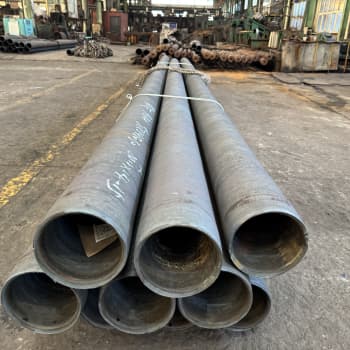
Seamless pipe is the dominant form for furnace and process piping because the drawn seamless wall has no weld seam to compromise at temperature. Sizes follow ASME B36.10 for standard pipe and B36.19 for stainless-pattern schedules. For furnace radiant tubes, pipe is frequently ordered to a specific OD and wall in millimetres rather than to a nominal schedule, because the wall is a thermal-design parameter as much as a pressure parameter.
Key Applications
- Furnace radiant tubes and muffle tubes in heat-treating and annealing lines.
- Fixtures and hangers for batch furnaces, where thermal cycling spalls ordinary scales.
- Reformer and cracking furnace internals in petrochemical service.
- Thermocouple protection tubes and burner components.
- Waste incineration gas path piping, where chlorine compounds are present.
- Glass and ceramics manufacturing hardware, and gas turbine combustor liners.
Welding and Fabrication
Inconel 601 welds readily with matching-composition filler such as ERNiCrFe-2 or ERNiCr-3, and no preheat or post-weld heat treatment is required. The alloy is fully austenitic, so weld joints do not suffer the ferrite-balance restrictions that austenitic stainless welds carry. Two fabrication cautions apply.
First, the oxide on annealed pipe is tenacious: joints should be cleaned to bright metal before welding, and the area immediately around a weld should be protected from oxidation if the component will serve in a cyclic furnace. Second, the alloy work-hardens rapidly, so cold bending requires heavier equipment than stainless of the same size, and tight-radius bends are better formed hot above roughly 870 deg C when the geometry allows.
Ordering and Inspection Notes
The alloy is sold under several trade names, and the certificate is the only reliable identity check. When ordering, specify UNS N06601 (not a brand name alone), the product standard B167 or B517 or B168, the condition (solution annealed), the size and schedule or exact OD x WT, and the length tolerance.
On receiving, verify three things: the mill certificate must state UNS N06601 with the heat analysis showing the 1.0 to 1.7 percent aluminum, the mechanical results must clear the B167 minimums, and for furnace-grade material the specification of the surface condition (annealed and pickled) should be confirmed, because a heavily oxidized as-hot-rolled surface can affect initial furnace behaviour.
For code pressure piping, request SB167 with the applicable ASME Section II Part D allowable stress table and EN 10204 3.1 certification where the project requires full traceability.
Inconel 601 pipe earns its place wherever the component is defined by oxidation life rather than by liquid corrosion or by cold strength. The aluminum addition, the flat retained strength at temperature, and the resistance to carburization and chlorine make it the default choice for furnace hardware across the heat-treating, petrochemical, and waste-to-energy industries, at a cost well below the precipitation-hardened superalloys that occupy the same temperature range.
FAQ
What temperature can Inconel 601 pipe withstand in service?
In continuous oxidizing service the alloy is used to approximately 1150 deg C, with short-term exposure to about 1200 deg C. The practical ceiling for long-life furnace components is set by oxidation rate and by the carburization limit of roughly 1000 deg C in carbon-rich atmospheres.
How is Inconel 601 different from Inconel 600?
The composition is nearly identical except for the aluminum addition, 1.0 to 1.7 percent in 601 versus a trace in 600. That aluminum grows an alumina layer that resists spallation under thermal cycling, so 601 outperforms 600 in cyclic furnace service above about 1000 deg C even though the two alloys look alike on paper.
Is Inconel 601 pipe weldable?
Yes. Matching filler such as ERNiCrFe-2 or ERNiCr-3 is used, with no preheat and no post-weld heat treatment. The fully austenitic structure means no ferrite-balance restrictions, but the surface oxide must be cleaned to bright metal before welding.
Can Inconel 601 replace 310 stainless steel in furnaces?
In many duties yes, and with thinner walls: 601 retains load-carrying strength much higher into the temperature range and resists cyclic spallation better than 310S. The trade-off is cost, so the replacement is justified where 310S life is the limiting factor.
What standards cover Inconel 601 pipe?
Seamless pipe is ASTM B167 / ASME SB167, welded pipe is ASTM B517, heat-exchanger tube is ASTM B163, and plate, sheet and strip are ASTM B168. EN designation NiCr23Fe, W.Nr. 2.4851, UNS N06601.


