


Reducers change the pipe size, and the choice between a concentric and an eccentric reducer is one of those small decisions that quietly decides whether a piping system drains properly, runs without trapped gas, and survives thermal cycles. Both are manufactured to ASME B16.9, both are butt-welding fittings, and both cost nearly the same.
The difference is in the centreline geometry, and that geometry controls where liquid pools, where gas collects, and how the pipe sits in its supports. This article explains the two designs, the code rules that govern their use, and the buying logic that gets the right fitting onto the requisition.
The Geometry Difference
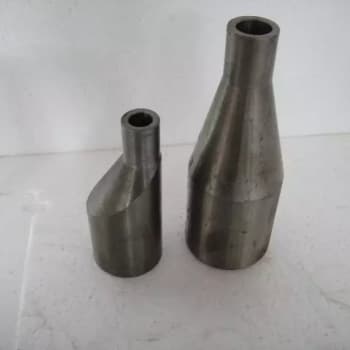
A concentric reducer keeps the centreline of the large end and the small end in the same axis: the fitting shrinks evenly on all sides, like a truncated cone. An eccentric reducer offsets the small end so that one side of the fitting is flat - either the top (eccentric flat-on-top) or the bottom (eccentric flat-on-bottom) - and the centreline shifts across the fitting.
| Feature | Concentric reducer | Eccentric reducer |
| Centreline | Stays centred | Shifts; one side is flat |
| Orientation | Any rotation | Flat-on-top or flat-on-bottom must be chosen |
| Drainage | Poor - liquid pools at the step | Flat-on-bottom drains fully |
| Venting | Poor - gas collects at the step | Flat-on-top vents fully |
| Stress flow | Symmetric, gradual | Asymmetric; check line layout |
The practical rule is short: in liquid service the flat goes on the bottom so the line drains; in gas or steam service the flat goes on the top so condensate and trapped vapour can escape; in vertical lines either works and concentric is the usual default.
Code Rules and Industry Practice
ASME B31.1 and B31.3 do not forbid concentric reducers in horizontal lines, but both the code commentary and decades of plant operating experience push designers toward eccentric reducers wherever draining or venting matters. The classic cases:
- Pump suction lines, where an eccentric reducer flat-on-top prevents vapour pockets that can cause cavitation at the impeller.
- Steam and condensate lines, where flat-on-top allows condensate to drain back instead of collecting against a concentric step.
- Drain and vent lines, where the flat-on-bottom arrangement guarantees complete draining at shutdown.
- Instrument impulse lines, where trapped gas or liquid corrupts the reading and the orientation must be drawn, not assumed.
The orientation is a drawing discipline: the wrong rotation of an eccentric reducer - flat-on-top where flat-on-bottom is required - is one of the most common field errors in piping construction, and it is invisible once the insulation goes on.
Where the Concentric Reducer Is Correct
The concentric reducer is not a mistake; it is the correct fitting in a defined set of situations:
- Vertical lines, where there is no drainage or venting issue and the symmetric stress flow is an advantage.
- Sections where the flow is fully turbulent and any pooling is carried away by the flow itself.
- Vent lines discharging upward, where the flat would serve no purpose.
- Where the supplier standardizes on concentric for stock and the service is dry or self-draining by design.
Choosing concentric in a horizontal wet line is not a code violation, but it is an operating cost: every shutdown leaves liquid sitting against the step, and in corrosive or freeze-prone service that pool is a maintenance event waiting to happen.
Dimensional and Material Notes per ASME B16.9
ASME B16.9 governs the outside diameter, wall thickness, length and end tolerances of both reducer types. Standard reducers are available in the same schedule families as the pipe, and the transition length follows the standard table for the size combination. For alloy and high-pressure service, the fitting should be ordered to the same material specification and heat-traceability requirement as the pipe, and buyers should state the schedule explicitly: a reducer bought to the wrong wall for the adjoining pipe is a field weld fit-up problem before it is a pressure problem.
Buying Checklist for Reducers
Work through these points before raising the purchase order:
- Confirm the size combination and schedule on both ends against the line list.
- Decide concentric or eccentric from the service: horizontal liquid lines flat-on-bottom, horizontal gas lines flat-on-top, vertical lines concentric.
- State the orientation on the drawing and on the PO if the fitting is eccentric.
- Match material and certificate requirements to the pipe specification.
- Confirm the wall thickness class and the end tolerance requirement for fit-up.
The reducer is a small fitting with a disproportionate effect on system behaviour. Selecting it with the drainage and venting logic above - rather than reaching for whichever type is in stock - is the difference between a line that drains and a line that hides water, gas, and maintenance cost behind its insulation.
FAQ
Which reducer goes on a pump suction line?
An eccentric reducer with the flat side on top. Keeping the top of the pipe level prevents vapour pockets from forming at the reducer, which is the leading cause of pump cavitation on suction lines. The flat-on-top orientation is the standard for pump suctions in both liquid and steam service.
Should the flat of an eccentric reducer face up or down in a horizontal steam line?
Flat on top. Steam and condensate lines use eccentric reducers flat-on-top so condensate drains back toward the low point instead of pooling against the step of a concentric reducer, where it can hammer and erode the fitting.
Can a concentric reducer be used on a vertical line?
Yes. In vertical lines there is no drainage or venting concern, and the symmetric, gradual geometry of a concentric reducer is the usual default. The eccentric choice matters almost exclusively in horizontal runs.
What happens if an eccentric reducer is installed with the flat on the wrong side?
The fitting seals and holds pressure, but the line no longer drains or vents as designed: liquid pools where it should not, or vapour pockets form where the pump expects liquid. Because the error is invisible once insulation is fitted, it is one of the most common field mistakes in piping construction.
Are concentric and eccentric reducers made to the same dimensional standard?
Yes. Both are manufactured to ASME B16.9 with the same outside diameters, wall thicknesses, lengths and end tolerances for a given size combination. The only difference is the centreline geometry, which is why the choice is made on drainage and venting logic rather than on dimensions.


