


Hydrochloric acid is the most aggressive common industrial acid, and it does not respect material selection rules that work elsewhere. Stainless steels fail by pitting within weeks, carbon steel dissolves, and even many nickel alloys fall apart quickly. The alloys that survive hydrochloric acid are few, and each covers only part of the concentration-temperature envelope.
Product Forms
Bar & Rod
Plate & Sheet
Coil & Strip
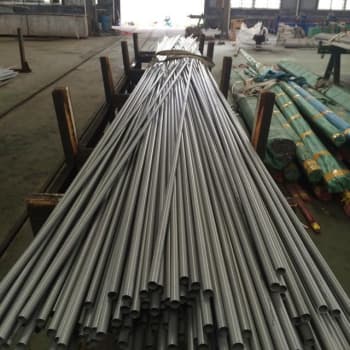
Pipe & Tube
Fitting: Flange, Tee, Elbow, Reducer etc.
Forging: Ring, Shaft, Circle, Block etc.
Why Hydrochloric Acid Is So Destructive
Hydrochloric acid is a reducing acid: it attacks metal by dissolving the protective oxide film rather than by oxidizing the surface. Stainless steels depend on a chromium oxide passive film, which HCl strips away, leaving the alloy to corrode uniformly and pit. The chloride ion also breaks down passivity locally, which is why pitting and crevice corrosion appear so quickly.
Materials that survive HCl do so either because they have no passive film to lose (nickel and its alloys) or because they are cathodically protected (some reactive metals). The practical consequence: the chromium that makes stainless steel corrosion-resistant elsewhere is a liability in HCl service.
The Alloys That Work, and Their Limits
| Material | HCl service range | Primary limit |
| Hastelloy B-3 (N10675) | All concentrations up to boiling point | Fails in oxidizing media; no chromium oxide film |
| Hastelloy C-276 (N10276) | Moderate concentrations, dilute to ~20% at low temp | Attacked by hot concentrated HCl |
| Zirconium (R60702) | All concentrations, very high temperatures | Cost; needs oxidizing impurities avoided |
| Rubber-lined carbon steel | Dilute to moderate, low temperature | Temperature and mechanical limits of lining |
| PTFE-lined / plastic systems | All concentrations at ambient | Temperature and pressure limits of the plastic |
B-3 vs C-276: The Key Decision
The two nickel alloys most often considered for HCl service are B-3 and C-276, and they are opposite in philosophy.
B-3 is a nickel-molybdenum alloy with almost no chromium: it survives hydrochloric acid at any concentration, but in oxidizing service it corrodes rapidly.
C-276 carries chromium (about 15-16%) and molybdenum (about 15-17%), which gives it a passive film and resistance to oxidizing media - but that chromium also makes it vulnerable to hot concentrated HCl.
The decision rule is simple: if the service is pure reducing acid (HCl without oxidizing contaminants), B-3 is the better alloy. If the stream can be oxidizing - air ingress, ferric or cupric chlorides, nitric acid traces - C-276 is safer because it keeps a passive film. Mixed environments are the classic trap: a "HCl line" that also sees oxidizing impurities can destroy B-3 equipment in weeks.
The Non-Metallic Alternatives
Not every HCl line needs a nickel alloy. Below about 60-80 C, rubber-lined carbon steel and plastic-lined systems (PTFE, PP, PVC) handle most concentrations at a fraction of the cost, which is why storage tanks and dilute acid lines are usually lined rather than solid alloy.
FRP (fiber-reinforced plastic) works for low-pressure ambient service. The limits are mechanical: linings fail at flanges and welds if thermal cycling is severe, and plastics lose strength quickly above 80 C.
The economic question is a crossover curve - lined systems win for large-diameter, low-temperature, low-pressure service; solid nickel alloy wins for small-bore, hot, high-pressure or cyclic service where linings cannot survive.
Other Reducing Environments
The same selection logic applies beyond HCl. Sulfuric acid at concentrations above about 60% and temperatures above about 60 C is a reducing service where B-type alloys shine, while the dilute low-temperature regime is handled by Alloy 20 or even stainless.
Phosphoric acid (wet process) is aggressive but contains enough oxidizing species that C-276 is often preferred over B-3. Acetic acid and other organic acids are much less demanding - 316L and Alloy 20 cover most service.
The message: name the acid, the concentration, the temperature and the oxidizing species before anyone can recommend a material. A datasheet without those four numbers is marketing, not engineering.
Selection Checklist
- Identify the acid, concentration, temperature and any oxidizing species in the stream.
- If the service is pure reducing acid at high severity: consider Hastelloy B-3.
- If oxidizing species are present: consider Hastelloy C-276 or a C-family alloy instead.
- For large-bore, low-temperature, low-pressure HCl: compare lined carbon steel before committing to solid alloy.
- For very hot, very concentrated HCl: zirconium is the only metal that stays competitive - but confirm oxidizing impurities are absent.
- Always specify the four service parameters on the material inquiry, and require the supplier to confirm the alloy choice.
What Buyers Get Wrong
- Assuming "nickel alloy" is one family - B-3 and C-276 behave oppositely in HCl, and swapping one for the other changes the corrosion result completely.
- Specifying C-276 for hot concentrated HCl "to be safe," when B-3 is the actual survivor and C-276 will corrode.
- Forgetting that air ingress turns an HCl line oxidizing - the alloy that worked in the lab test fails in the field.
- Ordering solid alloy for a large tank where a rubber-lined carbon steel tank would cost a fraction and last as long.


