


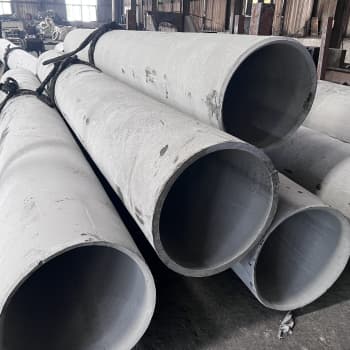
The two pipes look the same on the outside. Both are austenitic stainless, both ship with similar mechanical certificates, both are called "stainless steel" on the enquiry. Then the quotation arrives and 904L costs two to three times as much as 316L - and the buyer has to decide whether that multiplier is engineering necessity or overspecification.
This comparison breaks the decision into the numbers that actually separate the grades: chemistry, pitting resistance, chloride behaviour, acid resistance, and the service conditions that make the upgrade pay for itself.
Product Forms
Bar & Rod
Plate & Sheet
Coil & Strip
Pipe & Tube
Fitting: Flange, Tee, Elbow, Reducer etc.
Forging: Ring, Shaft, Circle, Block etc.
The chemistry difference in one table
| Element | 316L (typical) | 904L (UNS N08904) | What changes |
| Chromium | 16 - 18% | 19 - 23% | Higher passive-film stability |
| Nickel | 10 - 14% | 23 - 28% | Better toughness and chloride behaviour |
| Molybdenum | 2 - 3% | 4 - 5% | The pitting element - roughly doubles the Mo |
| Copper | Not specified | 1 - 2% | Resistance to reducing acids (sulphuric, phosphoric) |
| Nitrogen | 0.10% max | 0.04 - 0.06% | Small but counts in the PREN formula |
The 904L grade is sometimes classed as a "super-austenitic" or lean super-austenitic stainless, UNS N08904 / 1.4539 (EN X1NiCrMoCu25-20-5). The extra nickel, molybdenum and copper are not decoration - each one buys a specific corrosion property that 316L cannot reach by polishing or passivation.
PREN and CPT: the two numbers that separate them
The pitting resistance equivalent number (PREN) is calculated as Cr + 3.3 x Mo + 16 x N. Applying typical chemistry: 316L lands around 24 - 26, 904L around 34 - 38. That is not a small difference - it is the difference between a material that pits in warm seawater and one that survives it. The critical pitting temperature (CPT) makes it practical: 316L typically pits in seawater above roughly 15 - 25°C, while 904L resists pitting up to about 40 - 50°C in the same environment. Every degree of chloride service temperature is a step toward the 904L side of the line.
Why the price gap exists
| Driver | 316L | 904L | Effect on price |
| Nickel content | 10 - 14% | 23 - 28% | Nickel is the dominant alloy cost - roughly double |
| Molybdenum | 2 - 3% | 4 - 5% | Mo adds a further premium |
| Copper | None | 1 - 2% | Small additional cost |
| Availability | Standard stock | Longer lead, fewer mills | Supply adds to landed cost |
The price multiplier of 2 - 3x is real and persistent, which is why the question "can 316L do it?" must be answered honestly before upgrading. Overspecification is not harmless - it multiplies the cost of every metre of pipe and every fitting on the same line.
When 316L is the right answer
- Clean, low-chloride process fluids with temperatures below about 50°C
- Atmospheric and general corrosive service with routine inspection
- Food, pharmaceutical and light chemical duty where the requirement is hygiene and cleanability
- Where the system is designed so that chlorides are excluded or diluted
316L remains the workhorse because it is readily available, weldable, formable, and adequate for the majority of piping duties. The question is not whether 316L is "good" - it is whether the specific line stays inside its envelope.
When 904L becomes the cheaper choice
- Warm chloride service - seawater, brines, chloride-bearing process streams above about 25 - 30°C
- Sulphuric and phosphoric acid exposure, where the copper addition resists reducing acids that attack 316L
- Pitting and crevice environments where a single failure costs more than the upgrade (heat exchangers, offshore, flue-gas duty)
- Where inspection and shutdown for repairs are expensive - the premium buys campaign life
The economic logic flips when failure is expensive: one unplanned shutdown, one leaking exchanger, one contaminated batch pays for the difference between the two grades many times over.
The mechanical picture (pipe per ASTM A312)
| Property | 316L | 904L |
| Tensile strength (MPa) | 515 min | 490 min |
| Yield strength 0.2% (MPa) | 205 min | 220 min |
| Elongation (%) | 35 - 40 min | 35 min |
| PREN (typical) | 24 - 26 | 34 - 38 |
Mechanically the two grades are close; the selection is driven by corrosion, not strength. That is the opposite of most alloy selections and it is why buyers comparing tensile numbers alone pick 316L and then wonder why the exchanger leaks.
Fabrication: no free lunch on the upgrade
- Weld filler: 904L should be welded with over-alloyed filler (typically 625-type, ERNiCrMo-3) to match corrosion resistance - never with 316L filler
- Heat input and interpass: keep them low, as with any corrosion-critical austenitic weld
- Pickling after welding: required for chloride service to restore the passive film on both grades
Buying 904L pipe and welding it with 316L filler saves money for exactly one week - until the weld is the first place the chloride finds.
A three-question test before upgrading
- What is the maximum chloride concentration and temperature the line can see in normal and upset service?
- What happens when one pipe or weld fails - cost of lost production, safety, environmental exposure?
- Is the budget comparison made over the full campaign life, including inspection and repair, or only at purchase?
If the answer to the first question is "below the 316L envelope" and the second is "a cheap repair", 316L is the engineering answer. If the chloride is warm, the acid is reducing, or a failure is expensive, the 904L multiplier stops being a cost and becomes the cheaper material over the life of the plant.
FAQ
Q: Is 904L simply a higher-alloy version of 316L?
A: Not exactly. 904L raises chromium, nickel and molybdenum and adds copper - the copper specifically buys resistance to reducing acids that 316L lacks. It is classed separately (UNS N08904) and, in some applications, behaves like a lean super-austenitic.
Q: Can 904L replace 316L in every service?
A: No. 904L is better in chlorides and reducing acids, but it costs two to three times more. In clean, low-chloride service 316L is the economic choice; upgrading without a corrosion driver is overspending.
Q: What filler should be used to weld 904L pipe?
A: Over-alloyed nickel filler, typically 625-type (ERNiCrMo-3). Welding 904L with 316L filler creates a weld zone that pits in the same chloride service the pipe was bought to survive.
Q: What does PREN 34 - 38 mean in practice for 904L?
A: It places 904L well above 316L (PREN 24 - 26) and close to duplex grades, with a critical pitting temperature in seawater around 40 - 50°C versus 15 - 25°C for 316L - a practical margin in warm chloride service.


