


Hastelloy C-22 is the rare alloy that refuses to be boxed in: its nickel-chromium-molybdenum-tungsten balance was engineered to hold up on both sides of the acid spectrum at once, and it has been the default answer for chemical-process environments where the service defies clean classification.
This is the complete profile of the grade - the chemistry and what every element contributes, the mechanical envelope, the corrosion map drawn medium by medium, the temperature behaviour that decides weld and service life, the standard family, welding, applications, and the procurement notes that separate a sound C-22 order from a costly guess.
Product Forms
Bar & Rod
Plate & Sheet
Coil & Strip
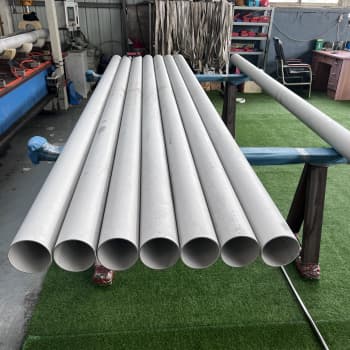
Pipe & Tube
Fitting: Flange, Tee, Elbow, Reducer etc.
Forging: Ring, Shaft, Circle, Block etc.
Where C-22 sits in the Hastelloy C family
The C family is the workhorse of wet-corrosion nickel alloys, and its three most specified members are distinguished by one design decision each. C276 was the original broad-spectrum member - nickel with roughly 16% chromium and 16% molybdenum, built to survive the worst reducing environments and most chlorides.
C2000 pushed chromium up to 23% to add oxidizing-acid capability. C-22, the middle child, balances roughly 22% chromium against 13% molybdenum and 3% tungsten to widen the middle of the map: it keeps most of C276's reducing-acid performance while resisting oxidizing media - ferric and cupric salts, nitric acid, wet chlorine - far better than its older sibling.
That balance, not any single headline number, is the reason C-22 out-specifies C276 in modern chemical plant. The practitioner's rule of thumb: when the process stream contains chlorides plus an oxidizer - the combination that defeats both stainless steel and C276 - C-22 is the alloy the specification lands on.
Chemistry: what each element buys in C-22
| Element | Nominal (wt %) | Range (wt %) | The job it does |
| Nickel | 56 | Balance | The matrix - chloride SCC immunity and reducing-medium stability |
| Chromium | 22 | 20.0 - 22.5 | Oxidizing-acid resistance and the passive film; the element C276 lacks |
| Molybdenum | 13 | 12.5 - 14.5 | Pitting, crevice and reducing-acid resistance |
| Tungsten | 3 | 2.5 - 3.5 | Adds strength at temperature and localized-corrosion margin |
| Iron | 3 | 2.0 - 6.0 | Cost control; kept low to preserve the nickel personality |
| Cobalt | 2.5 max | - | Controlled by specification |
| Carbon | 0.015 max | - | Ultra-low - keeps the weld zone free of harmful carbide networks |
| Vanadium | 0.35 max | - | Minor addition for structure control |
The column that matters is the pair chromium plus molybdenum: 22% chromium and 13% molybdenum in one alloy is a deliberate compromise that no other common nickel alloy strikes. Chromium fights oxidizing acids; molybdenum fights reducing acids and chlorides. Where they overlap, C-22 covers media that would send most alloys to two different specifications - and that is exactly the territory of modern chemical process streams.
Mechanical and physical properties (pipe per ASTM B622)
| Property | Minimum | Notes |
| Tensile strength | 690 MPa (100 ksi) | Solution-annealed pipe per B622 |
| Yield strength 0.2% | 283 MPa (41 ksi) | Solution-annealed pipe |
| Elongation | 40% | Ductile and fabricable |
| Hardness | ~95 HRB | Typical annealed range |
| Density | ~8.69 g/cm³ | Melting range ~1325 - 1400°C |
The strength numbers are modest by design - C-22 is not a structural alloy, and nobody buys it for yield. Its mechanical role is to be fabricable: it cold-forms, machines and welds predictably, which is what allows fabricators to build the reaction vessels and pipe systems that carry the corrosion duty.
The corrosion map, medium by medium
This is the table that matters on a C-22 datasheet - not the tensile row. Read it as a service map, and notice where C-22 sits versus the alloys it replaces.
| Environment | C-22 performance | How it beats the alternative |
| Hydrochloric acid (dilute to moderate) | Excellent | Molybdenum does the work; usable where stainless fails outright |
| Sulphuric acid (broad range) | Excellent | Holds both dilute and hot concentrated conditions within limits |
| Nitric acid and oxidizing media | Good to excellent | The 22% chromium beats C276 and most nickel alloys here |
| Wet chlorine, chlorine dioxide | Excellent | A signature C-22 service - bleach plants, chlorine handling |
| Hypochlorite and chlorate solutions | Excellent | Oxidizing chlorides - the combination that defeats most alloys |
| Ferric and cupric chloride | Excellent | Classic oxidizing-chloride test media; C-22 survives |
| Seawater and chloride service | Excellent | PREN in the mid-60s range; effectively no pitting in service |
| Mixed acids (acid + oxidizer + chloride) | Excellent | The real-world stream that C-22 was designed for |
| Caustic solutions | Good | Nickel content carries caustic duty |
The pattern is the point: there is no row on this map where C-22 is merely adequate. Other alloys have one or two strong rows; C-22 fills the whole grid, which is why engineers specify it when the stream composition varies - batch processes, upset conditions, and plants that cannot predict tomorrow's chemistry.
Temperature, sensitization and why welding needs discipline
Above roughly 500°C, all nickel-chromium-molybdenum alloys begin to precipitate secondary phases - the carbides and intermetallic networks that drain chromium and molybdenum from the grain boundaries and reopen the corrosion attack. C-22 was formulated to widen this window compared to C276: its lower carbon and balanced additions slow the precipitation, but they do not eliminate it. The practical consequences are three:
- Welding must be done with matching filler (ERNiCrMo-10) and controlled heat input - the weld heat-affected zone is where sensitization risk lives
- The solution anneal after fabrication is the standard recovery: heat to roughly 1065-1100°C and quench rapidly, restoring the fully dissolved structure
- Long-term service above about 425-650°C in corrosive media should be reviewed - if the duty is both hot and corrosive, the design must account for phase precipitation over campaign life
In practice, C-22 is used overwhelmingly for wet-corrosion service below 400°C, where sensitization never becomes a factor. The weld discipline matters because the as-welded heat-affected zone, not the base metal, is the first place localized attack finds.
Standards and product forms
| Form | Standard | Notes |
| Seamless pipe / tube | ASTM B622 | UNS N06022, 2.4602 |
| Welded pipe / tube | ASTM B626 | Welded construction per the same composition |
| Bar / rod | ASTM B574 | Machined components and fasteners |
| Plate / sheet / strip | ASTM B575 | Vessel cladding, fabricated equipment |
| Forgings | ASTM B564 | Flanges and heavy-section parts |
The European designation is 2.4602 (NiCr22Mo13W); the universal UNS number is N06022. Plate is often specified for vessel cladding over carbon steel in chloride-corrosion service - a cost-effective way to put C-22 on the wetted surface without a solid-alloy vessel.
Welding C-22 correctly
- Use matching over-alloyed filler: ERNiCrMo-10 is the standard choice, keeping the weld metal at or above base-metal corrosion resistance
- Never substitute stainless filler - the weld becomes the corrosion weak point in exactly the service the alloy was selected for
- Control heat input and interpass temperature; keep the weld clean and purge the root for tube and vessel duty
- For chloride or oxidizing service, pickle or mechanically clean weld zones to restore the passive surface
- Heavy fabrications may be solution annealed after welding to recover the fully dissolved structure
Applications that justify the premium
- Chemical process plant handling mixed acids, chlorides and oxidizers - reactors, heat exchangers, piping
- Pulp and paper bleach plants - chlorine dioxide stages where stainless grades pit and C276 under-performs on the oxidizing side
- Pharmaceutical and fine-chemical manufacturing with batch chemistry that varies
- Pollution-control and flue-gas desulphurization - scrubber internals in hot chloride condensate
- Wet chlorine and chlorine-derivative production and handling
- Offshore and marine seawater systems where crevice corrosion would end a stainless alloy's life
- Vessel cladding and lining over carbon steel for large chloride-corrosion duties
Procurement notes that protect the order
- Name the full identity on the PO: ASTM B622 / UNS N06022 / 2.4602, seamless, solution annealed
- Confirm the anneal - solution annealed with the temperature and quench on the certificate, not merely "annealed"
- Request the heat number, full chemistry and mechanical results (EN 10204 3.1 or equivalent)
- For vessel cladding, specify the bonding standard and minimum sound cladding thickness
- Ask the supplier for the service boundary in writing - if the duty is hot, concentrated reducing acid at the extreme, C276 or C2000 may be the honest recommendation, and a good supplier says so before the order
The bottom line
Hastelloy C-22 costs more than stainless, more than duplex, more than most nickel alloys - and it earns the premium only where the stream combines chloride with oxidizer, or where batch chemistry cannot be guaranteed. In that territory it is not the expensive option; it is the only option that survives. For the engineer who owns a plant with unpredictable chemistry, C-22 is the specification that turns a maintenance problem into a campaign that runs to schedule.
FAQ
Q: Is Hastelloy C-22 the same as C276?
A: No. Both are nickel-chromium-molybdenum alloys, but C-22 raises chromium to 22% and rebalances molybdenum to 13%, gaining far better resistance to oxidizing media - wet chlorine, ferric and cupric salts, nitric acid - while keeping most of C276's reducing-acid performance.
Q: What does the 22 in C-22 refer to?
A: The nominal 22% chromium content - the element that gives the alloy its oxidizing-acid capability and its edge over C276 in media like wet chlorine and hypochlorite.
Q: Can C-22 be welded with C276 filler?
A: Not ideally. The correct filler is ERNiCrMo-10, matched to C-22's chemistry. Using C276 filler creates a weld zone with lower chromium than the base metal, weakening the oxidizing-acid performance right where it matters.
Q: Does C-22 need post-weld heat treatment?
A: Not for wet-corrosion service. The ultra-low carbon and balanced composition keep the heat-affected zone sound; heavy fabrications in critical duty are sometimes solution annealed for extra margin.
Q: What is the maximum service temperature for C-22?
A: C-22 is a corrosion alloy, not a high-temperature alloy. Its service territory is wet corrosion below roughly 400°C; above that, secondary phase precipitation and loss of corrosion resistance begin, and hot structural duty belongs to the high-temperature nickel grades instead.
Q: Is C-22 magnetic?
A: No. It is fully austenitic (face-centred cubic) and essentially non-magnetic in the annealed condition - a useful field check when material identity is in doubt.
Q: Where does C-22 stop being the right answer?
A: Hot, extremely concentrated reducing acids at the aggressive end, and applications needing high-temperature strength. For those, the C family's specialist members or the high-temperature nickel alloys take over. Within its wet-corrosion territory, C-22 is as close to a universal answer as the family offers.


