


Inconel 718 is the rare nickel alloy whose strength does not exist until the heat treater creates it. In the annealed condition it is a modest 1000 MPa-class material; after the two-step precipitation treatment it reaches 1270 MPa minimum tensile with a yield above 1030 MPa, and that difference is the entire reason the alloy is specified in rotating machinery and pressure equipment.
What Inconel 718 Is
Inconel 718 (UNS N07718, EN 2.4668) is a precipitation-hardenable nickel-chromium-iron alloy strengthened by two intermetallic phases: gamma double-prime (g″, Ni3Nb) as the primary hardening phase and gamma prime (g′, Ni3(Al,Ti)) as the secondary phase.
The alloy is unusual among nickel superalloys in that its age-hardening response is slow, which is exactly what makes it weldable without the cracking that plagues fast-aging alloys such as X-750. It keeps high strength from cryogenic temperatures up to about 650 °C (1200 °F), which is the working envelope most datasheets quote for long-term service.
| Item | Value |
|---|---|
| UNS number | N07718 |
| EN / Werkstoff number | 2.4668 |
| Common names | Inconel 718, Alloy 718, Nickel 718, NiCr19Fe19Nb5Mo3 (EN shorthand) |
| Family | Precipitation-hardenable Ni-Cr-Fe-Nb-Mo |
| Strengthening mechanism | g″ (Ni3Nb) primary + g′ (Ni3(Al,Ti)) secondary |
| Density | 8.19 g/cm3 (0.296 lb/in3) |
| Melting range | 1320–1390 °C (2410–2540 °F) |
| Usable service range | -250 °C to +650 °C long term |
Chemical Composition
The composition below is the standard acceptance envelope used by AMS 5662 / AMS 5663 and ASTM B637 for bars and forgings. Niobium is the defining element: it forms the Ni3Nb gamma double-prime precipitate during aging, and its range is controlled tightly because too little niobium reduces the hardening response while too much promotes segregation and Laves phase. Iron is not an impurity here but a deliberate balance element that slows the aging response and improves fabricability.
| Element | Min (%) | Max (%) | Role |
|---|---|---|---|
| Nickel + Cobalt (Ni+Co) | 50.0 | 55.0 | Base matrix; high-temperature strength |
| Chromium (Cr) | 17.0 | 21.0 | Oxidation and corrosion resistance |
| Iron (Fe) | Balance | - | Matrix balance; slows aging response for weldability |
| Niobium + Tantalum (Nb+Ta) | 4.75 | 5.50 | Forms g″; the primary hardening element |
| Molybdenum (Mo) | 2.80 | 3.30 | Solid-solution strengthening |
| Titanium (Ti) | 0.65 | 1.15 | Forms g′; co-precipitant |
| Aluminum (Al) | 0.20 | 0.80 | Forms g′; co-precipitant |
| Cobalt (Co) | - | 1.00 | Impurity limit in most specifications |
| Carbon (C) | - | 0.08 | Kept low to avoid carbide embrittlement |
| Manganese (Mn) | - | 0.35 | Impurity control |
| Silicon (Si) | - | 0.35 | Impurity control |
| Phosphorus (P) | - | 0.015 | Impurity control |
| Sulfur (S) | - | 0.015 | Impurity control; critical for hot workability |
| Copper (Cu) | - | 0.30 | Impurity limit |
| Boron (B) | - | 0.006 | Micro-alloy for grain-boundary strength |
The Precipitation Mechanism: Why Heat Treatment Creates the Strength
In the annealed condition Inconel 718 is a solid-solution alloy with moderate strength, roughly 1030 MPa minimum tensile in the AMS 5662 condition.
The precipitation heat treatment takes the alloy to 185 ksi (1276 MPa) minimum tensile because it forces two things to happen in the microstructure: the niobium, titanium and aluminum atoms, which are dissolved in the matrix after solution treatment, come out of solution as nanometre-scale Ni3Nb and Ni3(Al,Ti) particles; and those particles pin the dislocation movement that would otherwise allow plastic deformation.
The two-step aging cycle exists because the two phases respond at different temperatures: the first step at 1325 °F nucleates the g″ phase, and the second at 1150 °F lets it grow to the size that gives the optimum strength-toughness balance. Skipping or shortening either step leaves the alloy under-hardened, which is why heat-treatment records matter more for 718 than for almost any other nickel alloy.
Delivery Conditions: AMS 5662, AMS 5663 and AMS 5664
Three AMS conditions dominate procurement of Inconel 718 bars, forgings and pipe. They are the same chemistry; the difference is entirely the heat-treatment state, and each has a different job in the supply chain.
| Specification | Condition | Minimum Properties (room temp) | Typical Use in the Supply Chain |
|---|---|---|---|
| AMS 5662 | Solution treated (annealed) | UTS 1034 MPa (150 ksi) min, YS 517 MPa (75 ksi) min | Raw material for machining; soft enough to cut easily |
| AMS 5663 | Solution treated + precipitation hardened | UTS 1276 MPa (185 ksi) min, YS 1034 MPa (150 ksi) min, EL 12% min, RA 15% min | Service-ready rotating hardware and pressure parts |
| AMS 5664 | Higher-strength cold-worked + aged variant | Exceeds AMS 5663 on strength | Fasteners and parts needing maximum strength |
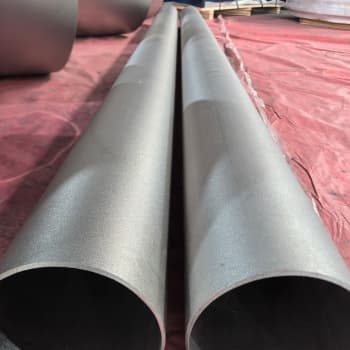
For piping and pressure equipment the procurement logic is: order AMS 5662 when the part must be machined or bent first and hardened later, and order AMS 5663 when the part is delivered in the final condition.
A common sourcing error is asking for AMS 5663 pipe and then machining or cold-bending it in-house, which work-hardens and may distort a part that was already at full strength; the correct route for machined-from-raw parts is AMS 5662 followed by a controlled aging cycle.
Heat Treatment Route
The standard precipitation hardening cycle per AMS 5663 is a two-step treatment. The solution treatment before aging dissolves the hardening elements and sets the grain size; the aging steps nucleate and grow the precipitates.
| Step | Temperature | Time / Cooling | Purpose |
|---|---|---|---|
| Solution anneal | 927–1010 °C (1700–1850 °F) | Hold per section size, air cool or faster | Dissolve Nb, Ti, Al; set grain size |
| Aging step 1 | 718 °C (1325 °F) | 8 hours | Nucleate g″ (Ni3Nb) phase |
| Aging step 2 | 621 °C (1150 °F) | Furnace cool from step 1; total aging time 18 h; air cool | Grow g″ and g′ to optimum size |
The 1325/1150 °F route is the AMS standard. A note for fabricators: the alloy shows a contraction of about 0.0008 in/in after precipitation hardening, so precision-machined dimensions should be set before aging or the contraction accounted for in the machining allowance.
Physical and Mechanical Data
The table below combines the physical constants with representative mechanical behaviour at temperature. The room-temperature minimums are contractual, the elevated-temperature figures are typical values for design guidance.
| Property | Value |
|---|---|
| Density | 8.19 g/cm3 |
| Modulus of elasticity, room temperature | 200 GPa (29 x 10³ ksi) |
| Mean CTE, 20–300 °C | 13.9 µm/m·K |
| Thermal conductivity, room temperature | 11.4 W/m·K |
| UTS, annealed (AMS 5662 min) | 1034 MPa |
| UTS, aged (AMS 5663 min) | 1276 MPa |
| YS, aged (AMS 5663 min) | 1034 MPa |
| Elongation, aged (AMS 5663 min) | 12% |
| Hardness, aged (typical) | 331 HBW min (approximately 36 HRC) |
High-Temperature and Cryogenic Behaviour
The same precipitation structure that gives 718 its room-temperature strength is stable to roughly 650 °C, which is why the alloy holds usable tensile and creep strength in the turbine and downhole range. Typical aged properties at 650 °C still show around 1100 MPa tensile, and stress-rupture performance is the reason 718 is the standard rotating-hardware alloy.
At the other end of the envelope, the austenitic matrix has no ductile-to-brittle transition, so the alloy is widely used in cryogenic tanks and valves down to liquid-hydrogen temperatures. This combination, high strength at both temperature extremes with weldability in between, is the reason no other nickel alloy matches its specification count in aerospace and oil-and-gas.
Welding and Fabrication
Inconel 718 is welded with matching nickel-base filler in the ERNiFeCr-2 class (AWS A5.14), the familiar Inconel 718 filler family. The alloy can be welded in either the annealed or the aged condition; the slow aging response means the heat-affected zone does not crack after welding the way fast-aging alloys do.
When welded in the annealed condition and then aged, the weld metal develops a large share of the base-metal strength, which is why weldments are normally designed as AMS 5662 material plus a post-weld aging cycle. Cold forming is straightforward in the annealed condition; aged material is strong enough that forming should be done before precipitation hardening. Machining notes mirror the other nickel alloys: rigid setup, positive feed, and sharp tools to avoid work hardening.
Standards and Product Forms
| Form | Governing Standard | Typical Range |
|---|---|---|
| Bar, rod, wire | ASTM B637 / AMS 5662, 5663, 5664 | Dia 6–300 mm |
| Seamless pipe and tube | AMS 5662-route, per project spec | OD 21.3–168.3 mm (NPS 1/2–6) |
| Plate, sheet, strip | ASTM B670 / AMS 5596, 5597 | Thickness 0.5–100 mm |
| Forgings and rings | ASTM B637 | Per drawing |
| Fasteners | AMS 5662/5663 + NACE MR0175 variants | Per drawing |
Applications
- Aerospace: turbine discs, compressor blades, engine shafts, casings and fasteners
- Rocket engines: turbopumps, housings, thrust components
- Oil and gas: downhole tools, MWD/LWD housings, pump shafts, safety valves, wellhead components per NACE MR0175 / API 6A CRA
- Cryogenic: LNG and hydrogen tanks, valves, transfer piping
- Nuclear: reactor internals and control-rod components
- Industrial: high-temperature springs, fasteners, dies and tooling
Common Procurement Mistakes
- Ordering AMS 5663 pipe and machining it in-house, losing the aged condition at the machined surface
- Assuming all 718 certificates are the same: the condition (annealed vs aged) must be stated on the PO
- Skipping the 1150 °F second aging step, which leaves the alloy under-hardened
- Ignoring the 0.0008 in/in aging contraction in precision dimensions
- Using a 625-class filler on 718, which changes the weld metal chemistry and reduces aged strength
FAQ
Q: What is the difference between AMS 5662 and AMS 5663 Inconel 718?
AMS 5662 is the solution-annealed condition with roughly 1034 MPa minimum tensile; AMS 5663 is the same material precipitation-hardened to 1276 MPa minimum tensile. Order 5662 for machining and forming, then age; order 5663 for service-ready parts.
Q: How is Inconel 718 hardened?
By a two-step age: 8 hours at 718 °C (1325 °F), then furnace cool to 621 °C (1150 °F) for a total aging time of 18 hours, then air cool. The treatment precipitates Ni3Nb (g″) and Ni3(Al,Ti) (g′) phases that pin dislocations.
Q: What temperature can Inconel 718 withstand?
Long-term service to about 650 °C (1200 °F), with good cryogenic performance down to -250 °C. Above 650 °C the g″ phase overages and strength drops.
Q: Is Inconel 718 weldable?
Yes, unusually so for a precipitation-hardened nickel alloy, because its aging response is slow. Use ERNiFeCr-2 filler; weld in the annealed condition and age afterward for near-base-metal weld strength.
Q: What standards cover Inconel 718?
ASTM B637 (bar and forgings), ASTM B670 (plate), AMS 5662/5663/5664 (aerospace conditions), plus NACE MR0175/ISO 15156 and API 6A CRA variants for oil and gas.
Q: Can Inconel 718 be used in sour service?
Yes, 718 is one of the few high-strength alloys listed in NACE MR0175/ISO 15156 for sour environments, with hardness limits that must be verified on the certificate


