


A 20 mm Monel K500 plate quotes roughly 15–20% above the same thickness in Monel 400. Buyers who refuse that premium assume it buys "better corrosion resistance." It does not. The two alloys share essentially the same nickel-copper chemistry, and in every medium that matters - seawater, HF, non-oxidizing acids, alkalis - their corrosion behaviour is close enough that a corrosion table cannot tell them apart. What the premium actually buys is strength: roughly three times the yield strength and about double the tensile strength, once the plate has been properly age-hardened.
That single clarification opens up everything else you need to know about Monel K500 plate as a product: what the aluminum and titanium additions physically do inside the metal, why the same plate ships in two very different strength levels, which ASTM standard actually covers plate (most pages get this wrong), and one surface phenomenon - a thin magnetic skin that can appear after aging - that catches buyers of non-magnetic components completely off guard.
We offers Monel K500 in a variety of forms, including:
- Bar
- Wire
- Sheet
- Plate
- Forgings
- Pipe fittings
- Flanges
- Seamless & Welded pipe
- Seamless Tube & Welded tube
- Weld Rod
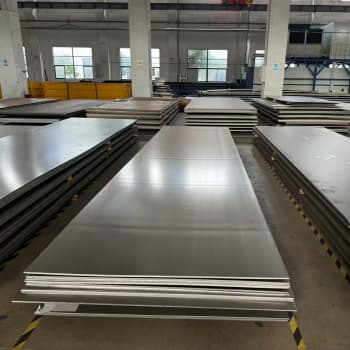
Two conditions, one product - the reading trap every SERP page falls into
Monel K500 plate is specified and supplied in two conditions: annealed and annealed + aged (the age-hardened condition). They are the same product, same UNS number, same chemistry - and their mechanical properties differ by a factor of two.
Here is the trap. Most datasheet pages - including high-ranking European data cards - quote 690 MPa minimum yield and 965 MPa minimum tensile as if they were generic K500 properties. Those are the aged-condition minimums. Annealed K500 plate sits at roughly half those numbers. If your design calculation assumes 690 MPa yield but the mill delivers the plate annealed because your PO did not state the condition, your factor of safety just halved on paper.
This is not an academic distinction. Condition is a PO field, not a datasheet footnote.
Table 1 - Chemical composition, Monel K500 (ASTM B868 / B865, UNS N05500)
|
Element |
Content (%) |
Role in the alloy |
|
Ni + Co |
63.0 min |
Corrosion-resistant matrix (same family as Monel 400) |
|
Cu |
27.0–33.0 |
Reducing-acid resistance; the "Monel" character |
|
Al |
2.30–3.15 |
γ′ former - the strength element |
|
Ti |
0.35–0.85 |
γ′ co-former, refines the precipitate |
|
Fe |
2.0 max |
Residual |
|
Mn |
1.5 max |
Deoxidation |
|
C |
0.25 max |
- |
|
Si |
0.50 max |
- |
|
S |
0.010 max |
- |
|
Density |
8.44 g/cm³ |
Weight math for plate (some pages quote 8.05–8.5 - use 8.44) |
|
W.Nr. |
2.4375 |
NiCu30Al |
What the aluminum and titanium actually do
In the annealed condition, Al and Ti sit dissolved in the nickel-copper matrix. Aging - a hold at roughly 593 °C for 16 hours followed by controlled cooling - forces them out of solution as a dense dispersion of sub-microscopic γ′ (Ni₃(Al,Ti)) precipitates. The precipitate particles are coherent with the matrix, which means dislocations cannot simply slide past them; they must cut through or loop around. That is the entire mechanism by which yield strength roughly triples, and it is why no amount of cold work in Monel 400 can ever reproduce K500's numbers.
The chain, in one line: Al + Ti in solution → 593 °C / 16 h age → coherent γ′ dispersion → yield ~345 → ~690 MPa.
Two practical consequences follow from the same mechanism.
First, the aged condition is not free of trade-offs: aging also raises hardness into the ~28–35 HRC band, which is exactly why sour-service specifications cap K500 hardness (NACE MR0175 lists the alloy with a 35 HRC limit for defined service).
Second, welding an aged plate locally re-dissolves the γ′ in the heat-affected zone unless the fabrication is re-aged afterward - which is why welded K500 fabrications are typically stress-relieved and re-aged, and why weldments in this alloy use ERNiCu-7 (FM 60) filler rather than a "stronger-looking" nickel-chromium wire.
Which ASTM standard covers plate? Most pages get this wrong
This is where the SERP for this keyword quietly fails its readers. The current top-10 pages, including otherwise detailed ones, map Monel K500 plate and sheet to ASTM B865. That is incorrect. B865 is the bar and rod standard. The plate/sheet/strip standard for UNS N05500 is ASTM B868.
Table 2 - Correct form-to-standard mapping, Monel K500
|
Product form |
Correct standard |
What SERP pages actually cite |
|
Bar and rod |
ASTM B865 |
✅ correct everywhere |
|
Plate, sheet, strip |
ASTM B868 |
❌ frequently mislabeled as B865 |
|
Forgings |
ASTM B865 / DIN 17754 |
mixed |
|
Weld wire |
ERNiCu-7 (FM 60) |
correct |
|
Weld electrode |
ENiCu-7 (FM 190) |
correct |
Why does this matter on a live project? Because EN 10204 3.1 certificates cite the standard the material was made to. If your PO says "plate to ASTM B865," a competent mill either refuses it or you end up in a deviation discussion at document review - over a typo that originated on a supplier datasheet page.
What the specification requires - both conditions, side by side
Table 3 - Mechanical requirements by condition, Monel K500 (aged rows per B865/B868 class values)
|
Property |
Annealed (typical spec floor) |
Aged (spec minimum) |
Procurement read |
|
Tensile strength |
~620 MPa |
965 MPa min |
The 2× gap buyers must state on the PO |
|
Yield 0.2% offset |
~345 MPa |
690 MPa min |
The 3×-vs-400 comparison is an aged-condition number |
|
Elongation |
~25% |
20% min |
Aged plate is still workable, but harder to form |
|
Hardness |
~150–200 HB |
28–35 HRC |
Sour service cap: 35 HRC |
If your application needs the strength, write the condition into the PO - "Monel K500 plate, ASTM B868, solution annealed and aged, 593 °C / 16 h" - and verify the certificate states the same condition the properties were tested in. If it doesn't need the strength, order annealed and machine more cheaply.
The magnetic surface film nobody warns you about
Monel K500 is nominally non-magnetic, and buyers of instrument components and non-magnetic tooling spec it for exactly that reason. Then the plate comes back from aging, and machined surfaces test faintly magnetic. The plate is not wrong.
During aging in an air furnace, aluminum and copper selectively oxidize at the free surface, leaving a thin, nickel-enriched layer - and nickel-rich metal is ferromagnetic. The effect is superficial: it sits on machined or pickled surfaces and does not extend into the bulk. Pickling or bright finishing removes it.
The only place it causes real trouble is fine wire and thin strip, where surface-to-volume is large - but since K500 plate buyers routinely have components machined from plate for instrument duty, it belongs on your incoming-inspection checklist, not in a footnote you discover after the customer's gaussmeter does.
Where the plate earns its keep - and where it doesn't
Table 4 - Duty-band verdicts, Monel K500 plate
|
Duty band |
Verdict |
Reasoning |
|
High-velocity seawater pump and valve components machined from plate |
K500 is the point |
400-class corrosion resistance + 3× yield = smaller, stiffer parts |
|
Non-magnetic instrument components |
Yes, with a note |
Bulk is non-magnetic; expect and pickle off the post-aging surface film |
|
HF service, ambient–moderate temperature |
Same family verdict as 400 |
Identical matrix chemistry; strength is the only upgrade |
|
Sour (wet H₂S) service |
Conditional |
NACE MR0175-listed with 35 HRC cap - aged condition sits right at the line |
|
Oxidizing acids (nitric, chromic) |
Neither K500 nor 400 |
No chromium passive film - wrong alloy family entirely |
|
Where strength is irrelevant |
Buy Monel 400 |
The premium buys strength and nothing else |
One market note: for the seawater injection and cooling-water pump spares machined from plate around Qatar's Ras Laffan cluster, owner specs routinely call out K500 in the aged condition for impellers and shaft sleeves, and routinely reject annealed-condition offers at review - the strength was the whole reason the grade was selected.
Price: the only common nickel plate where copper matters as much as nickel
Monel K500 is ~63–67% nickel and ~27–33% copper. That makes its raw-metal bill a two-metal basket - the quote tracks LME nickel and LME copper, with copper representing roughly a fifth of the metal cost. When you benchmark K500 plate offers, both LME lines move your benchmark, and a quote that suddenly looks cheap next to a competitor's is often just an older copper price.
Table 5 - Price structure, Monel K500 plate
|
Component |
Share of quote |
Behaviour |
|
Nickel metal (~65%) |
≈ 60–70% |
Tracks LME nickel |
|
Copper metal (~30%) |
≈ 15–20% |
Tracks LME copper - the second metal bill |
|
Aging heat treatment |
≈ 5–10% |
Only applies to the aged condition |
|
Conversion (melt + roll + anneal/pickle) |
balance |
- |
|
Typical band, plate FOB |
- |
typically ranges US$30–50/kg, moving with LME Ni + Cu |
FAQ
Q: Is Monel K500 more corrosion-resistant than Monel 400?
No. The corrosion-resistant chemistry is essentially the same nickel-copper matrix. K500 adds Al and Ti for strength, not corrosion performance. If a supplier's page lists K500 above 400 in a seawater corrosion ranking, the ranking is marketing, not metallurgy.
Q: Why did my K500 plate test slightly magnetic after heat treatment?
Aging in an air atmosphere selectively oxidizes Al and Cu at the surface, leaving a thin nickel-rich film that is ferromagnetic. The bulk remains non-magnetic. Pickling or machining the surface removes the film; it is a surface effect, not a lot defect.
Q: Can I weld Monel K500 plate?
Yes, with ERNiCu-7 (FM 60) filler or ENiCu-7 (FM 190) electrodes - but plan for postweld heat treatment. Welding locally re-dissolves γ′ in the HAZ, so welded fabrications that need the aged strength are stress-relieved and re-aged after welding. Do not substitute a nickel-chromium filler on the assumption that "stronger wire fixes it."
Q: What condition should I order - annealed or aged?
Decide it from the design calculation, not the datasheet. The famous 3×-yield comparison is an aged-condition number (~690 MPa min vs ~345 annealed). If the PO does not state the condition, the mill ships annealed, and your factor of safety halves on paper.
Q: Which ASTM standard applies to K500 plate?
ASTM B868 for plate, sheet and strip; ASTM B865 for bar and rod. Several top-ranking pages map plate to B865 - that mapping is wrong, and it will surface as a document-review discrepancy if it migrates onto your PO.
CTA
Need Monel K500 plate in the correct condition - annealed for machinability or aged to the 690 MPa row?
Send your thickness range and condition to market@htpipe.com with the PO condition stated, and we will confirm the spec row, the aging parameter on the certificate, and a price that tracks both LME lines honestly. If Monel 400 does the job, we will tell you that too.


