


Two plates of 99.0% minimum pure nickel. Same density - 8.89 g/cm³. Same melting range - 1435–1446 °C. Nearly identical corrosion data in every caustic compatibility table you will ever download. And yet one of them will quietly lose ductility and crack if you run it above 315 °C, while the other carries on to 600 °C and beyond.
The entire difference between Nickel 200 plate and Nickel 201 plate is 0.13 percentage points of carbon - 0.15% max versus 0.02% max. That single number is the only metallurgical variable you need to manage, and it decides grade selection more decisively than any corrosion table.
Product Forms
Bar & Rod
Plate & Sheet
Coil & Strip
Pipe & Tube
Fitting: Flange, Tee, Elbow, Reducer etc.
Forging: Ring, Shaft, Circle, Block etc.
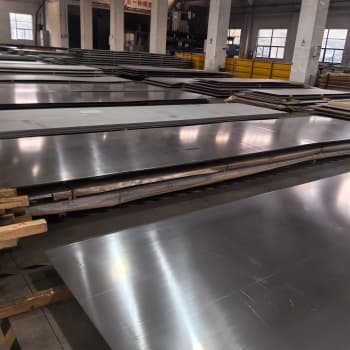
One element, one boundary
Both grades fall under the same specification - ASTM B162 / ASME SB-162 for plate, sheet and strip - with the UNS number written on the PO. Everything except carbon is effectively identical.
Table 1 - Chemical composition, Nickel 200 vs Nickel 201 plate (ASTM B162)
|
Element |
Nickel 200 (N02200) |
Nickel 201 (N02201) |
Why it matters |
|
Ni + Co |
99.0 min |
99.0 min |
Same purity class - both are commercial pure nickel |
|
C |
0.15 max |
0.02 max |
The only real variable - see below |
|
Fe |
0.40 max |
0.40 max |
Identical |
|
Cu |
0.25 max |
0.25 max |
Identical |
|
Mn |
0.35 max |
0.35 max |
Identical |
|
Si |
0.35 max |
0.35 max |
Identical |
|
S |
0.010 max |
0.010 max |
Identical |
|
Density |
8.89 g/cm³ |
8.89 g/cm³ |
Same weight math for both |
|
W.Nr. |
2.4066 |
2.4061 |
European designation differs - do not mix on drawings |
The carbon in Nickel 200 is not an impurity in the "dirt" sense - it is deliberately left at the higher level, which gives the grade slightly higher room-temperature strength and lower production cost. The carbon in Nickel 201 is deliberately stripped out, because at temperature that carbon stops being harmless.
What the carbon actually does - the failure mode corrosion tables never show
Above roughly 315 °C, carbon held in solid solution in Nickel 200 migrates to grain boundaries and precipitates as graphite. The plate does not get thinner, does not pit, and does not show anything a corrosion-rate table would flag. What it loses is ductility and impact strength at the grain boundaries - the failure mode is embrittlement, not wall loss.
That distinction is the whole selection logic, and it is the thing most comparison pages on this query never state plainly:
A corrosion-rate chart comparing the two grades in NaOH shows both at effectively zero wall loss. The chart is true and useless at the same time - the risk in Nickel 200 above 315 °C is mechanical, not chemical.
Sustained exposure matters more than excursions. A short trip above 315 °C is not the design case; thousands of hours at 340–400 °C in concentrated caustic is where graphite precipitation actually develops.
Welding and repeated thermal cycling accelerate the story, which is why welded fabrications for hot caustic duty are specified in 201 even when the design temperature sits marginally below the classical threshold.
What ASTM B162 requires - the minimums, not the brochure values
SERP pages quote "typical" annealed properties (462 MPa tensile for 200, 403 MPa for 201). Those are producer averages, not what the specification guarantees. On a PO and on a mill test certificate, the rows below are the ones that govern acceptance.
Table 2 - ASTM B162 annealed plate, minimum mechanical requirements
|
Property |
Nickel 200 (N02200) |
Nickel 201 (N02201) |
Procurement read |
|
Tensile strength, min |
379 MPa |
345 MPa |
200 spec row is ~10% higher - comes from the carbon |
|
Yield 0.2% offset, min |
103 MPa |
83 MPa |
The gap buyers actually design against |
|
Elongation, min |
30 % |
30 % |
Identical floor - both are highly ductile |
Two practical consequences. First, if your design calc is leaning on the yield floor, Nickel 200 buys you 20 MPa of extra minimum yield - that is the honest strength argument for the grade, not the marketing version. Second, 201 is the slightly softer plate at the annealed minimum, which is why it forms and deep-draws more predictably - bellows, diaphragms and spun heads spec 201 for that reason alone, temperature aside.
Media boundaries - where each plate earns its keep
Table 3 - Grade decision by medium and temperature band
|
Duty band |
Verdict |
Reasoning |
|
NaOH, all concentrations, ambient–315 °C |
Either - 200 is the rational buy |
Corrosion behaviour identical; 200 costs marginally less and stocks wider |
|
NaOH above 315 °C, sustained |
201 - non-negotiable |
Graphitization boundary; most owner specs simply reject N02200 above the line |
|
Dry Cl₂ and HCl gas, moderate temperature |
Either |
Both excellent; velocity and temperature decide |
|
Dilute HF, ambient |
Either |
Pure nickel is among the best common metals here |
|
Oxidizing acids (nitric, etc.) |
Neither |
Pure nickel has no chromium passive film - wrong alloy family entirely |
|
Seawater immersion |
Caution |
Resistant but velocity-sensitive; not the first pick against Cu-Ni or 6Mo grades |
|
Heavy welded fabrication, hot duty |
201 |
Low carbon welds cleaner and avoids sensitization-type issues on reheat |
One market note: in the chlor-alkali chain around Saudi Arabia's Jubail cluster - where caustic leaves the evaporators hot and concentrated - owner specifications standardize on N02201 for the hot side, and a Nickel 200 datasheet for that duty simply gets rejected at spec review. Below the temperature line, the same plants buy 200 for storage and transfer without a second thought.
Why the price difference is not the point
Here is the procurement reality: with 99%+ nickel content, the raw metal bill for both grades is roughly 0.99 × the LME nickel price. At any given nickel quote, the two plates price within a few percent of each other - the conversion cost (melting, rolling, annealing, pickling) dominates whatever small spread exists.
Table 4 - Price structure, pure nickel plate
|
Component |
Share of quote |
Behaviour |
|
Nickel metal (≥99%) |
≈ 85–92% |
Tracks LME nickel almost 1:1 - the quote IS the nickel market |
|
Conversion (melt + roll + anneal) |
≈ 8–15% |
The only meaningful spread between 200 and 201 |
|
Typical band, plate FOB |
- |
typically ranges US$22–38/kg, moving with LME nickel |
The implication cuts against instinct: don't audit the grade difference, audit the metal exposure. A quote far below the LME-derived floor is a red flag about purity or certification, not a bargain - and a quote 20% above the band is someone selling you a story, not extra nickel. Grade selection should be made on temperature, full stop.
FAQ
Can I use Nickel 200 plate below 315 °C even where 201 is specified?
Usually yes, and it is the standard cost optimization. Confirm the maximum sustained temperature - including upset conditions - stays below the line, and confirm the owner's spec does not blanket-mandate N02201 for caustic service regardless of temperature.
Can a mill certify plate as dual-grade Nickel 200/201?
No, not honestly. One heat has one carbon analysis; if carbon comes in at 0.02% the heat is genuinely N02201, and N02201 material used below 315 °C is de facto acceptable where 200 was specified - but the reverse substitution is never acceptable. Order by UNS number.
Is nickel 200/201 plate magnetic?
Below 358 °C - the Curie temperature - pure nickel is ferromagnetic, which surprises buyers used to austenitic stainless. Above 358 °C it loses magnetism. This is a property of the element, identical for both grades.
What filler is used for welding these plates?
ERNi-1 (AWS A5.14) is the matching filler for both grades. For hot caustic fabrications in 201, standard nickel welding practice with low heat input applies.
How do I verify which grade I actually received?
The mill test certificate's carbon line is the grade: 0.02% max = 201, anything up to 0.15% = 200. Chemistry is the only reliable discriminator - the two grades are visually and physically identical in every other respect.
CTA
Send your thickness, size and operating temperature to market@htpipe.com - we will quote ASTM B162 plate in the correct UNS grade, show the LME-linked price math, and tell you straight if 200 does the job below the line so you don't pay for carbon you don't need.


