


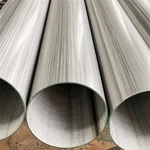

15-5PH Stainless Steel Pipe
1. Standard: ASTM A564
2. Outer Diameter (OD): 1/8" to 24"
3. Wall Thickness: Schedule 10 to Schedule XXS (Extra Extra Strong)
4. Length: Single random, double random, and cut lengths
15-5PH Stainless Steel Pipe is the precipitation hardening stainless steel that engineers specify when a component must carry 1,000 MPa plus of load and still survive impact, vibration, and chloride-bearing process media. The alloy, UNS S15500, is the direct descendant of 17-4PH - same chromium-nickel-copper design, same one-step aging heat treatment, same martensitic matrix - but it was engineered to close the one weakness of the older grade: through-thickness toughness.
Product Forms
Bar & Rod
Plate & Sheet
Coil & Strip
Pipe & Tube
Fitting: Flange, Tee, Elbow, Reducer etc.
Forging: Ring, Shaft, Circle, Block etc.

How 15-5PH differs from 17-4PH
The family relationship matters because most buyers arrive at 15-5PH through 17-4PH. Both alloys are martensitic in the annealed condition and are strengthened by aging that precipitates a copper-rich phase; both are covered by the same ASTM A564 bar specification and behave identically in the shop.
The difference is metallurgical control: 15-5PH is made with a tight balance of ferrite-forming and austenite-forming elements so that delta ferrite is essentially eliminated, and the melt is usually refined by electro-slag remelting (ESR) to control inclusion size and shape.
The result is markedly better toughness in the short-transverse direction - the direction that matters in thick sections, pressure parts, and heavily loaded fasteners - and more uniform properties through the cross-section.
For pipe and tube in high-pressure hydraulic or instrumentation duty, that toughness reserve is the reason to pay the premium over 17-4PH.
Chemical composition per ASTM A564 / AMS 5659
The composition limits below follow ASTM A564 for UNS S15500 bars, wire and shapes, and AMS 5659 for bars, forgings, tubing and rings. Iron is the balance element.
| Element | Composition limit, % |
| C | 0.07 max |
| Mn | 1.00 max |
| P | 0.040 max |
| S | 0.030 max |
| Si | 1.00 max |
| Cr | 14.00 - 15.50 |
| Ni | 3.50 - 5.50 |
| Cu | 2.50 - 4.50 |
| Nb + Ta | 0.15 - 0.45 |
| Fe | Balance |
Three rows carry the engineering story. The chromium row at 14.00-15.50% gives the alloy corrosion resistance comparable to Type 304 in most media, which is well above the hardenable 400-series grades.
The copper row at 2.50-4.50% is the precipitation former: the aging heat treatment precipitates a copper-rich phase in the martensite matrix, and it is this precipitate that raises the yield from roughly 760 MPa in the annealed condition to over 1,170 MPa at H900.
The columbium row at 0.15-0.45% is the stabilizer: niobium combines with carbon so the alloy resists sensitization in the aging range and retains toughness after welding. The nickel at 3.50-5.50% is what suppresses delta ferrite and gives the alloy its through-thickness toughness advantage over 17-4PH.
The heat-treatment matrix: one alloy, six property sets
15-5PH is delivered in the annealed condition - solution heat treated at approximately 1038-1066°C and cooled - and the mechanical properties are then set by a single aging step. The heat-treatment code on the specification tells the fabricator exactly which aging cycle to run, and each code is a deliberate trade between strength and toughness.
| Condition | Aging cycle | 0.2% yield, MPa (ksi) min | Tensile, MPa (ksi) min | Hardness, HRC |
| Condition A | As solution annealed | 760 (110) typ. | 1030 (150) typ. | 33 typ. |
| H900 | 482°C, 1 h, air cool | 1170 (170) | 1310 (190) | 40 - 47 |
| H925 | 496°C, 4 h, air cool | 1070 (155) | 1170 (170) | 38 - 45 |
| H1025 | 552°C, 4 h, air cool | 1000 (145) | 1070 (155) | 35 - 42 |
| H1075 | 579°C, 4 h, air cool | 860 (125) | 1000 (145) | 33 - 39 |
| H1100 | 593°C, 4 h, air cool | 790 (115) | 965 (140) | 32 - 38 |
| H1150 | 621°C, 4 h, air cool | 725 (105) | 930 (135) | 28 - 37 |
The reading order of the table is the buying decision. H900 gives the maximum strength, slightly above 1,300 MPa tensile, and is the choice for structural and shafting duty where load dominates.
H1025 is the balanced condition: over 1,000 MPa yield with good ductility, and the most common specification for pressure parts and general engineering. H1150 is the overaged condition, selected when the component runs in chloride service where peak-strength martensite is susceptible to stress-corrosion cracking - the rule is to age at the highest temperature that still meets the strength requirement.
The annealed Condition A must not be put into service: the untempered martensite is hard, brittle, and sensitive to hydrogen and chloride cracking until it receives its aging treatment.
Physical properties
15-5PH is strongly ferromagnetic in all conditions, which distinguishes it from the austenitic grades and matters for instruments and valve solenoids. The density runs from 7.75 g/cm³ in the annealed condition to about 7.86 g/cm³ in the overaged condition, and the modulus of elasticity is approximately 196 GPa (28.5 x 10⁶ psi) in all heat-treated conditions.
| Property | Value |
| Density | 7.75 - 7.86 g/cm³ (by condition) |
| Modulus of elasticity | 196 GPa (approx.) |
| Magnetic permeability | Strongly ferromagnetic, all conditions |
| Melting range | 1400 - 1440°C (approx.) |
| Electrical resistivity | 77 - 98 microhm-cm (by condition) |
Pipe sizes and delivery forms
15-5PH is a specialty martensitic grade, and its pipe and tube forms are supplied against the wrought specifications, typically with the mechanical properties of ASTM A564 and the dimensional discipline of the tube drawing process. The following envelope is standard:
| Parameter | Range |
| Outside diameter | 6.0 mm to 168.3 mm (smaller NPS by request) |
| Wall thickness | 0.5 mm to 12.7 mm; heavier walls by enquiry |
| Length | Fixed 3 m / 6 m / 12 m, or cut-to-length |
| Delivery condition | Condition A (solution annealed), ready for aging |
| Surface | Centerless ground, drawn, or pickled by application |
| Straightness | Close tolerance for hydraulic and shafting use |
Because the aging heat treatment is almost always performed after machining and welding, the enquiry should state whether the pipe is required in Condition A for in-house aging, or pre-aged to a specified H condition. In aerospace and defense supply chains, 15-5PH is frequently purchased in Condition A and aged by the component manufacturer, which keeps the machining done in the soft condition and the final properties set at the end of the line.
Typical applications
The load-and-toughness combination of 15-5PH is specified across the following duties:
| Application | Why 15-5PH is used |
| Aerospace actuators, fittings, and landing-gear components | High strength with high fracture toughness |
| Pump shafts and impellers | Fatigue strength in the H900-H1025 range |
| Valve stems, seats, and trim in oil and gas | Strength plus moderate chloride resistance |
| Nuclear and marine fasteners and couplings | Through-thickness toughness and inspectability |
| High-pressure hydraulic tubing | Over 1,000 MPa yield in thin walls |
| Paper and chemical machine parts | Wear resistance with 304-class corrosion resistance |
Welding and fabrication
15-5PH welds by the conventional inert-gas methods used for stainless grades, with no preheat normally required. The two choices of filler produce two different joints. With matching filler of the 15-5PH family, the weld responds to the post-weld aging treatment and develops properties comparable to the parent metal; this is the route for load-bearing joints.
With a non-matching austenitic filler such as 308L, the weld is ductile and does not precipitation-harden, which is the route when weld strength is secondary. For multiple-pass welds, a solution anneal before the final aging treatment equalizes the thermal-cycling effects on the weld region and produces the most uniform properties. After welding, the standard practice is to run the chosen aging cycle - most often H1025 or H1150 - and to verify hardness on the finished component.
What to specify on the order
The specification errors on 15-5PH orders usually concern the condition, and the enquiry should therefore state the following:
- Grade and standard: "UNS S15500, per ASTM A564" or "per AMS 5659" for bar and tubing
- Condition: Condition A (solution annealed) for in-house aging, or the finished H condition
- Heat-treatment code where aged: H900 / H925 / H1025 / H1075 / H1100 / H1150
- Dimensions: OD x wall in millimetres, length, and surface finish
- Certificate: EN 10204 3.1 with heat chemistry, annealed tensile results, and hardness; state the aging code in the PO
15-5PH is specified when the design needs the strength of a hardened alloy and the toughness reserve that 17-4PH cannot guarantee in the short-transverse direction. The buying decision is the condition decision: name the standard, name the aging code, and the delivered pipe will carry the load and survive the impact that the drawing assumes.
FAQ
Q: About 15-5PH Stainless Steel Pipe price per kg?
A: Prices ranges from $25 to $40 per kg, vary depending on size, wall thickness, supplier etc.
Q: How long does your delivery time take?
A: Delivery time is within 5-21 days
Q: Is There Sample Service?
A: Samples Are Provided Free Of Charge
Q: What Is The Minimum Order Quantity?
A: No Minimum Order Quantity
Q: How to pack the products?
A: The inner layer has a waterproof paper outer layer and is fixed with a fumigation wooden pallet.
Q: Exported Countries
A: Brazil, South Africa, Indonesia, India, Singapore, Malaysia, Iran, Russia, UAE, Chile, Laos, etc
Hot Tags: 15-5PH pipe, UNS S15500, 15-5PH stainless steel, ASTM A564, AMS 5659, precipitation hardening stainless steel, 15-5PH seamless pipe, XM-12, 316 pipe, 316l pipe, 316l stainless pipe, 317 Stainless Steel Tube, AL6XN Stainless Steel Pipe, AL6XN Stainless Steel Tube
Previous
316LN Seamless PipeNext
No InformationYou Might Also Like


Send Inquiry