


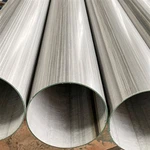
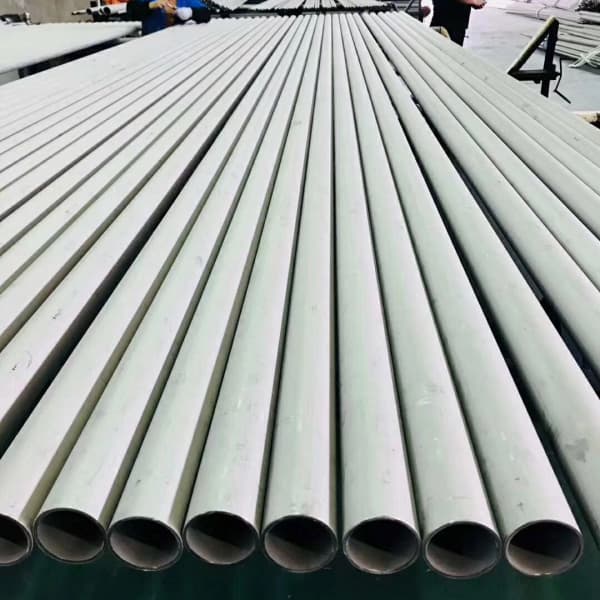
316LN Seamless Pipe
1. Standard: ASTM A312, A213, A269
2. Size: 1/2''~48''
3. Thickness: SCH5~SCHXXS
4. Service: Cutting, Welding, Fabricated, Customized
5. Grades: 316LN | UNS S31653 | 1.4429 | 1.4406
The 316LN designation sits inside a small group of stainless grades that most stock lists show but few suppliers can actually explain: it is a 316L chemistry with a deliberately controlled nitrogen addition, and that single element changes the mechanical personality of the pipe without changing its corrosion resistance. A buyer comparing 316LN against plain 316L on paper sees a higher yield strength number and a slightly different UNS code, S31653 instead of S31603.
Product Forms
Bar & Rod
Plate & Sheet
Coil & Strip
Pipe & Tube
Fitting: Flange, Tee, Elbow, Reducer etc.
Forging: Ring, Shaft, Circle, Block etc.
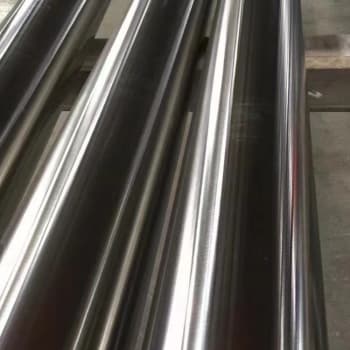
Stainless Steel ASTM A312 SS 316LN Pipe Specification
| Sizes: | 1/8" to 24" |
| Type: | Seamless / ERW / Welded / Fabricated / LSAW Pipes |
| Grades: | SS 316LN Steel, 1.4429 | 1.4406 Stainless Steel |
| Schedules: | STD, XS, XXS, SCH5S, SCH10/10S, SCH20, SCH30, SCH40/40S, SCH60, SCH80/80S, SCH100, SCH120, SCH140, SCH160 |
| Standards: | ASTM A213, ASTM A312, ASTM A269 |
| Thickness: | 15 NB UP TO 600 NB IN SCH 5S, 10S,10, 20, 40S, 40, STD, 60, 80S, 80, XS, 100, 120, 140, 160 & XXS |
| Form: | Round, Square, Rectangular, Hydraulic Etc |
| Lengths: | SRL and DRL 5meters up to 11meters available from Stock or Production. |
| Ends: | Plain/Bevelled |
What the "LN" Means: UNS S31653 and EN 1.4429
316LN Seamless Pipe is the nitrogen-strengthened version of 316L. The base chemistry is the same low-carbon molybdenum-bearing austenitic grade, but nitrogen is specified in a controlled band of 0.10 to 0.16 percent instead of being left to whatever the melt picks up. The controlled nitrogen does two jobs at once: it raises the minimum yield strength through solid-solution strengthening, and it keeps the grade resistant to sensitisation alongside the low carbon content. The grade appears in the US system as UNS S31653 and in the European system as EN 1.4429 (X2CrNiMoN17-13-3), so a European enquiry and an American enquiry for the same pipe may use completely different designations for the same product.
The chemical specification that governs 316LN pipe is ASTM A312 for seamless and welded pipe, with the plate counterpart in ASTM A240. The composition limits are shown below; the values are the standard maximums and ranges, and a mill certificate for 316LN pipe should sit inside every one of these bands.
Chemical Composition of 316LN (UNS S31653)
Composition limits per ASTM A312 (pipe) and ASTM A240 (plate), percent by weight:
| Element | Min (%) | Max (%) | Why It Is Controlled |
|---|---|---|---|
| Carbon (C) | - | 0.030 | Low carbon keeps the grade immune to sensitisation during welding; the L in the name |
| Manganese (Mn) | - | 2.00 | Deoxidiser and austenite stabiliser; also helps nitrogen solubility |
| Silicon (Si) | - | 0.75 | Deoxidation aid during melting |
| Phosphorus (P) | - | 0.045 | Impurity control for hot workability and toughness |
| Sulfur (S) | - | 0.030 | Impurity control; kept low for weldability |
| Chromium (Cr) | 16.00 | 18.00 | Primary corrosion resistance; passive film former |
| Nickel (Ni) | 10.00 | 14.00 | Austenite stabiliser; toughness at low temperature |
| Molybdenum (Mo) | 2.00 | 3.00 | Resistance to pitting and crevice attack in chlorides |
| Nitrogen (N) | 0.10 | 0.16 | Solid-solution strengthener; the element that makes this grade 316LN instead of 316L |
The Role of Nitrogen
Nitrogen dissolves interstitially in the austenite lattice and blocks dislocation movement, which is the same mechanism that raises strength without adding alloy cost or sacrificing ductility. The practical result is a minimum yield strength of 205 MPa (30 ksi) in the annealed condition against 170 MPa (25 ksi) for 316L, a gain of roughly 20 percent.
Because nitrogen is added to the melt rather than rolled into the wall, the strengthening is uniform through the section, and it does not disappear when the pipe is welded, bent or formed the way cold-work strengthening can. The other benefit is less well known: nitrogen improves resistance to pitting corrosion in chloride service, so 316LN is slightly more tolerant of crevice and pitting attack than the same pipe in 316L at identical chemistry.
Mechanical Properties, Annealed
The minimum mechanical properties below are taken from the annealed condition of the governing standards. The pipe version (ASTM A312) and the plate version (ASTM A240) set the same tensile and yield minimums, with elongation measured on the relevant gauge length. Hardness applies primarily to the plate product in A240.
| Property | ASTM A312 (pipe) | ASTM A240 (plate) | Note |
|---|---|---|---|
| Tensile strength, min | 515 MPa (75 ksi) | 515 MPa (75 ksi) | Same minimum in both product forms |
| Yield strength, min | 205 MPa (30 ksi) | 205 MPa (30 ksi) | The nitrogen credit over 316L's 170 MPa |
| Elongation, min | 35% (on 2 in or 50 mm) | 40% (on 2 in or 50 mm) | Plate minimum is higher by standard wording |
| Hardness, max | - | 217 HBW / 95 HRB | Plate per A240; pipe hardness not specified in A312 |
The elongation figures deserve a second look. 316LN keeps a 35 to 40 percent minimum elongation despite the higher yield, which means the grade can be cold bent, flared, expanded and rolled into coils without cracking, and the finished spool retains the same strength as the as-delivered pipe. This combination, higher yield with retained ductility, is exactly what makes 316LN attractive for pressure-containing equipment where wall thickness is set by the design code.
Physical Properties
The physical constants below are the generally accepted values for the 316 family with the nitrogen addition; they are not contractual values but are useful for thermal design, weight calculation and expansion calculations.
| Property | Typical Value | Unit |
|---|---|---|
| Density | 7.98 | g/cm³ (0.288 lb/in³) |
| Modulus of elasticity, room temperature | 193 | GPa (28,000 ksi) |
| Mean coefficient of thermal expansion, 20–100°C | 16.0 | µm/m·K |
| Thermal conductivity, 100°C | 16.3 | W/m·K |
| Specific heat, 0–100°C | 500 | J/kg·K |
| Electrical resistivity, room temperature | 0.74 | µΩ·m |
| Melting range | 1371–1399 | °C (2500–2550 °F) |
Low-Temperature Performance: Where 316LN Pipe Wins
The single strongest technical argument for 316LN pipe is its behaviour at cryogenic temperatures. Austenitic stainless steels already outperform carbon steel and most ferritic grades at low temperature because the face-centred-cubic lattice does not undergo a ductile-to-brittle transition; 316LN adds a higher base yield so that the pipe keeps usable design strength at -196 °C (liquid nitrogen) and below, while retaining excellent Charpy impact energy. This is why 316LN is a standard choice for LNG terminals, air separation cold boxes and cryogenic storage tank piping, where 316L would need a thicker wall to reach the same allowable stress at the same design temperature.
For a piping buyer the comparison is straightforward: if the line operates below about -50 °C and the governing code allows the material, 316LN gives more design margin per millimetre of wall than 316L. The extra strength is not purchased with a heat treatment that must be repeated after welding, and it does not reduce the low-temperature toughness the way higher carbon or ferrite content would.
Standards, Forms and Finishes
316LN is produced across the normal stainless product family, and each product form has its own governing standard. A buyer should state both the UNS number and the product standard on the enquiry, because 316LN bar, plate, pipe and forgings are all covered by different ASTM documents.
| Product Form | Governing Standard | Typical Size Range Supplied |
|---|---|---|
| Seamless pipe | ASTM A312 TP316LN | NPS 1/8 to NPS 12 (DN 6 to DN 300), wall SCH 5S to SCH 80S |
| Welded pipe (EFW/ERW) | ASTM A312 TP316LN / A358 Grade 316LN | NPS 6 to NPS 24 (DN 150 to DN 600) for large-bore lines |
| Tube (heat exchanger) | ASTM A269 / A213 | OD 6.0 to 60.0 mm, wall 0.8 to 4.0 mm |
| Plate and sheet | ASTM A240 UNS S31653 | Thickness 0.5 to 80 mm, width up to 2500 mm |
| Bar and billet | ASTM A479 / A276 | Round bar Ø 10 to 300 mm |
Pipe surfaces follow the same conventions as 316L: seamless pipe is normally supplied with a mill finish suitable for most process duties, while welded and polished product is available for sanitary and high-purity lines. Plate is available in No.1 (hot rolled, annealed and pickled) and 2B finishes, with BA or mirror polish available on thin sheet. For cryogenic and high-integrity service, specify the impact testing requirement on the PO rather than assuming the standard includes it.
Fabrication and Welding Behaviour
316LN welds with the same filler families as 316L, and the nitrogen content does not force a change of procedure. Matching filler is ER316L / E316L for most joints; where the weld must match the base metal yield strength, use 316LN-designed filler or a 316L filler and accept that the weld metal will be slightly softer than the nitrogen-strengthened base pipe.
The grade is fully austenitic in the weld zone, which means no preheat is required and no post-weld heat treatment is needed for corrosion service. The low carbon content and the nitrogen addition both protect against chromium carbide precipitation at the grain boundaries, so the HAZ stays resistant to intergranular corrosion even in multi-pass welds.
Two fabrication cautions apply. First, nitrogen-strengthened austenitic grades work-harden slightly faster than 316L, so cold bending and swaging tools should be set for a little more springback and a little more force.
Second, if the finished spool is annealed after forming for a fully softened condition, the heat treatment temperature and quench must follow the A312/A240 annealing practice for this grade; the common 1060–1120 °C solution treatment with a water quench restores both the strength and the corrosion resistance.
Applications That Justify 316LN Over 316L
Not every 316L line needs to become 316LN. The grade earns its specification where one of three conditions is present: low-temperature service where the yield credit reduces wall thickness, high-pressure service where the design is strength-governed rather than corrosion-governed, or chloride exposure where the nitrogen pitting credit is worth having. The table below lists the service classes and the reasoning for each.
| Service | Why 316LN Is Specified | Design Note |
|---|---|---|
| LNG and cryogenic piping | High yield at -196 °C with excellent impact energy | Wall often set by code allowable stress; 316LN cuts weight |
| Air separation cold boxes | Low-temperature toughness and weldability | Check Charpy requirements on the PO |
| Chemical and petrochemical process lines | Higher design stress for the same wall as 316L | Useful where B31.3 pressure design governs the wall |
| Seawater and chloride service | Nitrogen improves pitting resistance over 316L | Still not a substitute for duplex in hot seawater; use with design review |
| Nuclear and high-integrity vessels | Controlled nitrogen, low carbon, uniform properties | May require additional NDE and traceability per project spec |
| Pharmaceutical and food lines | Cleanability and weldability equal to 316L | Specify polished bore if product contact |
Size Range, Lengths and Supply Form
316LN seamless pipe is most commonly supplied in the NPS 1/8 to NPS 12 range with walls from SCH 5S to SCH 80S, in both random lengths (normally 5 to 7 m) and cut-to-length. Larger diameters are available as welded-and-annealed product per A312 or A358. The table below shows the standard outside diameters for the sizes most frequently ordered; the wall thickness for a given schedule follows the ASME B36.19M stainless steel schedule table, and the inside diameter is the OD minus twice the wall.
| NPS | DN | Outside Diameter (mm) | Typical Walls Supplied |
|---|---|---|---|
| 1/2 | 15 | 21.3 | SCH 5S, 10S, 40S, 80S |
| 3/4 | 20 | 26.7 | SCH 5S, 10S, 40S, 80S |
| 1 | 25 | 33.4 | SCH 5S, 10S, 40S, 80S |
| 1 1/2 | 40 | 48.3 | SCH 5S, 10S, 40S, 80S |
| 2 | 50 | 60.3 | SCH 5S, 10S, 40S, 80S |
| 3 | 80 | 88.9 | SCH 5S, 10S, 40S, 80S |
| 4 | 100 | 114.3 | SCH 5S, 10S, 40S, 80S |
| 6 | 150 | 168.3 | SCH 5S, 10S, 40S, 80S |
| 8 | 200 | 219.1 | SCH 5S, 10S, 40S, 80S |
| 10 | 250 | 273.1 | SCH 5S, 10S, 40S, 80S |
| 12 | 300 | 323.9 | SCH 5S, 10S, 40S, 80S |
What to State on the Enquiry
To get a 316LN pipe quotation that matches the design intent, the enquiry should carry the following information; a short list avoids the two most common supply errors, which are receiving 316L instead of 316LN and receiving a welded product where seamless was intended.
- Designation: 316LN, UNS S31653, EN 1.4429, per ASTM A312 TP316LN
- Product form and standard: seamless pipe per A312, or welded-and-annealed per A312/A358 for large bore
- Size: NPS or DN, outside diameter, and schedule or explicit wall thickness in mm
- Quantity and length basis: random lengths, cut lengths, or exact metreage
- Condition: annealed (solution treated at 1060–1120 °C and quenched) as standard
- Testing: mill certificate EN 10204 3.1, and whether Charpy impact at -196 °C or room temperature is required
- Finish: mill finish for process lines; polished bore for hygienic service
- Traceability: full heat traceability and marking per A999/A530 when project specification demands it
Supplied 316LN pipe is normally marked with the standard, grade, heat number and size, and is backed by a 3.1 mill certificate reporting the actual chemistry and tensile results of the heat. Because 316LN and 316L share the same corrosion resistance envelope, the grade is occasionally substituted on site; the enquiry should state explicitly that 316LN is a contract requirement and that substitution to 316L is not acceptable without approval.
FAQ
Q: About 316LN Seamless Pipe price per kg?
A: Prices ranges from $2 to $10 per kg, vary depending on size, wall thickness, supplier etc.
Q: How long does your delivery time take?
A: Delivery time is within 5-21 days
Q: Is There Sample Service?
A: Samples Are Provided Free Of Charge
Q: What Is The Minimum Order Quantity?
A: No Minimum Order Quantity
Q: How to pack the products?
A: The inner layer has a waterproof paper outer layer and is fixed with a fumigation wooden pallet.
Q: Exported Countries
A: Brazil, South Africa, Indonesia, India, Singapore, Malaysia, Iran, Russia, UAE, Chile, Laos, etc
Hot Tags: 316LN pipe, 316LN seamless pipe, ASTM A312 TP316LN, UNS S31653, 1.4429 stainless steel pipe, nitrogen strengthened stainless steel, 316LN stainless steel pipe, 316LN pressure pipe, 304 pipe, 316 Stainless Steel Tube, 316l stainless steel, astm a269, stainless steel 304 pipe, steel welded tube
Next
No InformationYou Might Also Like


Send Inquiry