


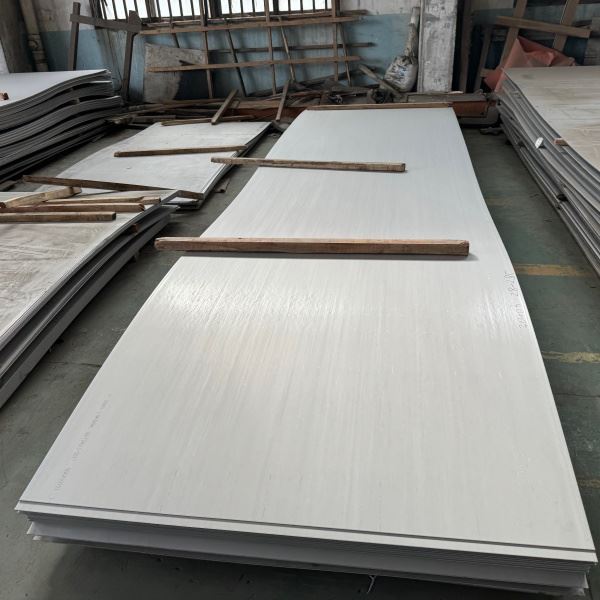
Hastelloy B-2 Plate
1. Standard:ASTM B333
2. Length: 0-12m
3. Width: 0-2500mm
4. Thickness: 0.3-1200mm
5. Process: Hot rolled, cold rolled
Hastelloy B-2 Plate has two dominant elements. Nickel at roughly 65–70%, molybdenum at 26–30%. Everything else is there to be kept small: carbon 0.02% max, silicon 0.10% max, iron 2.0% max, chromium 0.7% max. That last pair is the subject of this page, because those two ceilings are not arbitrary housekeeping. They are the alloy.
Product Forms
Bar & Rod
Plate & Sheet
Coil & Strip
Pipe & Tube
Fitting: Flange, Tee, Elbow, Reducer etc.
Forging: Ring, Shaft, Circle, Block etc.
1. The Chemistry, and Why the Ceilings Sit Where They Sit
| Element | ASTM B333 limit (N10665) | What it does |
| Ni | Balance (≈65–70%) | Matrix; gives resistance to chloride SCC and to reducing acids |
| Mo | 26.0–30.0 | The corrosion element; drives resistance to HCl and non-oxidizing acids |
| Fe | 2.0 max | Above this, promotes Ni₄Mo (β) formation at grain boundaries |
| Cr | 0.7 max | Small amounts raise corrosion rate in reducing acid; larger amounts change the alloy's whole character |
| C | 0.02 max | Carbide precipitation at grain boundaries |
| Si | 0.10 max | Silicide formation; also affects weldability |
| Mn | 1.0 max | Deoxidation residual |
| Cu | 0.5 max | Residual |
The reason iron and chromium are capped is metallurgical, and it is worth understanding rather than memorising. Nickel-molybdenum alloys in the 26–30% Mo range are metastable. If the metal spends time in the wrong temperature band - roughly 550 to 850 °C - molybdenum and nickel combine into an ordered intermetallic, Ni₄Mo, which forms as a grain-boundary network.
Once that network exists, the alloy becomes brittle and the boundaries become corrosion paths. Iron and chromium both lower the driving force for that ordering; keeping them low raises the barrier. That is why B-2's specification reads as a list of ceilings rather than a list of additions.
The consequence for a buyer is that B-2 is not a grade you can weld and stress-relieve. A stress relief treatment would be run somewhere in the 600–700 °C range - precisely inside the window that produces Ni₄Mo. The correct answer is not "stress-relieve carefully." It is "do not stress-relieve." B-2 plate is supplied solution annealed and must stay that way, and the as-welded condition is the intended service condition.
A fabricator who applies a generic post-weld heat treatment schedule to a B-2 shell because the project's WPS template says so has ruined the plate, and the failure will not show up until the vessel is in acid service.
2. Thickness Range and What Each Band Is For
B-2 plate is routinely supplied from about 0.5 mm to 100 mm, with 6 mm and 8 mm carried in stock by most distributors because those are the gauges that go into linings and small vessels.
| Thickness band | Typical supply route | Condition | Notes |
| 0.5–2.0 mm | Cold rolled sheet | Solution annealed, soft | For linings, gaskets, spacer plates; deep forming possible |
| 2.0–6.0 mm | Cold rolled or hot rolled sheet | Solution annealed, pickled | Vessel linings, small shells; the stock gauges |
| 6.0–25 mm | Hot rolled plate | Solution annealed, pickled, descaled | Fabricated components, tube sheets, flanges cut from plate |
| 25–50 mm | Hot rolled plate | Solution annealed | Requires mill confirmation of centre properties |
| 50–100 mm | Hot rolled plate, mill order | Solution annealed | Not stock; annealing uniformity is the question to ask about |
Standard plate sizes run to 1000–1219 mm width and 2000–6000 mm length, with cut-to-size and edge bevelling available. Widths above 1500 mm are normally a mill-order item rather than stock.
Tolerances follow the general requirements of the flat-rolled nickel-alloy specification rather than a mill's house standard, and for B-2 the tolerance question is slightly different from stainless. Thickness tolerance is the tolerance you should read first: an over-thickness plate is a free 9.22 kg per square metre per millimetre of extra weight, and an under-thickness plate that is still within tolerance can leave a lining too thin at the design condition. Both are legally compliant. Only one is what you designed.
| Dimension | What to specify | Why it matters on B-2 specifically |
| Thickness | Nominal, or minimum, or average - pick one and write it | A nominal-with-negative-tolerance order can arrive at the low end on every plate |
| Width / length | Actual dimensions, not nominal + trim allowance | B-2 plate is often cut from stock; the usable area differs from the ordered area |
| Flatness | State a limit in mm per metre | Waviness on thicker plate shows up when lining is fitted against a shell |
| Edge condition | Sheared, plasma cut, or machined | Sheared edges on B-2 need burr removal; burrs are crack initiation sites in this alloy |
| Surface | Pickled and descaled, or as-rolled | Scale left on the surface traps contaminants that later become corrosion sites |
| Marking | Heat number on each plate, transferred to each cut piece | Mixed-heat bundles are the most common traceability failure |
That last row is not paperwork pedantry. B-2 is specified by chemistry, and chemistry is per heat. If a 1 m × 2 m plate is cut into six lining panels and only the parent plate carries the heat number, you have six pieces of alloy with no demonstrated composition. Ask for the transfer method before the plate is cut, not after.
The thickness point that matters more than any other: solution annealing at 1065–1080 °C followed by water quench is not optional, and the water quench is where thick plate gets hard. Air cooling is not a substitute. Slowly cooling through 850–550 °C is exactly how you precipitate the phase the low-iron chemistry was designed to prevent.
On a 6 mm sheet, a water quench cools the whole section in under a second. On a 60 mm plate, the centre is still shedding heat long after the surface has stabilised, and no quench tank changes that. If you need heavy B-2 plate, ask the mill what the centre-section cooling path looks like and whether the anneal was done with the plate individually handled or in a stack.
3. Mechanical Properties: Which Number Is the Real One
Here is the answer to the opening puzzle. ASTM B333 specifies minimum properties for solution-annealed plate. Different product forms and editions have produced different published minima, and trade pages mix typical and minimum values without saying which is which.
| Property | Typical B333 minimum | Typical production value | Where the confusion comes from |
| Tensile strength | 690 MPa (100 ksi) | 760–880 MPa | Some pages quote the higher figure as minimum |
| Yield strength, 0.2% | 283–350 MPa (41–51 ksi) | 310–400 MPa | The widest spread of any value in this grade |
| Elongation in 50 mm | 40% | 50–60% | Reliable across suppliers |
| Hardness | - (not specified as min) | ~90–100 HRB | Some pages quote HB, some HRB |
| Density | 9.22 g/cm³ | - | Consistent |
| Melting range | 1330–1380 °C | - | Consistent |
For design purposes, use the code allowable stress from ASME Section II Part D, not a supplier's typical value. For purchase verification, ask which figure on the certificate is the specification minimum and which is the measured result - a certificate showing 350 MPa yield tells you the heat passed, but tells you nothing about which minimum it was tested against.
The density figure is worth remembering for a different reason. At 9.22 g/cm³, B-2 plate is about 15% heavier than 316L for the same volume. A 1000 × 2000 mm plate at 6 mm weighs about 111 kg; the same plate in 316L weighs about 95 kg. That shows up in handling, in freight and in support steel.
4. Where B-2 Plate Works, and Where It Stops Working
B-2's reputation rests on one behaviour: in oxygen-free hydrochloric acid it is resistant across the full concentration range, up to boiling. In deaerated HCl, corrosion rates stay in the sub-0.1 mm/year range across concentrations where 316L would be consumed. That is a genuine engineering capability, not a marketing claim.
What the trade pages underplay is how narrow the qualifying condition is.
- Dissolved oxygen. Aerated HCl raises the corrosion rate by orders of magnitude. The alloy is not "somewhat less good" with oxygen present; it stops being a B-2 application.
- Ferric and cupric ions. These are oxidizers delivered as contaminants. A hydrochloric acid stream that has touched carbon steel upstream now contains Fe³⁺, and that stream will attack B-2. The same applies to copper-alloy valves or pump trim anywhere upstream. This is the single most common way a B-2 installation fails: the alloy was right and the piping upstream of it was not.
- Nitric acid, wet chlorine, hypochlorites, chlorates. Oxidizing by nature; not B-2 service at any concentration.
- Seawater and chloride pitting environments. B-2 is a reducing-acid alloy, not a chloride alloy. Chromium is capped at 0.7%; there is no passive film to speak of. For chloride pitting and crevice service, the molybdenum-chromium family is the answer, not this one.
For B-3: it exists precisely because B-2's low iron and chromium make it hard to hot work. B-3 relaxes those ceilings to buy fabricability. If you are forming thick plate into complex shapes and hitting cracking, B-3 is the conversation. If your service is genuinely oxygen-free HCl and you are buying flat plate to line or roll, B-2's tighter chemistry is the better bet.
There is one more boundary that suppliers rarely put in writing, and it is the one that decides whether a B-2 plate project succeeds: the alloy's performance depends on the whole circuit, not on the plate. A plate that is correct in isolation can still fail because a carbon-steel pump body, a copper-alloy valve seat, or an open tank vent introduced oxygen or metallic ions upstream.
When that happens, the material is blamed and the alloy gets a reputation for being inconsistent. It is not inconsistent. It is intolerant of one specific condition, and the condition is usually created outside the plate.
5. Ordering Information for European and Middle East Buyers
For a buyer in Rotterdam or Antwerp running a chemical distribution or tank-lining operation, the specification conversation usually comes down to two things: whether the plate can be certified to EN 10204 3.1 with the heat number traceable to the plate itself (not just to the bundle), and whether cut-to-size pieces carry the same heat identification after cutting. B-2 plate is heat-sensitive enough that a mixed-heat bundle is a genuine risk, not a paperwork one.
Standard supply is solution annealed, pickled and descaled, with EN 10204 3.1 mill certificate as the baseline and 3.2 available on request. Filler metal for welding is ERNiMo-7 (AWS A5.14) for GTAW, or ENiMo-7 covered electrodes; the older ERNiMo-2 designation appears on some Chinese supplier documents and is not the current AWS designation. Root shielding with argon is mandatory - an oxidised root loses its resistance to HCl entirely.
FAQ
Q: About Hastelloy B-2 Plate price per kg?
A: Prices ranges from $25 to $40 per kg, vary depending on size, wall thickness, supplier etc.
Q: How long does your delivery time take?
A: Delivery time is within 5-21 days
Q: Is There Sample Service?
A: Samples Are Provided Free Of Charge
Q: What Is The Minimum Order Quantity?
A: No Minimum Order Quantity
Q: How to pack the products?
A: The inner layer has a waterproof paper outer layer and is fixed with a fumigation wooden pallet.
Q: Exported Countries
A: Brazil, South Africa, Indonesia, India, Singapore, Malaysia, Iran, Russia, UAE, Chile, Laos, etc
Hot Tags: UNS N10665, ASTM B333, nickel-molybdenum plate, Ni₄Mo beta phase, solution annealed plate, hydrochloric acid resistance, ERNiMo-7 filler, thickness tolerance
Previous
AMS 5536 Hastelloy X PlateNext
No InformationYou Might Also Like


Send Inquiry