


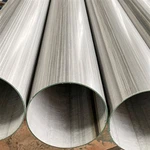

Alloy 825 Welded Pipe
1. Standard: ASTM B423、ASTM B407、ASTM B163
2. Diameters: 4.0 - 1219.2 mm
3. Wall thickness: 0.5 to 20mm
4. Length: Single, Double Random & Cut Length
5. Grades:Incoloy 825, UNS N08825, WNR.2.4858
Alloy 825 welded pipe is a solid-solution-strengthened nickel-iron-chromium alloy featuring distinct additions of molybdenum, copper, and titanium. Unlike pure nickel-based superalloys, its balanced iron-nickel matrix provides a cost-effective alternative while maintaining resilience against both reducing and oxidizing environment. HT PIPE is a incoloy alloy 825 uns n08825 pipe supplier with 15+ export experience. Contact us for more information and quotes for free!
Product Forms
Bar & Rod
Plate & Sheet
Coil & Strip
Pipe & Tube
Fitting: Flange, Tee, Elbow, Reducer etc.
Forging: Ring, Shaft, Circle, Block etc.

Chemical Composition Profile
The specific limits of its chemical makeup (by weight percentage) are strictly controlled to guarantee predictability in the field:
Nickel (Ni): 38.0% – 46.0%
Iron (Fe): Balance (typically around 22.0% minimum)
Chromium (Cr): 19.5% – 23.5%
Molybdenum (Mo): 2.5% – 3.5%
Copper (Cu): 1.5% – 3.0%
Titanium (Ti): 0.6% – 1.2%
Carbon (C): 0.05% Maximum
The Roles of Key Elements
Every element in the matrix serves a specific purpose to protect the integrity of the pipe:
Nickel prevents chloride-ion stress corrosion cracking (SCC), a common cause of failure in standard austenitic stainless steels exposed to saltwater or brine.
Chromium establishes a passive oxide layer that protects against oxidizing agents like nitric acid, nitrates, and oxidizing salts.
Molybdenum and Copper combine to resist reducing chemicals, making the alloy exceptionally reliable when handling sulfuric and phosphoric acids. Molybdenum also enhances resistance to localized pitting and crevice corrosion.
Titanium acts as a stabilizing agent. Through targeted stabilization annealing, titanium binds with carbon to form titanium carbides. This prevents the precipitation of chromium carbides at the grain boundaries (sensitization) during welding or thermal exposure, shielding the material from intergranular corrosion.
Manufacturing Standards and Formats
Alloy 825 pipes are manufactured as either seamless or welded structures to fit different architectural needs and pressure configurations.
Seamless Pipes (ASTM B423 / ASME SB 423): Extruded and cold-drawn without any weld seams, these are preferred for high-pressure, high-integrity roles like downhole oil tools and chemical injection lines.
Welded Pipes (ASTM B705, B775 / ASME SB 705, SB 775): Formed from flat-rolled sheets and longitudinally welded. Advanced automated welding combined with post-weld stabilization annealing yields a microstructure that minimizes the risk of localized corrosion at the weld bead.
Primary Industrial Deployments
Thanks to its balanced resistance profile, Alloy 825 piping is utilized across several heavy industries:
1. Oil and Natural Gas Extraction
In sour gas wells, extraction fluids carry high concentrations of hydrogen sulfide, carbon dioxide, and volatile chlorides. Alloy 825 pipes serve as downhole production tubing, casing strings, and liners, offering long-term reliability without failing from sour-service cracking.
2. Chemical Processing and Acid Production
Chemical processing facilities utilize Alloy 825 pipes to manage highly corrosive process media. It serves as a core material for heating coils, vessels, and transfer lines dealing with hot sulfuric acid solutions, phosphoric acid evaporators, and organic acid blends.
3. Marine and Seawater Environments
With a Pitting Resistance Equivalent Number (PREN) of approximately 31, the alloy handles brackish water, high-velocity seawater flows, and marine spray. It is frequently chosen for offshore platform piping systems, marine propeller shafts, and coastal power generation condensers.
4. Nuclear Fuel Reprocessing
The material's dual resistance to both highly oxidizing nitric acid and reducing alkaline solutions makes it a reliable option for containment piping and dissolver vessels used in nuclear waste management and spent fuel reprocessing.
Fabrication, Machining, and Welding Guidelines
Alloy 825 can be hot worked, cold worked, and welded using standard industrial methods, provided its specific physical properties are taken into account.
Work Hardening: Like most high-nickel alloys, Alloy 825 work-hardens more rapidly than standard carbon steels. Fabricators must use rigid tooling, positive feed rates, and continuous engagement to cut cleanly past the work-hardened surface layer.
Thermal Working: Hot forming should be managed between 870°C and 1180°C (1600°F to 2150°F). For optimal corrosion resistance, final hot working should conclude within the 870°C to 980°C (1600°F to 1800°F) window, followed by a rapid air cool or water quench.
Welding Consumables: When joining Alloy 825 pipes, matching composition weld wires or over-alloyed filler metals are typically selected, such as AWS A5.14 ERNiFeCr-1 or AWS A5.11 ENiCrMo-3. Cleanliness is paramount; all surfaces must be free of sulfur, phosphorus, oil, or low-melting-point contaminants before heating to prevent hot cracking.
FAQ
Q: About Alloy 825 tube price per kg?
A: Prices ranges from $25 to $40 per kg, vary depending on size, wall thickness, supplier etc.
Q: How long does your delivery time take?
A: Delivery time is within 5-21 days
Q: Is There Sample Service?
A: Samples Are Provided Free Of Charge
Q: What Is The Minimum Order Quantity?
A: No Minimum Order Quantity
Q: How to pack the products?
A: The inner layer has a waterproof paper outer layer and is fixed with a fumigation wooden pallet.
Q: Exported Countries
A: Brazil, South Africa, Indonesia, India, Singapore, Malaysia, Iran, Russia, UAE, Chile, Laos, etc
Hot Tags: alloy 825 welded pipe, China alloy 825 welded pipe manufacturers, suppliers
Previous
Incoloy 800HT Steel PipeNext
No InformationYou Might Also Like


Send Inquiry