


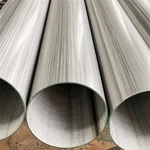

Alloy 20 Heat Exchanger Tubing
1. Standard: ASTM B729, ASTM B464, ASTM B474
2. OD Sizes: 1/2 - 48
3. Thickness: SCH5~SCHXXS
4. Type: Seamless / Welded / ERW / EFW / SAW
Alloy 20 Heat Exchanger Tubing was not designed as a general corrosion alloy. It was designed for one specific problem: hot sulfuric acid that eats 316L in a single campaign and forces a plant to replace a heat exchanger bundle every eighteen months. The 32-38% nickel, 19-21% chromium and 3-4% copper combination in UNS N08020 is what makes a tube survive that service, and the copper is the part most buyers forget to check on the mill certificate.
This page covers the tube itself: which specification governs it, what the chemistry has to be, how the U-bend geometry is set, which BWG wall to order, and where the alloy stops being the right answer.

Which Specification Governs the Tube
Three ASTM documents matter, and buyers routinely quote the wrong one.
ASTM B729 covers seamless pipe and tube in UNS N08020, N08026, N08024, N08925, N08926 and N08354, cold worked and annealed. This is the specification for a seamless heat exchanger tube. ASME SB729 is the identical pressure-vessel edition and is what a stamped exchanger usually calls out.
ASTM B468 covers welded tube in the same alloy family. If the tube is welded and then drawn, the weld seam has to be cold worked and annealed through, and the certificate has to say so. A welded tube that was not sink-drawn after welding keeps a cast weld nugget in the middle of a corrosion service, which is exactly where the acid will find it.
ASTM B366 covers the fittings, and B463 covers plate. If the bundle is being built from a mix of seamless tube, welded tube and a clad tubesheet, each line item needs the correct specification on its own certificate, not one blanket reference to "ASTM B729" over the whole package.
| Product form | Specification | Typical use in an exchanger |
|---|---|---|
| Seamless tube | ASTM B729 / ASME SB729 | Corrosion-side tubes in sulfuric and phosphoric service |
| Welded tube, cold drawn and annealed | ASTM B468 | Longer lengths where seamless mill run is short |
| Plate and sheet | ASTM B463 | Shell, channel, baffles |
| Fittings and flanges | ASTM B366 | Nozzles, return bends, headers |
Chemistry: The Copper Is the Point
The composition range in ASTM B729 is the one to hold a purchase order to. Two lines in that table decide whether the tube works in sulfuric acid: copper and niobium.
| Element | Range (ASTM B729) | What it does in service |
|---|---|---|
| Nickel | 32.0-38.0% | Austenitic matrix, keeps the alloy ductile and weldable |
| Chromium | 19.0-21.0% | Passive film former, sets the oxidizing-side resistance |
| Molybdenum | 2.0-3.0% | Pitting and crevice resistance in chlorides |
| Copper | 3.0-4.0% | Raises resistance to reducing sulfuric acid, the reason the grade exists |
| Niobium + tantalum | 8 x C min, 1.0 max | Stabilizes carbon, blocks grain-boundary carbide precipitation in the weld heat-affected zone |
| Carbon | 0.07% max | Capped low so the stabilization ratio stays achievable |
A certificate showing 31% nickel and 2.5% copper meets no clause of this table, yet such material does move through the market as "Alloy 20". The check is cheap: read the copper and niobium lines before releasing the heat for bending.
Mechanical properties are modest and stable, which is why they rarely decide the order:
| Property | Requirement, annealed |
|---|---|
| Tensile strength | 550 MPa (80 ksi) min |
| Yield strength, 0.2% offset | 240 MPa (35 ksi) min |
| Elongation in 2 in | 30% min |
| Hardness | Typically under 95 HRB in the annealed condition |
The number that matters at the tube mill is hardness, not strength. A tube that arrives at 105 HRB has been cold worked and not properly annealed, and it will crack on the U-bend rather than in service.
U-Bend Geometry: Where Tubes Get Scrapped
Most of the scrap in an Alloy 20 bundle is generated at the bend, not in the acid. Three numbers control it.
First, the centreline bend radius. TEMA practice puts the minimum at 1.5 times the tube outside diameter for a bend that will be pulled through a baffle, and most fabricators work to a larger radius when the tube count allows. A 25.4 mm tube therefore wants at least a 38 mm centreline radius, and anything tighter needs a written concession and a bend test from the same heat.
Second, the straight leg left before the bend. The tube has to sit in the tubesheet, clear the shell nozzle and still let the roller reach the joint. A straight length shorter than about 300 mm in front of the tangent line is a fabrication problem even when the bend itself is perfect.
Third, ovality after bending. A bend that flats the section by more than roughly 8% of the original diameter will not pass a ball test through the bore and will show up as a flow restriction on the thermal rating. Measure it on the first article, then on a sample, not on every tube.
Alloy 20 work-hardens quickly, more than 316L, so the bending operation has to be planned as one pass with a generous radius and a mandrel, not as a series of small corrections. A tube bent, straightened and re-bent in the same area carries a hardness rise that no subsequent anneal will fully remove unless the whole tube goes back through a full solution treatment.
Wall Thickness: BWG Numbers and What They Buy
Heat exchanger tube wall is quoted in Birmingham Wire Gauge, which is a different scale from the pipe schedule numbers used on the shell side. The common picks for Alloy 20:
| BWG | Nominal wall (mm) | Where it is used |
|---|---|---|
| 16 | 1.65 | High-pressure or erosive service, and tubes that will be re-rolled more than once |
| 18 | 1.24 | The default for chemical exchangers; the best balance of corrosion allowance and heat transfer |
| 20 | 0.89 | Clean, low-pressure service where thermal performance drives the design |
Going one gauge heavier costs heat transfer and tube count; going one gauge lighter costs corrosion allowance. For sulfuric acid service the wall is usually set by the corrosion allowance, not by pressure, so a 20 BWG tube in a hot acid stream is a false economy: the tube will reach its retirement thickness before the bundle reaches its design life.
Wall tolerance is part of the order, not the mill's discretion. ASTM B729 permits a minus tolerance on the wall, and a bundle designed on nominal wall with a minus-tolerance tube is thinner than the thermal and mechanical calculation assumed. State the tolerance and the minimum wall in the purchase order.
Tube-to-Tubesheet Joints
Alloy 20 is normally roller expanded, and the joint is the second place where bundles fail.
Three options dominate. Roller expansion alone suits a low-pressure joint where the tubesheet is the same alloy. Expansion plus seal welding suits corrosive tube-side service and is the standard for sulfuric acid coolers, but the weld needs a matching filler (ERNiCrMo-3 type chemistry is not the correct match; the Alloy 20 filler is its own chemistry) and the weld has to be made before or after expansion in a defined sequence. Strength welding, where the joint carries load, is a different qualification and needs a procedure test.
Expansion has a rule that is easy to miss: over-rolling thins the tube wall at the joint and leaves a residual stress that promotes chloride cracking in the tubesheet crevice. The expansion target is usually expressed as a percentage of wall reduction, and it should be written into the work instruction rather than left to the operator's feel.
Where Alloy 20 Stops Being the Answer
Alloy 20 is not universally better than its neighbours, and quoting it into the wrong service is as costly as quoting 316L into the right one.
Against 904L: both handle sulfuric acid, and both contain copper and molybdenum. 904L carries more nickel and more molybdenum and generally wins where chloride pitting is also present, at a higher price. Where the duty is straightforward sulfuric acid without chlorides, Alloy 20 usually wins on cost.
Against 254SMO and the 6% molybdenum family: the high-molybdenum austenitics win in seawater and high-chloride streams and lose on cost in plain acid. A seawater-cooled exchanger and a hot acid exchanger are different problems even when they sit on the same plot plan.
Against the nickel-molybdenum grades: Hastelloy B2 and B3 own hydrochloric acid, and Alloy 20 does not. If the stream carries free HCl, the specification should move, not the wall thickness.
Against duplex 2205: duplex is stronger and cheaper and handles dilute sulfuric acid with chlorides reasonably, but it is not the grade for hot concentrated acid. A duplex bundle that replaced an Alloy 20 bundle because the price looked better is a common maintenance story.
What to Put on the Purchase Order
Six lines cover most of the risk:
- Specification: ASTM B729 or ASME SB729, seamless, solution annealed, with the edition year stated
- Chemistry: full composition on the certificate, with copper and niobium reported as analysed values, not as "typical"
- Dimensions: OD, BWG wall, wall tolerance, minimum wall, length and straight-leg allowance
- Bend: centreline radius, ovality limit, ball test requirement, and whether bend testing is on the first article only
- Surface: pickled and passivated, with a free-iron test result per ASTM A380 on the finished tube
- Documentation: mill certificate, heat number traceable to the tube, and a hydrostatic or eddy-current test report per the specification
Alloy 20 tube is a specialty item with a long mill lead time, and most of the failures attributed to the alloy are actually failures of documentation, bend practice or joint procedure. The alloy does its job when the order is written precisely enough to make the mill prove it.
FAQ
Q: About Alloy 20 Heat Exchanger Tubing price per kg?
A: Prices ranges from $25 to $40 per kg, vary depending on size, wall thickness, supplier etc.
Q: How long does your delivery time take?
A: Delivery time is within 5-21 days
Q: Is There Sample Service?
A: Samples Are Provided Free Of Charge
Q: What Is The Minimum Order Quantity?
A: No Minimum Order Quantity
Q: How to pack the products?
A: The inner layer has a waterproof paper outer layer and is fixed with a fumigation wooden pallet.
Q: Exported Countries
A: Brazil, South Africa, Indonesia, India, Singapore, Malaysia, Iran, Russia, UAE, Chile, Laos, etc
Hot Tags: alloy 20 heat exchanger tube, UNS N08020 tube, ASTM B729 seamless tube, alloy 20 U-bend tube, 2.4660 heat exchanger tube, nickel alloy condenser tube
Next
No InformationYou Might Also Like



Send Inquiry