


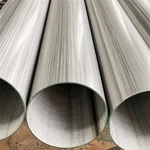

2205 Duplex Stainless Steel Plate
1. Standard: ASTM A240 / ASME SA240
2. Thickness: 0.5mm-50mm
3. Width: 1000-2500mm
4. Length: 1000-6000mm
5. Equivalent: Duplex 2205, UNS S32205, WNR.1.4462
Most 2205 Duplex Stainless Steel Plate data sheets tell you the same six things: chromium 22–23%, molybdenum 3%, yield 450 MPa, density 7.8 g/cm³, ASTM A240. That's the spec sheet. What it does not tell you is why a 14 mm 2205 plate costs less in a pressure vessel than a 20 mm 316L plate, why your fabricator cannot use the same welding procedure as 316L, and why "ASME BPVC Section VIII allowable stress" is a different number from "ASME B31.3 allowable stress" even though both say 2205.
Product Forms
Bar & Rod
Plate & Sheet
Coil & Strip
Pipe & Tube
Fitting: Flange, Tee, Elbow, Reducer etc.
Forging: Ring, Shaft, Circle, Block etc.

What the Spec Sheet Says vs What It Means
ASTM A240 / ASME SA-240 covers chromium and chromium-nickel stainless steel plate for pressure vessels and general applications. For UNS S32205 (2205), the spec sheet numbers are:
| Element / Property | ASTM A240 Limit (UNS S32205) | Typical Mill Heat | What the Difference Means |
|---|---|---|---|
| Chromium | 22.0 – 23.0% | 22.5% | Above 22% - the threshold for chloride SCC resistance |
| Nickel | 4.5 – 6.5% | 5.5% | Balances ferrite phase; too low = brittle |
| Molybdenum | 3.0 – 3.5% | 3.2% | Pitting resistance in chlorides |
| Nitrogen | 0.14 – 0.20% | 0.17% | Boosts PREN; stabilizes austenite |
| Carbon | ≤ 0.030% | 0.020% | Low carbon to prevent sensitization |
| PREN (calculated) | ≥ 35 | ~36.7 | Threshold for "duplex" performance |
| Yield strength, min | 450 MPa (65 ksi) | 460–480 MPa | ~2.6× the yield of 316L (170 MPa) |
| Tensile strength, min | 620 MPa (90 ksi) | 650–700 MPa | ~1.3× the tensile of 316L |
| Elongation, min | 25% | 30% | Ductility for forming and rolling |
| Hardness, max | 31 HRC (293 HBW) | 28 HRC | For sour service, ≤ 28 HRC per NACE MR0175 |
| Density | 7.8 g/cm³ (0.285 lb/in³) | - | Lighter than carbon steel by ~3% |
| Melting range | 1420 – 1465 °C | - | Welding window above 1000 °C |
The single most important number for the spec sheet is the 22% chromium floor. Below that, you do not have a duplex stainless - you have a lean duplex with compromised chloride resistance. Several mills produce S31803 (the older 2205 designation with 21% Cr minimum) at a small cost savings; if your spec says "S32205" you get the higher chromium chemistry and the PREN value that goes with it.
Why Buy 2205 Plate Instead of 316L Plate
For most buyers, the comparison is not 2205 vs 2507. It is 2205 vs 316L. The answer comes down to two things: weight (and therefore cost) and chloride resistance.
| Vessel / Service | Material Comparison | Weight / Cost Implication |
|---|---|---|
| Pressure vessel, ambient seawater, 25 °C | 14 mm 2205 vs 20 mm 316L | 2205 plate weighs 30% less; material cost saves 25–35% even at 1.8× the 316L price |
| Desalination evaporator shell | 12 mm 2205 vs 18 mm 316L | 2205 saves 33% on plate weight; reduces skid weight, foundation cost, lifting cost |
| Offshore topside equipment frame | 8 mm 2205 vs 12 mm 316L | 2205 saves 33% weight; less coating area, easier installation |
| Tubesheet (heat exchanger) | 2205 plate (vs titanium for seawater) | 2205 saves 50%+ vs titanium; ASME BPVC VIII qualified |
| Storage tank, dilute acid | 2205 plate (vs 316L) | 2205 lasts 2–3× longer in chloride-bearing acid |
Thickness, Sizes and Forms Available
We supply 2205 plate to ASTM A240 / ASME SA-240 in the following range. Other thicknesses and cut-to-size available on request.
| Form | Thickness Range | Width Range | Length Range | Finish |
|---|---|---|---|---|
| Hot rolled plate (HRAP) | 3.0 – 100 mm | 1000 – 2500 mm (up to 3000 mm) | 2000 – 12000 mm | No.1 (HR, annealed, pickled) |
| Cold rolled sheet | 0.5 – 6.4 mm | 1000 – 1500 mm | 2000 – 6000 mm | 2B, BA, No.4, mirror |
| Plasma / laser cut plate | As above | Custom | Custom | As-rolled or pickled |
| Plate for tubesheet (heavy) | 50 – 150 mm | up to 2500 mm | up to 6000 mm | No.1, machined faces |
The standard plate thickness range we keep in stock is 6 mm to 50 mm, which covers most pressure vessel and structural applications. Below 6 mm becomes "sheet" territory (cold rolled, 2B finish). Above 50 mm we order to size for the specific project; lead time is typically 6–10 weeks because heavy plate requires special rolling and solution annealing.
Standards, Certification and Documentation
For pressure vessel and structural applications, 2205 plate is supplied to the following standards:
| Standard | Scope | Typical Use |
|---|---|---|
| ASTM A240 / ASME SA-240 | Chromium / Cr-Ni stainless steel plate for pressure vessels | Most common; default |
| ASTM A480 / ASME SA-480 | General requirements for flat-rolled stainless | Companion to A240 |
| EN 10028-7 | Stainless steel flat products for pressure purposes | European pressure vessel |
| EN 10088-3 | Stainless steels for general purposes | European general |
| Werkstoff 1.4462 | German material number | European designation |
| NACE MR0175 / ISO 15156-3 | Sour service (H2S) compliance | Oil & gas, 28 HRC max |
| ASTM A923 | Detecting detrimental intermetallic phases in duplex | Weld procedure qualification |
Documentation shipped with every plate order:
| Document | Standard | Typical For |
|---|---|---|
| Mill Test Certificate (MTC) | EN 10204 3.1 or 3.2 | All shipments |
| Chemistry check (Cr 22–23%, Mo 3.0–3.5%, N 0.14–0.20%) | ASTM A240 | All shipments |
| Mechanical test report (yield, tensile, elongation, hardness) | ASTM A370 | All shipments |
| Solution annealing record (1020–1100 °C + rapid water quench) | Mill process record | All shipments |
| Ferrite content (35–65% per ASTM E562) | ASTM E562 | Duplex welds |
| Intermetallic phase test | ASTM A923 Method A | Welds for sour service |
| Charpy impact at –46 °C (≥ 150 J average, 3 specimens) | ASTM A370 | Cold-service / subsea |
| Country of origin / mill location | Customs | GCC and EU imports |
| PED conformity (for EU pressure equipment) | PED 2014/68/EU | European delivery |
For GCC delivery, the documentation list expands to include dual-tagging (heat number on plate AND certificate), AVL registration, and Saudi Arabia SASO conformity. Ask for a document transmittal list at RFQ stage so you know what arrives with the shipment.
Where 2205 Plate Is Used
Pressure vessel, structural, and fabrication applications:
| Industry | Where 2205 Plate Goes |
|---|---|
| Oil & gas | Separator vessels, scrubber shells, production manifold bodies, flare stack linings, hydrocarbon storage |
| Desalination | SWRO high-pressure pump housings, evaporator shells, brine heater shells, intake piping supports |
| Chemical / petrochemical | Reactor vessels, acid storage tanks, heat exchanger tubesheets and shells |
| Pulp & paper | Digesters, blow tanks, black liquor heaters |
| Marine / offshore | Topside equipment frames, firewater pump housings, structural support plates |
| Power generation | FGD absorber shells (2205 qualified to ~300 °C; above that, upgrade to Inconel 625), cooling water systems |
| Mining | Slurry pipelines, leaching vessels, thickener shells |
The decision rule for upgrading from 2205 plate to 2507 super duplex plate is the same as the pipe decision: chloride concentration above ~5,000 ppm, H2S partial pressure above 0.05 psi, or seawater service temperature above ~50 °C. For 2205 plate at temperatures above 300 °C (continuous service), upgrade to Inconel 625 plate.
Welding Notes (Plate vs Pipe)
Plate welds behave differently from pipe welds, and the fabricator's WPS must reflect this.
| Difference | Pipe Welding | Plate Welding |
|---|---|---|
| Position | All positions (6G qualified) | Mostly flat (1G) and horizontal (2G) |
| Joint type | Butt weld, branch connection | Butt weld, fillet weld, lap joint, tubesheet-to-shell |
| Heat input | 0.5 – 2.5 kJ/mm (duplex) | Same window - heat input matters just as much |
| Filler | ER2209 (most common) | ER2209 (same) |
| PWHT | Never (sigma phase risk) | Never (sigma phase risk) |
| Ferrite check | Weld + HAZ per ASTM E562 | Same - weld + HAZ per ASTM E562 |
| Intermetallic phase test | ASTM A923 Method A (welds) | Same - ASTM A923 Method A |
The plate-specific risks to watch for: thick-plate welds (above ~25 mm) may require multiple passes with controlled interpass temperature (≤ 150 °C) because heat builds up in the joint; tubesheet-to-shell welds are deep grooves with high restraint and risk of root cracking if the WPS is not qualified for the actual joint geometry; clad plate (2205 plate with a stainless or nickel alloy cladding layer) requires separate welding procedures for the base 2205 and the cladding layer.
What to put in your RFQ: "plate to be welded per ASME Section IX qualified WPS using ER2209 filler, heat input 0.5–2.0 kJ/mm, interpass temperature ≤ 150 °C, ferrite content 35–65% per ASTM E562 in weld and HAZ, ASTM A923 Method A corrosion test on PQR coupon, no PWHT."
FAQ
Q: About 2205 Duplex Stainless Steel Plate price per kg?
A: Prices ranges from $5 to $10 per kg, vary depending on size, wall thickness, supplier etc.
Q: How long does your delivery time take?
A: Delivery time is within 5-21 days
Q: Is There Sample Service?
A: Samples Are Provided Free Of Charge
Q: What Is The Minimum Order Quantity?
A: No Minimum Order Quantity
Q: How to pack the products?
A: The inner layer has a waterproof paper outer layer and is fixed with a fumigation wooden pallet.
Q: Exported Countries
A: Brazil, South Africa, Indonesia, India, Singapore, Malaysia, Iran, Russia, UAE, Chile, Laos, etc
Hot Tags: 2205 duplex stainless steel plate, ASTM A240 S32205 plate, duplex 2205 plate supplier, SA 240 duplex plate, UNS S32205 plate, 304 plate, 317 Stainless Steel Plate, 321 Stainless Steel Plate, duplex steel plate, s31803 plate, Stainless Steel Plate
Previous
S321 PlateYou Might Also Like


Send Inquiry