


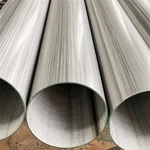

AMS 5536 Hastelloy UNS N06002 Plate
1. ASTM B435, ASME SB 435
2. Length: 0-12m
3. Width: 0-2500mm
4. Thickness: 0.3-120mm
5. Process: Hot rolled, cold rolled
6. Grades:Hastelloy x, alloy x,2.4665, UNS N06002
Most nickel alloys on a plate mill's schedule are sold for corrosion. AMS 5536 Hastelloy UNS N06002 Plate is sold for heat. It is a nickel-chromium-iron-molybdenum alloy with roughly 22% chromium and 18% iron, solid-solution strengthened by molybdenum, tungsten and cobalt, and specified almost everywhere a metal part has to hold shape in an oxidizing furnace atmosphere above 900 °C.
When a drawing says AMS 5536 or ASTM B435 and calls for Alloy X, HX or UNS N06002, this is the plate that answers it. This page covers the specification structure, the composition and mechanical limits that a mill certificate actually has to meet, the physical data a designer needs, the heat-treatment window, the sheet-to-plate boundary that changes tolerances, and the fabrication rules that decide whether the part survives its first thermal cycle.

What the designation actually names
Four names travel together and are often used interchangeably on purchase orders, which is where confusion starts:
Hastelloy X - the original Haynes trade name. Still the name most drawings use.
Alloy X / HX - the generic designation used by SAE and by mills that do not hold the trademark.
UNS N06002 - the only identifier that is unambiguous across standards bodies.
W.Nr. 2.4665 / NiCr22Fe18Mo - the European number and compositional name, used when a project is specified to DIN or EN-derived documents.
Two specification families cover the same plate, and they are not interchangeable in scope:
| Document | Scope | Who uses it |
|---|---|---|
| AMS 5536 (rev R, 2024) | Sheet, strip and plate, solution heat treated, aerospace quality | Aerospace primes, gas turbine supply chains, defence |
| AMS 5754 | Bar, forgings and rings of the same alloy and condition | Same customers, different product form |
| ASTM B435 / ASME SB-435 | Plate, sheet and strip for general and pressure service | Industrial furnace builders, chemical plant, EPC |
| ASTM B572 / B619 / B622 / B626 | Rod, welded pipe, seamless tube, welded tube | Where the duty is tubular rather than flat |
| ASTM B366 | Fittings | Piping packages |
AMS 5536 and B435 describe the same metal, in the same heat-treated condition, with the same nominal chemistry. The difference is the administrative layer: AMS adds aerospace sampling, strain-rate control in tensile testing, pyrometry and identification requirements that a general industrial order does not need and should not pay for. If the end user is a turbine OEM, order AMS 5536. If the end user is a furnace or a chemical plant, B435 is sufficient and cheaper to certify.
Composition, as the specification writes it
The limits below are the AMS 5536R table. B435 sits within a few hundredths of a percent on the residuals and is functionally the same alloy. Buyers should not accept a certificate that reports only typical values for carbon, because carbon is the element that controls both creep behaviour and long-term embrittlement.
| Element | Min (%) | Max (%) | Function in the alloy |
|---|---|---|---|
| Ni | balance | - | Austenitic matrix, toughness, phase stability |
| Cr | 20.50 | 23.00 | Cr2O3 scale - the oxidation resistance |
| Fe | 17.00 | 20.00 | Cost control, thermal expansion balance |
| Mo | 8.00 | 10.00 | Principal solid-solution strengthener |
| Co | 0.50 | 2.50 | Supplementary solid-solution strengthening |
| W | 0.20 | 1.00 | High-temperature creep contribution |
| C | 0.05 | 0.15 | Grain-boundary carbides; creep versus ductility trade-off |
| Mn | - | 1.00 | Deoxidation, residual control |
| Si | - | 1.00 | Melt practice residual |
| Al | - | 0.50 | Residual; not an age-hardening addition |
| Ti | - | 0.15 | Residual only |
| B | - | 0.010 | Grain-boundary strengthening at trace level |
| Cu | - | 0.50 | Residual |
| P / S | - | 0.040 / 0.030 | Residual limits |
Two practical consequences follow from that table. First, this is a solid-solution alloy, not a precipitation-hardening one. There is no ageing step, no γ″, no solution-plus-age cycle. It cannot be made stronger by heat treatment the way 718 or A286 can, which is exactly why it welds and forms without strain-age cracking. Second, the 17–20% iron is what separates it commercially from 625: roughly half the molybdenum, no niobium, and iron instead of a fully nickel-based matrix, which is why X plate typically prices well below 625 plate at equal thickness.
Mechanical limits and what a mill certificate shows
AMS 5536 requires, in the solution heat treated condition, at room temperature:
| Property | ksi | MPa | Note |
|---|---|---|---|
| Tensile strength, min | 100 | 690 | Specification minimum |
| Yield strength, 0.2% offset, min | 45 | 310 | Specification minimum |
| Elongation in 2 in, min | - | 35% | Ductility floor |
Typical solution-treated plate runs considerably above those floors. Representative values from mill and producer data:
| Test temperature | 0.2% yield (MPa) | Tensile (MPa) | Elongation (%) |
|---|---|---|---|
| 21 °C (70 °F) | 340 | 760 | 48.9 |
| 538 °C (1,000 °F) | 224 | 604 | 60.2 |
| 649 °C (1,200 °F) | 212 | 558 | 63.5 |
| 760 °C (1,400 °F) | 218 | 421 | 74.5 |
| 871 °C (1,600 °F) | 189 | 255 | 98.1 |
| 982 °C (1,800 °F) | 94 | 138 | 98.1 |
| 1,093 °C (2,000 °F) | 45 | 72 | 95.3 |
Read the yield column carefully. Between 649 °C and 760 °C the yield strength is essentially flat, then collapses above 871 °C. That is not a defect; it is the signature of a solid-solution alloy with no precipitation reserve. Design above about 900 °C must be governed by creep rupture data and the allowable stress table, not by a tensile value, because the tensile test no longer describes what the part is doing under sustained load.
Physical properties
| Property | Value |
|---|---|
| Density | 8.22 g/cm³ (0.297 lb/in³) |
| Melting range | 1,260–1,355 °C (2,300–2,470 °F) |
| Modulus of elasticity, room temperature | 205 GPa (29.8 × 10&sup6; psi) |
| Thermal expansion, 25–93 °C | 13.9 × 10⁻⁶/°C |
| Thermal expansion, 20–538 °C | 15.1 × 10⁻⁶/°C |
| Thermal expansion, 26–982 °C | 16.6 × 10⁻⁶/°C |
| Thermal conductivity, room temperature | 9.1 W/(m·K) |
| Thermal conductivity, 593 °C | 20.8 W/(m·K) |
| Hardness, plate, solution treated | 87 HRB typical |
| Grain size, plate, typical | ASTM 3.5–6 |
| Magnetic response | Paramagnetic, fully austenitic |
The low thermal conductivity is the number that catches fabricators. At 9.1 W/(m·K) this alloy conducts heat at roughly a fifth of the rate of carbon steel, so heat sits in the weld pool and in the heat-affected zone. Weld procedures written for stainless steel, with stainless-steel heat input and stainless-steel interpass limits, will over-heat this alloy. Groove preparations also need more root clearance than a stainless procedure would use to achieve full penetration.
The sheet-to-plate boundary at 4.76 mm
AMS 5536 covers sheet, strip and plate in one document, but the tolerance regime changes at the sheet/plate line: sheet is up to and including 0.1874 in (4.76 mm), plate is 0.1875 in (4.76 mm) and above. The same boundary logic appears in the nickel plate standards generally. Two things follow for a buyer:
- A 4.5 mm item and a 5 mm item are not the same product even though both are "Alloy X". Thickness tolerance, camber allowance and edge condition are governed by different clauses.
- If a drawing calls for 4.76 mm exactly, confirm with the mill whether it will be rolled as sheet or as plate before quoting, because the price step at that boundary is real.
Heat treatment: the window is narrow and it is not optional
Wrought product is supplied solution heat treated unless the order states otherwise. The standard practice is a hold at 1,175–1,205 °C (2,150–2,200 °F) followed by rapid cooling - water quench, or rapid air for thin sections, with bright-annealed material cooled in hydrogen.
Annealing below the solution temperature is the mistake that ruins plate quietly. Between roughly 650 °C and 982 °C this alloy precipitates secondary phases, and those phases raise room-temperature strength while removing ductility. A plate annealed at 1,050 °C because the furnace could not reach 1,180 °C will pass a tensile test and fail a bend test, and it will be brittle in service. Any hot-worked or cold-worked part must be re-solution-treated and rapidly cooled before it goes into a furnace.
Welding and what the heat-affected zone does
This alloy has excellent weldability for a superalloy, and the reason is structural: because it does not age-harden, it cannot suffer strain-age cracking during the weld thermal cycle. That is what makes it the default choice for complex, multi-pass sheet assemblies such as combustor liners and transition ducts.
| Parameter | Practice |
|---|---|
| Processes | GTAW primary; GMAW for heavier sections; PAW and EBW for aerospace joints; resistance welding for thin sheet |
| Filler metal | ERNiCrMo-2 matching filler (AMS 5798 wire); ERNiCrMo-3 acceptable for many joints |
| Preheat | Not required; shop temperature is the usual specification |
| Interpass temperature | Below 93 °C (200 °F) |
| Post-weld heat treatment | Generally not required; solution anneal at 1,175 °C for severe service, or stress relief at 871 °C for one hour on large complex fabrications |
| Submerged arc welding | Not recommended - high heat input and slow cooling raise restraint and promote cracking |
Two failure modes belong to the heat-affected zone rather than to the weld metal. The first is microfissuring under excessive heat input, which is why interpass temperature control matters more here than on stainless steel.
The second is long-term embrittlement: service in the 650–870 °C band precipitates grain-boundary phases, and Charpy impact energy falls from roughly 73 J in the solution-treated condition to about 12 J after 168 hours at 816 °C. The part does not crack in service at temperature; it cracks during a cold start, a shutdown, or a straightening operation afterwards. Handle long-service X plate as a brittle material, not as the ductile plate that arrived at goods-in.
Oxidation and atmosphere resistance: where this grade is actually specified
The chromium level produces a tenacious Cr2O3 scale that resists spalling, which is why the alloy is quoted for oxidizing service to 1,204 °C (2,204 °F) and for useful strength to about 816–870 °C. Above that, oxidation is still acceptable but design becomes creep-governed.
Its behaviour in carburizing and nitriding atmospheres is the part most competing pages skip. In petroleum coke at 1,038 °C, a 309 stainless specimen was fully penetrated within 100 hours while Alloy X showed no measurable carburization depth. In a hydrogen/nitrogen/ammonia atmosphere at 593 °C and 15,000 psi, apparent nitride layer thickness was 0.01 mm against 0.08 mm for 310 stainless, with no intergranular attack and no bend failure.
The limitation is equally specific: this grade is not a wet-corrosion alloy. It should not be ordered for seawater immersion, chloride brines, or reducing acid service. A 22% Cr, 9% Mo nickel alloy will survive many acidic streams, but it has no molybdenum level comparable to C-276 and no niobium to match 625, and specifying it for wet chloride duty is a mis-application that no certificate will rescue.
How it compares with the alloys it usually replaces
| Grade | Practical ceiling in oxidizing service | Strength above 900 °C | Wet corrosion | Relative plate cost |
|---|---|---|---|---|
| 310S / 310H stainless | ~1,050–1,150 °C | Low; scaling and creep limit life | Moderate, aqueous only | Baseline for high-heat stainless |
| Incoloy 800H / 800HT | ~1,100 °C | Moderate | Good in many aqueous streams | Below Alloy X |
| Inconel 625 | ~980 °C | Lower above 950 °C | Excellent, chlorides and seawater | Above Alloy X |
| Hastelloy X | ~1,204 °C intermittent | Highest of the four in this band | Not intended for wet chloride | Middle of the group |
The substitution pattern that shows up in real projects: 800H is downgraded into where the duty is 900–1,000 °C and load is modest; 310S is used where cost dominates and the part is a simple heat-resistant shape; 625 is pulled in when the same part also sees wet chlorides or needs room-temperature strength.
Alloy X is specified when the temperature is high and the part is a formed, welded sheet structure with mechanical load - the combustion-zone component that has to hold its shape through thousands of thermal cycles.
Fabrication notes that affect the invoice
- Hot forming requires the whole piece to reach 1,177 °C, not just the surface, before deformation. Parts that were only surface-heated crack at the outside radius.
- Cold forming is practical and the work-hardening rate is close to that of austenitic stainless steel, so existing press tooling usually transfers without redesign.
- Machining runs at 40–80 surface feet per minute with carbide, flood coolant, positive-rake inserts. Dry machining work-hardens the surface and destroys tool life within a few passes.
- Cutting is best done by waterjet or plasma with a defined edge allowance, because the cut edge is a heat-affected zone that may need to be dressed back before the part goes into service.
- Pickling after welding removes the heat tint that would otherwise become the initiation site for scale breakdown in the first thermal cycle.
Typical duties this plate is ordered for
Gas turbine combustion hardware - transition ducts, combustor cans and liners, spray bars, flame holders, afterburner and tailpipe components. Industrial furnace internals - furnace rolls, trays, fixtures, muffles, retorts, radiant tubes, heat-treating baskets, kiln furniture, radiation shields. Chemical and petrochemical - catalyst support grids, high-temperature ducting, pyrolysis tube hangers, flash-drier components, pressure vessels for sulphurous gas service.
The service record worth quoting: furnace rolls of this alloy were still in good condition after 8,700 hours at 1,177 °C. That is the kind of evidence a furnace builder wants, and it is only achievable when the plate went in solution-treated, the weld was made with matching filler, and the scale was allowed to form cleanly without repeated reducing excursions.
What to put on the purchase order
| Line item | What to write | Why it matters at goods-in |
|---|---|---|
| Standard and form | AMS 5536R or ASTM B435, plate, solution heat treated | Determines the certification pack and the tolerance clause |
| UNS number | UNS N06002 (with Alloy X / HX as cross-reference) | Prevents substitution with a corrosion-grade Hastelloy |
| Thickness basis | Nominal or minimum, plus the applicable AMS 2262 tolerance class | Weight, price and fit all move with this single word |
| Condition verification | Solution anneal temperature and cooling method stated on the certificate | The only defence against a low-temperature anneal |
| Grain size | ASTM 3.5–6 if creep life is designed in; omitted otherwise | A clause nobody checks adds cost and no value |
| Testing | Tensile plus product analysis; UT per ASME VIII where pressure service applies; PMI on 100% of pieces for critical duty | Mixed-load risk on a grade that looks like every other nickel plate |
| Surface | Hot rolled and pickled, or bright annealed, with the finish class stated | Oxide carry-over into a furnace is a service-life penalty |
| Edge and cut | Sheared, saw cut or waterjet, with the allowance for heat-affected material defined | Plasma-cut edges are not weld-prep edges |
Indicative plate pricing in 2026, ex-stock Asia, runs roughly USD 35–85 per kilogram depending on thickness, finish and certification level, with heavy plate and aerospace-certified stock at the upper end and standard industrial plate toward the lower. Treat that as a band, not a quote: nickel, cobalt and molybdenum movements, plus mill rolling schedules for a low-volume grade, move this alloy more than published lists do.
Huitong supplies Hastelloy X plate and sheet to AMS 5536 and ASTM B435 / ASME SB-435 in thickness from 3 mm to 60 mm, cut to size, with mill test certificates, third-party inspection and PMI on request. Send the drawing, the design temperature and the atmosphere the part will see, and the grade question usually answers itself before the quotation stage.
FAQ
Q: About AMS 5536 Hastelloy UNS N06002 Plate price per kg?
A: Prices ranges from $25 to $40 per kg, vary depending on size, wall thickness, supplier etc.
Q: How long does your delivery time take?
A: Delivery time is within 5-21 days
Q: Is There Sample Service?
A: Samples Are Provided Free Of Charge
Q: What Is The Minimum Order Quantity?
A: No Minimum Order Quantity
Q: How to pack the products?
A: The inner layer has a waterproof paper outer layer and is fixed with a fumigation wooden pallet.
Q: Exported Countries
A: Brazil, South Africa, Indonesia, India, Singapore, Malaysia, Iran, Russia, UAE, Chile, Laos, etc
Hot Tags: ams 5536 hastelloy uns n06002 plate, China ams 5536 hastelloy uns n06002 plate manufacturers, suppliers
Previous
Hastelloy B-2 PlateNext
No InformationYou Might Also Like


Send Inquiry