


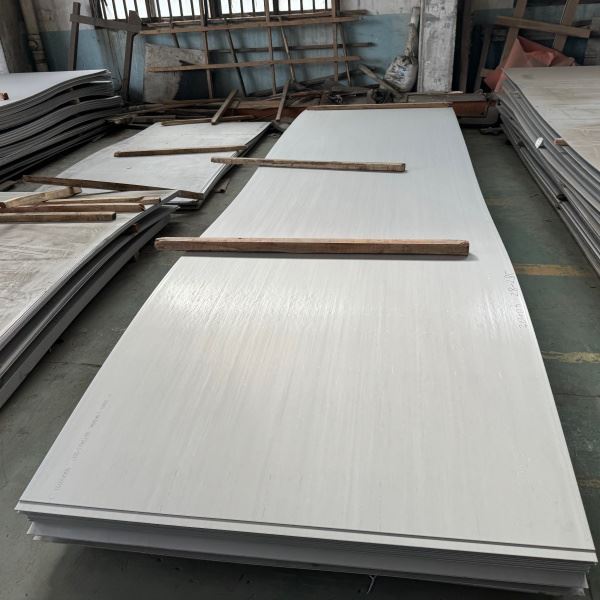
Hastelloy B3 UNS N10675 Plate
ASTM B333 / ASME SB-333
UNS N10675 / 2.4600
Solution annealed, 0.5-50 mm
Hastelloy B3 UNS N10675 Plate travels under a family of standards, and the fastest way to spot a sloppy quote is to check whether the right document is attached to the right form:
Table 1. Form-standard map for UNS N10675
| Product form | Governing standard | Notes |
| Plate, sheet, strip | ASTM B333 / ASME SB-333 | The document your plate RFQ must cite |
| Bar and rod | ASTM B335 | Forgings per B564 / B462 |
| Seamless pipe and tube | ASTM B622 | Welded pipe per B619 / B626 |
| Welded fittings | ASTM B366 | Fabricated from plate or pipe |
| W.Nr. / GB equivalents | 2.4600 / NiMo28 / NS3203 | Appear on EU and Chinese paperwork |
The recurring paperwork error we correct: plate RFQs that reference B622 (a pipe standard) or B619 (welded pipe). A mill that receives "B622 plate" either returns the RFQ or, worse, ships pipe-standard documentation against plate - and the mismatch surfaces at certificate review, not at the mill.
Product Forms
Bar & Rod
Plate & Sheet
Coil & Strip
Pipe & Tube
Fitting: Flange, Tee, Elbow, Reducer etc.
Forging: Ring, Shaft, Circle, Block etc.
What the certificate legally guarantees: two listings, two different minimums
Current listings for B-3 plate disagree on the most basic numbers: one states tensile ≥ 760 MPa and yield ≥ 350 MPa; another writes 690 MPa and 310 MPa. Only the first set is right for plate. ASTM B333 for annealed N10675 requires:
Table 2. Certified minimums for annealed B-3 plate
| Property | ASTM B333 minimum (annealed) | Typical delivered value |
| Tensile strength | ≥ 760 MPa (110 ksi) | ≈ 860-890 MPa |
| 0.2% yield strength | ≥ 350 MPa (51 ksi) | ≈ 400-420 MPa |
| Elongation | ≥ 40% | ≈ 50-58% |
| Hardness | ≈ HRB 100 max (annealed) | ≈ 92-95 HRB |
The 690/310 pair floating around SERP pages is a lower bar than the standard sets - material passing it is not automatically conforming B-3 plate. If a supplier's datasheet shows those numbers, ask which document they were copied from; nobody has produced a standard that contains them. Design calculations should use the B333 floor, and thickness sizing should use the 9.22 g/cm3 density (110.6 kg per square metre at 12 mm) when checking quote weights.
The size program: what ships from where
This is the tier map behind the price spread. B-3 production runs are smaller than for the C-family alloys, so availability - not just price - changes by thickness:
Table 3. Thickness tiers, typical widths and supply reality
| Tier | Thickness | Typical widths (mm) | Condition / finish | Supply reality |
| Cold-rolled sheet | 0.5-3.0 mm | 1000 / 1219 | Solution annealed, 2D | Coil and sheet stock; fastest cut-to-size turnaround |
| Cold-rolled sheet | 3.0-6.0 mm | 1219 / 1500 | Solution annealed, 2D | Partial stock; commonly short-lead mill order |
| Hot-rolled plate | 6.0-12 mm | 1500 / 2000 | Solution annealed, No.1 | The workhorse tier; mill-order dominant, some stock in common sizes |
| Hot-rolled plate | 12-25 mm | 1500 / 2000 | Solution annealed, No.1 | Mill order; plan procurement ahead of fabrication start |
| Heavy plate | 25-50 mm | 1500 / 2000 | Solution annealed, No.1 + UT option | Mill order, longest lead; ask for ultrasonic test on thick tiers |
| Above 50 mm | By agreement | By agreement | Solution annealed, UT | Forged or rolled to order; treat as a project item |
One structural fact of this market worth knowing before you write the PO: inventory in this family concentrates in B-2 (N10665), while B-3 is more frequently a mill-order item. B-2 and B-3 share the B333 mechanical floors, so where a B-2 plate is genuinely on the shelf and your design allows it, substitution is sometimes the schedule-saving move - but the chemistry and weldability differences mean that call belongs on the engineering side of the desk, not the procurement side, and the substitute must ship under its own UNS designation, never relabelled.
Four lines to put on the B-3 plate PO
The purchase order is where tier pricing either protects you or ambushes you:
- Standard and form on one line: "UNS N10675 plate per ASTM B333" - not B622, not "Hastelloy B material", not a bare grade name.
- Condition with temperature: solution annealed, with the actual anneal temperature and rapid quench recorded on the MTR. B-3's thermal stability is the grade's selling point over B-2; a plate cooled slowly through intermediate temperatures quietly gives that advantage away.
- Surface and edge by tier: No.1 (hot-rolled, annealed, pickled) for plate tiers; 2D for cold-rolled sheet; mill edge or sheared edge specified, not assumed.
- UT on heavy tiers: ultrasonic examination requested explicitly above about 25 mm; it is an add-on item, not a default.
On the 12-25 mm band specifically: it is mill-order territory, and fabrication start dates that assume shelf availability in that band are the single most common replanning trigger on this grade. Plan procurement against the mill lead time, not against a stock figure from a listing.
FAQ
Q: About Hastelloy B3 UNS N10675 Plate price per kg?
A: Prices ranges from $25 to $40 per kg, vary depending on size, wall thickness, supplier etc.
Q: How long does your delivery time take?
A: Delivery time is within 5-21 days
Q: Is There Sample Service?
A: Samples Are Provided Free Of Charge
Q: What Is The Minimum Order Quantity?
A: No Minimum Order Quantity
Q: How to pack the products?
A: The inner layer has a waterproof paper outer layer and is fixed with a fumigation wooden pallet.
Q: Exported Countries
A: Brazil, South Africa, Indonesia, India, Singapore, Malaysia, Iran, Russia, UAE, Chile, Laos, etc
Hot Tags: UNS N10675, ASTM B333, 2.4600, NS3203, NiMo28, nickel-molybdenum plate, B335 bar, B622 seamless pipe
Next
No InformationYou Might Also Like


Send Inquiry