


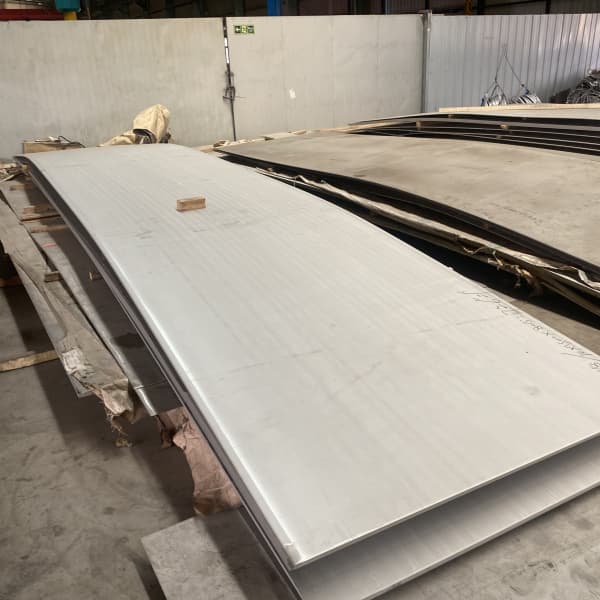
ASTM A693 Type 630 17-4 PH Plate
1.Thickness: 0.1mm - 150mm
2.Width: 1000 - 3300mm
3.Length: 1000 - 12000mm
4.Equivalent: UNS S17400, WNR.1.4542, Type 630
5.Standard:ASTM A 693,ASME SA 693,AMS 5604
The name 17-4PH is quietly misleading. The "17" reads like a 400-series ferritic stainless, the "4" sounds like a nickel add-on, and the whole name looks like a chemistry footnote. In fact 17-4PH is one of the strongest stainless steels a fabricator can buy - a martensitic precipitation-hardening grade that reaches 1,310 MPa tensile in its hardest condition, about 70% stronger than a standard 304 at the same section.
The name hides the interesting part: this grade does not get its strength from alloying alone, but from a heat-treatment step that the buyer - not the mill - must specify. Order 17-4PH plate without naming a condition and you receive a soft, machinable plate with half the strength it is capable of. This article explains the two personalities, the five aged conditions in between, and the fields that must appear on the purchase order.
Product Forms
Bar & Rod
Plate & Sheet
Coil & Strip
Pipe & Tube
Fitting: Flange, Tee, Elbow, Reducer etc.
Forging: Ring, Shaft, Circle, Block etc.
Personality one: the soft condition (Condition A)
As delivered and after solution annealing at about 1,038°C with air cooling, 17-4PH is martensitic but soft - roughly 895 MPa tensile at room temperature, with good elongation. In this condition the plate can be formed, machined, and welded more easily than at any later stage. It is the condition in which fabricators do the work: cut the blanks, machine the faces, weld the assembly. The strength is added afterwards, in the final heat treatment. This two-stage logic is the entire point of precipitation-hardening stainless: shape it while it is soft, harden it when it is done.
Personality two: the hardened conditions (H900 to H1150)
A short age at 482°C to 621°C transforms the plate. Copper, which is dissolved in the martensitic matrix after annealing, precipitates as nanoscale copper-rich particles that pin the structure and lift the yield strength to 1,170 MPa at H900. Raise the ageing temperature and the precipitates coarsen, trading strength for toughness and corrosion resistance. The buyer picks the trade-off point - the same plate chemistry, the same mill, five different finished products. That is why the condition code is the most important line on a 17-4PH order.
The chemistry behind the trick
| Element | Range (wt %) | Job it does |
| Carbon | 0.07 max | Kept low; strength comes from precipitation, not from carbides |
| Chromium | 15.0 - 17.5 | Passive film and corrosion resistance on the level of 304 in most services |
| Nickel | 3.0 - 5.0 | Stabilises the martensitic structure and toughness |
| Copper | 3.0 - 5.0 | The precipitation element - forms the Cu-rich particles that harden the plate |
| Niobium + Tantalum | 0.15 - 0.45 | Refines grain and helps control the precipitation response |
| Manganese / Silicon | 1.00 / 1.00 max | Deoxidation and melting discipline |
Two numbers do the heavy lifting: copper makes the grade hardenable, chromium makes it stainless. Remove the copper and the plate stays at martensitic-strength levels with no way to climb to 1,300 MPa. Remove the chromium and the corrosion resistance collapses to a low-alloy steel.
Choosing the condition: strength or toughness
| Condition | Aging temp | Tensile (MPa) | Yield 0.2% (MPa) | Elongation (%) | Hardness (HRC) |
| H900 | 482 °C / 1 h | 1310 min | 1170 min | 10 min | 40 - 47 |
| H925 | 496 °C / 4 h | 1170 min | 1070 min | 10 min | 38 - 46 |
| H1025 | 552 °C / 4 h | 1070 min | 1000 min | 12 min | 35 - 44 |
| H1075 | 579 °C / 4 h | 1000 min | 860 min | 13 min | 33 - 43 |
| H1100 | 593 °C / 4 h | 965 min | 795 min | 14 min | 32 - 40 |
| H1150 | 621 °C / 4 h | 930 min | 724 min | 16 min | 28 - 38 |
The rule of thumb: H900 buys maximum strength and hardness for components that carry load in compression or wear - pump shafts, valve stems, fasteners. H1025 to H1075 is the engineering middle, where strength stays high and toughness is acceptable. H1150 is chosen when the part sees impact, chloride exposure, or needs good weldability after hardening. The same plate, five different engineering answers.
Standards and product forms
| Form | Standard | Notes |
| Plate / sheet / strip | ASTM A693 (Type 630) | The plate standard; covers Condition A and the H conditions |
| Bar / rod / wire | ASTM A564 (Grade 630) | The most common form for machined components |
| Forgings | ASTM A705 | Valve bodies, flanges, pump components |
| Aerospace sheet | AMS 5604 | Aerospace-grade plate and sheet |
Where 17-4PH plate earns its premium
- Valve stems and trims - high hardness, good galling resistance, machined from hardened bar or plate
- Pump shafts and impellers - fatigue strength at the H900-H1075 range
- Aerospace and defence components - AMS 5604 sheet in H1025/H1075
- Fasteners and pins - the classic 17-4PH duty, replacing alloy steels where corrosion also matters
- Mould and tooling plates - wear resistance at moderate cost
Three misconceptions that cost money
- "17-4PH is stainless, so it is corrosion-proof." It resists corrosion about like 304 in atmospheric and mild service, but in strong chlorides it pits and can suffer SCC. For aggressive chloride duty, specify the H1150 condition and consider a higher-alloy grade instead.
- "Welding is fine without heat treatment." Welding in Condition A is acceptable, but the weld zone loses the precipitation hardening - the assembly must be re-solution-annealed and aged to recover strength, or the design must tolerate a locally soft weld.
- "H900 is the best condition because it is the strongest." Above roughly 300°C service temperature the H900 condition over-ages and softens, and its toughness is the lowest of the family. High-temperature or impact service calls for a higher aging condition.
What to put on the purchase order
- Standard and grade: ASTM A693 Type 630 / UNS S17400
- Condition: Condition A (for fabrication) or the exact H code (for finished components) - never leave this blank
- Dimensions: thickness, width, length, and the cutting tolerance if blanks are supplied
- Certificate: EN 10204 3.1 with chemistry, heat number, and the heat-treatment record
- Inspection: hardness check on the delivered plate against the ordered condition
The plate that arrives is only half the specification. The other half is the heat-treatment decision the buyer controls. Name the condition, and 17-4PH delivers the strongest stainless plate in the catalogue; leave it unstated, and the same plate arrives at a fraction of that strength.
FAQ
Q: About ASTM A693 Type 630 17-4 PH Plate price per kg?
A: Prices ranges from $2 to $10 per kg, vary depending on size, wall thickness, supplier etc.
Q: How long does your delivery time take?
A: Delivery time is within 5-21 days
Q: Is There Sample Service?
A: Samples Are Provided Free Of Charge
Q: What Is The Minimum Order Quantity?
A: No Minimum Order Quantity
Q: How to pack the products?
A: The inner layer has a waterproof paper outer layer and is fixed with a fumigation wooden pallet.
Q: Exported Countries
A: Brazil, South Africa, Indonesia, India, Singapore, Malaysia, Iran, Russia, UAE, Chile, Laos, etc
Hot Tags: 17-4ph plate, UNS S17400, ASTM A693, type 630 stainless, 17-4 ph stainless steel, precipitation hardening plate, S17400 plate, 1.4542, 2205 stainless steel plate, 310S Stainless Steel Plate, 316 stainless plate, 347 Stainless Steel Plate, duplex 2205 plate, s31803 duplex
Next
No InformationYou Might Also Like


Send Inquiry