


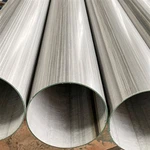

ASME SB423 Incoloy 825 Pipe
1. Standard: ASTM B423、ASTM B407、ASTM B163
2. Diameters: 4.0 - 1219.2 mm
3. Wall thickness: 0.5 to 20mm
4. Length: Single, Double Random & Cut Length
5. Grades:Incoloy 825, UNS N08825, WNR.2.4858
ASME SB423 Incoloy 825 pipe (UNS N08825, W.Nr. 2.4858) sits in a useful spot in the nickel alloy family: it carries enough chromium, molybdenum, and copper to handle sulfuric and phosphoric acid service that destroys 316L, but it costs substantially less than Inconel 625 or Hastelloy C276. The titanium stabilization that is built into its chemistry makes it weldable without the sensitization problems that plague non-stabilized grades.
Product Forms
Bar & Rod
Plate & Sheet
Coil & Strip
Pipe & Tube
Fitting: Flange, Tee, Elbow, Reducer etc.
Forging: Ring, Shaft, Circle, Block etc.

Chemical Composition (ASTM B423)
| Element | Specification (wt %) | Typical | What It Does |
|---|---|---|---|
| Nickel | 38.0 – 46.0 | 42.0 | Austenitic base; sufficient Ni for chloride SCC resistance |
| Chromium | 19.5 – 23.5 | 21.5 | Passive film for oxidizing acid resistance |
| Iron | 22.0 min | 30.0 | Balance; keeps cost below higher-Ni alloys |
| Molybdenum | 2.5 – 3.5 | 3.0 | Pitting and crevice resistance in chlorides |
| Copper | 1.5 – 3.0 | 2.2 | Reducing-acid resistance - the element that makes 825 good in H2SO4 |
| Titanium | 0.6 – 1.2 | 0.9 | Stabilization - ties up carbon, prevents sensitization in the weld HAZ |
| Carbon | 0.05 max | 0.02 | Kept low; Ti handles the rest |
| Manganese | 1.0 max | 0.5 | Deoxidation |
| Silicon | 0.5 max | 0.2 | - |
| Sulfur | 0.03 max | 0.01 | - |
| Aluminum | 0.2 max | 0.05 | - |
The titanium is the element that makes 825 different from a standard Ni-Cr-Fe alloy like 800H. Without titanium, welding 800H can cause chromium carbide precipitation at grain boundaries in the HAZ, creating a narrow zone susceptible to intergranular attack. 825's Ti (0.6–1.2%) preferentially forms TiC, leaving the chromium in solution and the HAZ corrosion-resistant as-welded. This is why 825 is specified for welded pipe spools in acid service where 800H would need solution annealing after welding.
The copper (1.5–3.0%) is the other distinguishing element. Copper gives 825 its edge in sulfuric and phosphoric acid - it is the same reason 904L carries copper. Without copper, the alloy would be a general-purpose Ni-Cr-Fe grade; with it, 825 handles dilute-to-intermediate sulfuric acid at temperatures that pit 316L.
Mechanical Properties (ASTM B423 Annealed)
| Property | Cold-Worked Annealed (typical) | Hot-Finished Annealed |
|---|---|---|
| Tensile strength, min | 586 MPa (85 ksi) | 517 MPa (75 ksi) |
| Yield strength (0.2% offset), min | 241 MPa (35 ksi) | 172 MPa (25 ksi) |
| Elongation in 50 mm, min | 30 % | 30 % |
| Hardness (typical) | ≤ 200 HB | ≤ 200 HB |
Most process piping is supplied in the cold-worked annealed condition, which delivers the higher mechanical properties. For pressure design, always confirm which condition your MTR references - the yield strength difference between the two conditions is significant (241 vs 172 MPa) and changes wall thickness calculations.
Physical Properties
| Property | Value | Design Note |
|---|---|---|
| Density | 8.14 g/cm³ | Lighter than C276 (8.89) and 625 (8.44) |
| Melting range | 1370 – 1400 °C | - |
| Thermal conductivity @ 20 °C | 10.8 W/m·K | Low; insulation design needed |
| Coefficient of thermal expansion (20–100 °C) | 14.0 µm/m·°C | Higher than carbon steel; dissimilar welds need planning |
| Electrical resistivity | 112 µΩ·cm | - |
| Modulus of elasticity | 196 GPa | Similar to stainless steel |
| Magnetic | Non-magnetic (annealed) | - |
Corrosion Resistance: Where 825 Works - and Where It Does Not
| Environment | Incoloy 825 Performance |
|---|---|
| Sulfuric acid, dilute to intermediate (10–50%), moderate temperature | Excellent - Cu + Mo combination; the classic 825 service |
| Phosphoric acid (with impurities) | Very good - better than 316L, comparable to 904L |
| Nitric acid | Good - Cr provides resistance, but 304L is usually more economical |
| Hydrochloric acid, dilute, no oxidizers | Moderate - C276 or 625 are better choices |
| Chloride-bearing solutions, moderate temperature | Good - resists chloride SCC; better than 316L |
| Seawater, ambient | Good - adequate, but 625 or 2507 are preferred for warm seawater |
| Wet chlorine, hypochlorite | Not recommended - use C22 or C276 |
| Caustic soda, hot | Moderate - Nickel 201 is the specialist |
| Reducing acids with oxidizing impurities | Good - the mixed service where 825 was designed to work |
| Strongly oxidizing acids (hot concentrated HNO3) | Not ideal - 304L or a higher-Cr alloy |
The practical rule: 825 is the cost-effective choice for sulfuric and phosphoric acid service, chloride-bearing reducing environments, and mixed oxidizing-reducing conditions at moderate temperatures. It is not the right choice for wet chlorine, hot caustic, or warm seawater - and a supplier that tells you so before taking the order is the one to keep.
Sizes, Forms and Standards
| Form | Standard | Typical Range |
|---|---|---|
| Seamless pipe | ASTM B423 / ASME SB423 | NPS 1/8" – 24" (10.3 – 610 mm OD), Sch 5S – XXS |
| Welded pipe | ASTM B705 / ASME SB705 | Larger diameters on request |
| Seamless heat exchanger tube | ASTM B163 / ASME SB163 | OD 6.35 – 127 mm, wall 0.89 – 12.7 mm |
| Welded tube | ASTM B704 / ASME SB704 | Heat exchanger and instrumentation tube |
| Welded pipe (large diameter) | ASTM B515 / ASME SB515 | Larger diameters, fabricated construction |
| Cut lengths | - | Random 3 – 7 m or fixed to drawing, plain or bevelled |
Most inquiries we handle are for ASTM B423 seamless pipe in NPS 1/2" to 6", Sch 40S and 80S, cold-worked annealed. For heat exchangers in sulfuric or phosphoric acid service, ASTM B163 tube is the common call-out. Filler metal for 825 welding is ERNiFeCr-2 (AWS A5.14) or Inconel 625 filler for higher-corrosion welds.
Incoloy 825 vs 800H vs 625 vs 316L: When to Choose Each
Buyers often ask "why 825 and not 625 or 800H?" The answer depends on the service chemistry and temperature.
| Criterion | 825 (N08825) | 800H (N08810) | 625 (N06625) | 316L (S31603) |
|---|---|---|---|---|
| Best service | H2SO4, H3PO4, mixed acids, moderate temp | High-temperature oxidation/carburizing | Seawater, mixed acids, high strength | Clean, low-chloride, general purpose |
| Cr content | 19.5–23.5% | 19.0–23.0% | 20.0–23.0% | 16.0–18.0% |
| Mo content | 2.5–3.5% | - | 8.0–10.0% | 2.0–3.0% |
| Cu content | 1.5–3.0% | - | - | - |
| Ti stabilization | Yes (0.6–1.2%) | Yes (0.15–0.60% Al+Ti) | No (Nb stabilized) | No (L grade) |
| Max service temp | ~ 540 °C | ~ 980 °C | ~ 650 °C (corrosion) / higher (oxidation) | ~ 425 °C |
| Weldable as-welded | Yes - Ti prevents HAZ sensitization | Limited - HAZ sensitization risk without solution anneal | Yes - Nb stabilized | Yes - L grade |
| Relative price | Moderate | Moderate | High | Lowest |
| When to choose | Acid service, moderate temp, welded spools | High-temp structural, not acid | Seawater, aggressive acids, high strength | Clean water, general industrial |
The key decision points:
825 vs 800H: Both are Ni-Cr-Fe, but 825 has Mo + Cu for acid resistance and Ti for as-welded HAZ protection. 800H is for high-temperature structural service (carburizing, oxidizing) where acid resistance is not the concern. If your line carries acid, choose 825. If your line runs at 800 °C in a furnace, choose 800H.
825 vs 625: 625 has 8–10% Mo and 3.15–4.15% Nb - far higher pitting resistance and strength. For seawater or aggressive mixed-acid service at temperature, 625 wins. For moderate sulfuric/phosphoric acid service at ambient-to-moderate temperature, 825 does the same job at a lower price. The upgrade to 625 is justified when chlorides and temperature push 825 past its limits.
825 vs 316L: 316L fails in sulfuric acid above 40 °C at intermediate concentrations and pits in chlorides above 40 °C. 825 handles both. The upgrade from 316L to 825 is the standard move when acid service rules out stainless.
Typical Applications
| Industry | Where Incoloy 825 Pipe Is Used |
|---|---|
| Chemical processing | Sulfuric acid transfer lines, reactor feed lines, pickling tank piping |
| Oil & gas | Sour gas service (NACE MR0175 compliant), downhole tubing, sour water handling |
| Phosphoric acid production | Evaporator tubes, acid transfer piping in fertilizer plants |
| Pollution control | FGD scrubber internals, waste incineration ducting |
| Marine engineering | Seawater cooling lines (ambient temperature, not warm service) |
| Nuclear | Acid handling systems in fuel processing |
FAQ
Q: About ASME SB423 Incoloy 825 pipe price per kg?
A: Prices ranges from $25 to $40 per kg, vary depending on size, wall thickness, supplier etc.
Q: How long does your delivery time take?
A: Delivery time is within 5-21 days
Q: Is There Sample Service?
A: Samples Are Provided Free Of Charge
Q: What Is The Minimum Order Quantity?
A: No Minimum Order Quantity
Q: How to pack the products?
A: The inner layer has a waterproof paper outer layer and is fixed with a fumigation wooden pallet.
Q: Exported Countries
A: Brazil, South Africa, Indonesia, India, Singapore, Malaysia, Iran, Russia, UAE, Chile, Laos, etc
Hot Tags: Incoloy 825 pipe, ASTM B423 Incoloy 825 pipe, UNS N08825 pipe, Alloy 825 pipe supplier
You Might Also Like


Send Inquiry